

Cassoulet, Hooray!
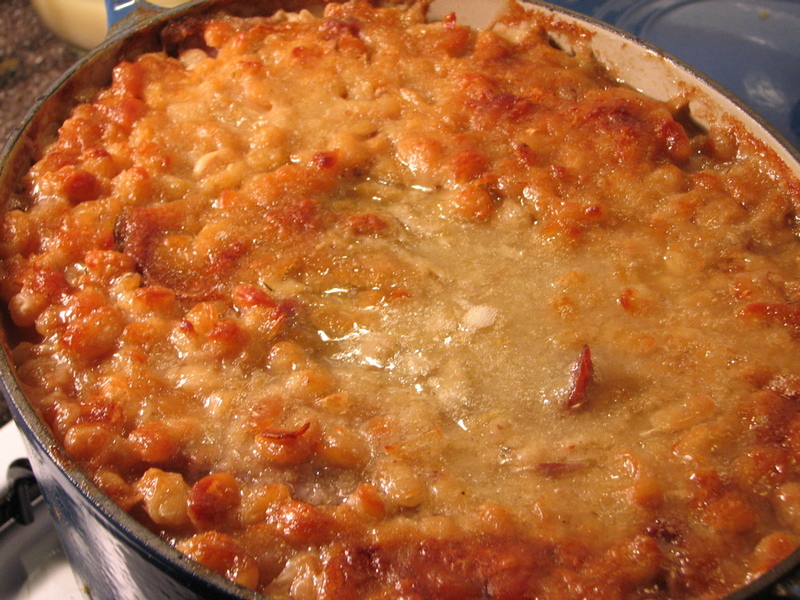 It was a terrifying moment: The bottom of my pan was lined with raw pig skin, on top of which were alternating layers of beans, the meat from pig knuckles, duck confit, sausages, a paste made of blended onions and more boiled pig skin--and I was rapidly reaching the top rim. In fact, I'd already reached it. I still had a bowl of beans, not to mention 4 cups of gelatinous bean and pork water I was supposed to be pouring over everything, to bind all this together into a cohesive dish. I shut my eyes and put the whole thing into a 375 degree oven, where it promptly began to bubble over and burn all over the oven floor. Three frantic feet of tin foil later, I literally washed my hands, stuffed them into my pockets, and took a walk. I'd spent far too long with this dish, and if what I'd put into it was any measure--time, research, obsession, boiled hog skin with duck fat--it was going to turn out just fine. When I picture it as a peasant dish, I picture lots of peasants handling the various positions—somebody’s boiling beans, somebody’s stuffing and boiling sausages, someone else is warming the preserved duck or goose—and it all comes together in a beautiful, collective moment. Doing this along is hard, both in preparation and trying to eat it--when Nick and I finally got around to sampling this dish, we probably could have eaten 10-12 spoonfuls and been done with it (we couldn't stop, however, so we kept eating until it was no longer humanly possible and we felt decidedly sick). Next time, I'll try a 40-minute cassoulet . But was it a success? On a measure of sheer ambition, I'd say yes. And because it was extremely exciting and absurd, if lonely to be cooking all by myself. But what it also made me think about was the possibilities for invention cassoulet has--different meats, different ways or preparing them, types of beans, using tomatoes (which would have added a wonderful acidity that I think mine was lacking), various temperatures and cooking times--and that a wonderful cassoulet could be achieved with a more straightforward, modern approach. In short, I'll probably never line my pot with pig skin again. It got all slippery and gelatinous and it was just pretty weird in general. That's why I own a Le Creseut, because it has a nice enamel coating that keeps things from sticking already. I’m not actually, despite my wildest dreams, a French peasant. My main problem with this recipe was how totally thick and ridiculously viscous it was--though the beans were wonderful, the flavor was there, but it just got sticky and that made a heavy dish feel heavier. I longed for a cleaner tasty, fresher broth. It could have something to do with my miscalculation regarding the size of my pot in proportion to the number of beans I needed to stuff into it. But I also think it's a matter of skill and an acquired understanding of a dish like this--something that you throw into the oven and have little idea what's going to happen to it. When you attempt to be this authentic and eschew all forms of shortcut and modernity, it's difficult to know what you're doing without some previous experience. This isn't a soup that you can taste along the way, checking periodically. Is being authentic really worth it? Does it taste better? So in all seriousness, I don't suggest trying this at home. This was all a giant experiment (and now I've got something like 15 pounds of food to show for it). When I've managed to pawn off all of this cassoulet, I'd like to try another one , something with some lamb to replace some pork, something thinner certainly, definitely with some herbs (this dish, remarkably, asked for them only as a little seasoning for the beans--and it could really use a burst of freshness) or tomatoes. But for sheer entertainment value, you should probably read about how this all came together. Authentic-to-a-Fault Cassoulet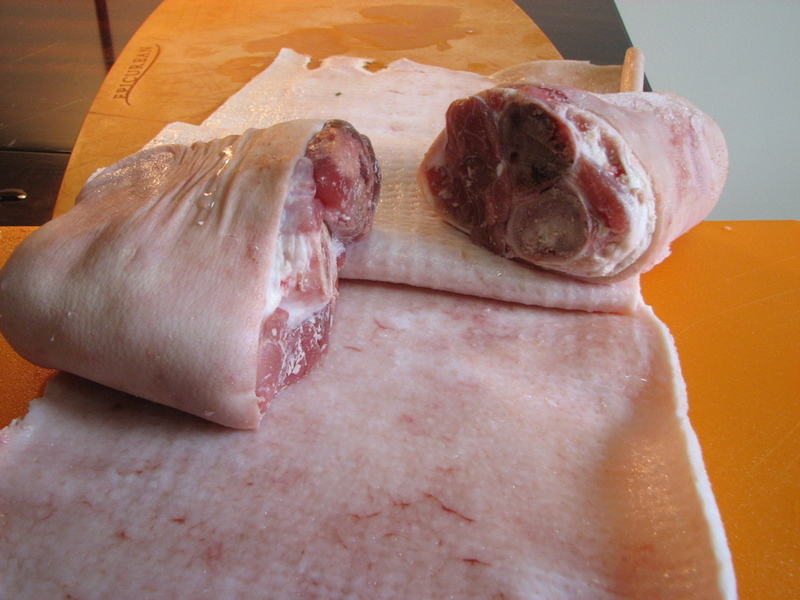
- 5 cups white beans (I used Dermason beans which were recommended to me at Kalustyan's . More on this later)
- 3 Pork hocks (knuckles) or 2 pounds pork belly
- 1 lb pork rind (a.k.a. pig skin)
- 1 bouquet garni (bay leaf, sprig of parsley, couple sprigs thyme, tied together or wrapped in cheesecloth)
- 1 onion, quartered
- 6 pork sausages
- 1/4 cup duck fat
- 3 onions thinly sliced
- 1 clove chopped garlic
- 4 legs Duck Confit
Adapted from Anthony Bourdain's Les Halles Cookbook . Day 1 First, I put the beans in a large bowl with 2-3 inches water above them. Soak overnight. Day 2 Then I drained and rinsed the beans and threw them into a large pot. In went the pork hocks (or belly was another option), the quartered onion, the bouquet garni, 1/4 pound of the pork rind. That gets covered with water. 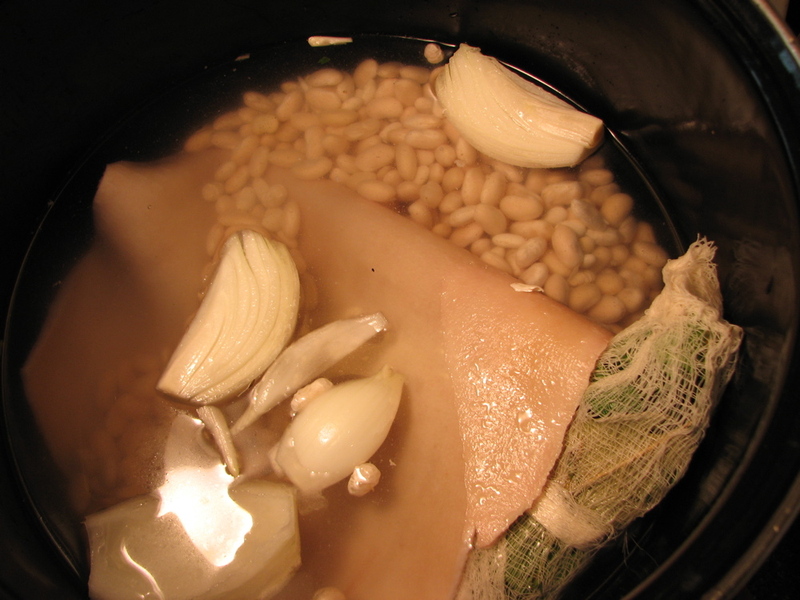 Next I added salt and pepper, brought it to a boil, then simmered until the beans were tender. Anthony claimed this would take an hour, but it took me almost 2 before the beans were soft. Perhaps it was the type of beans I used. Speaking of types of beans: I used Dermason, a Turkish bean that the ever-helpful (but not necessarily friendly) folks at Kalustyan's , the destination for dried legumes and crazy spices you can't find anywhere else, recommended (you can find them on Lex at 28th st., next to Curry in a Hurry). Some cassoulet recipes say to use small white beans, some say Great Northern, some say Cannellini (but that's more Italian), others insist on flageolet, still others recommend Navy or more esoteric ideas like Tarbais. It's a little dizzying, especially because many say a cassoulet, despite the quality of the other ingredients, hinges on how the beans turn out : they should be toothsome but not hard, soft and reminiscent of the cassoulet flavors, but never mushy. You can read all about your options for beans at the ever-helpful website Cook's Thesaurus . In the meantime, I pulled the duck confit out of the fridge so that the fat could warm enough to pull the duck legs out of it.
 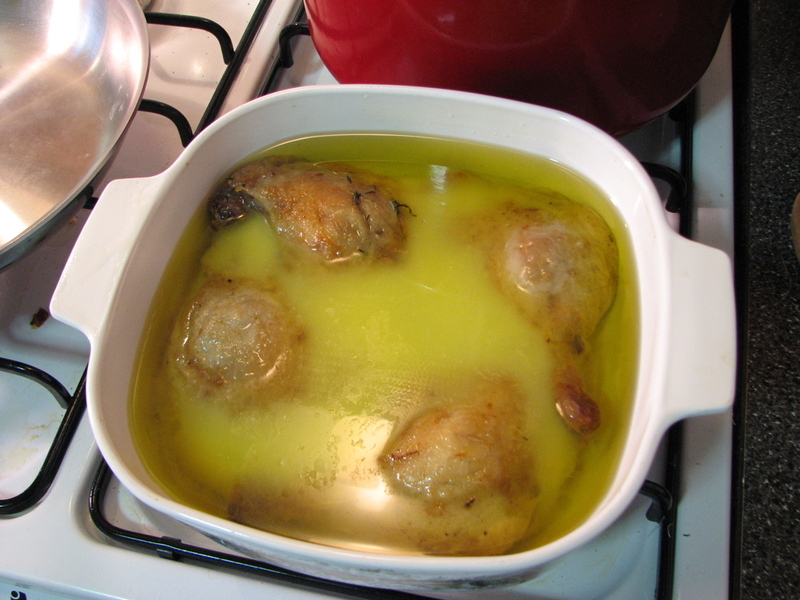 When the beans are nearing al dente, you remove the pork hocks. I let them cool, then went at them with a knife to cut out the edible meat.
 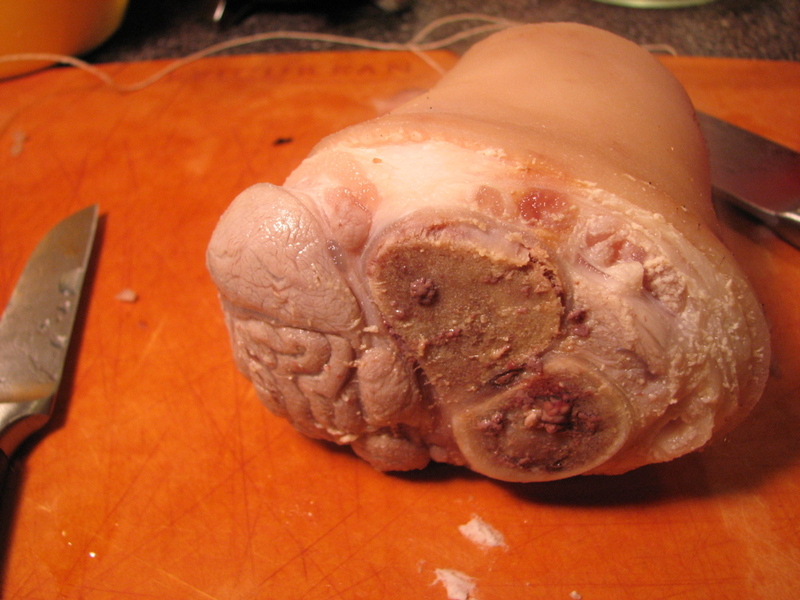 Most of this beautiful knuckle is just cartilage, gristle, bone, etc., but there is some usable meat (much of purpose here was just to flavor the beans as they cooked). Just start hacking at it and you'll figure it out. Put the usable meat in a bowl. At this point, preheat the oven to 350 degrees.
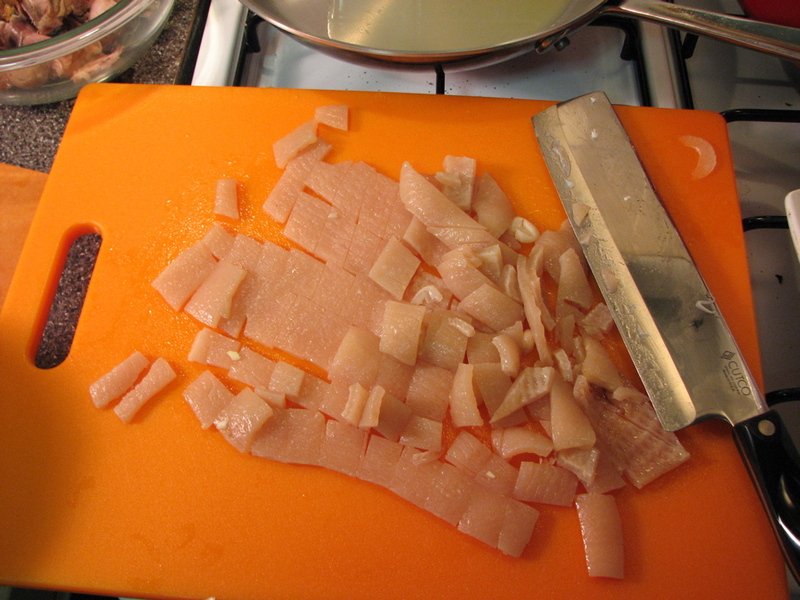
 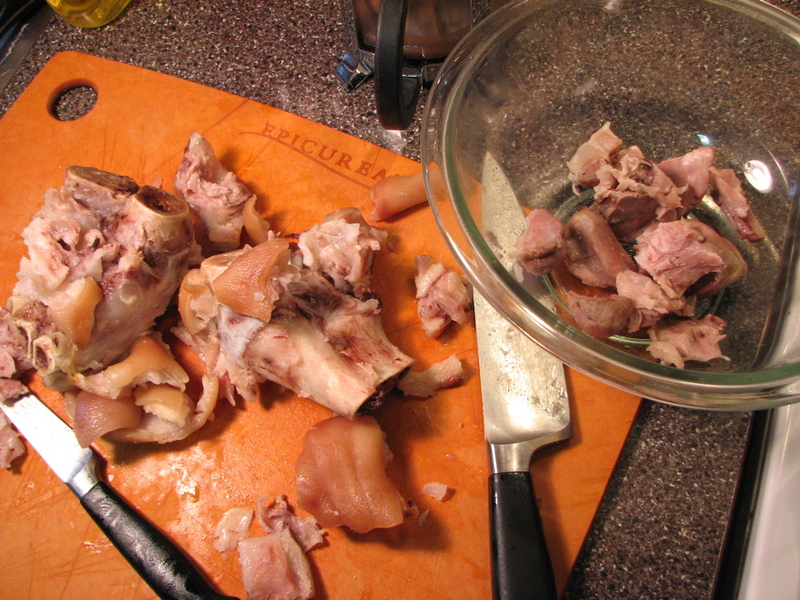 Next, I took out the pork rind that was simmering with the beans and sliced it up into little squares.
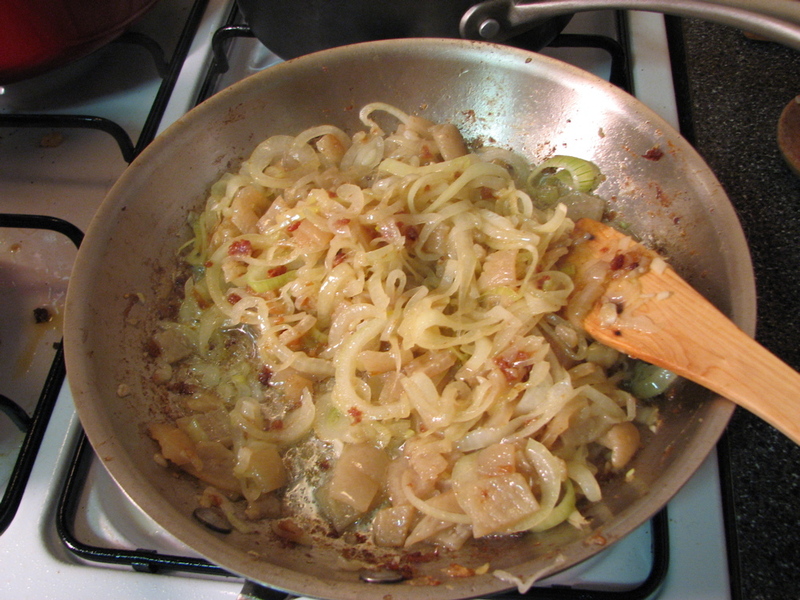
  I heated all but 1 tablespoon of the duck fat in a skillet and browned the sausages, putting them in the blow with the hock meat. Then I added the onion, garlic, and the pork rind and browned those. Next, Bourdain says to take all that goodness, throw it in a blender with the last tablespoon of duck fat, and blend it into a paste. I also grabbed some bean water and deglazed the skillet to collect all the flavorful brown bits that were stuck to my skillet.
  Now, it's time to build the cassoulet. Drain the beans but reserve all that beans juice. Take the remaining 3/4 pound of pig skin and line the pot. Add the ingredients in layers, starting with beans and adding a few dabs of the blender paste between each layer.
 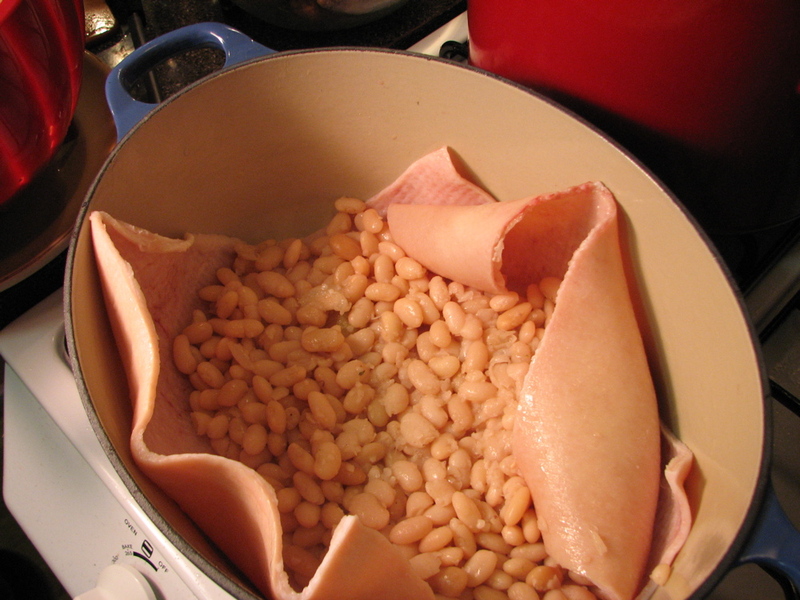 I went beans, paste, sausages, paste, beans, duck legs, paste, beans, paste, hock meat, beans...then when you're done pour bean juice until it's overflowing. You're supposed to put juice an inch over the top, but I of course had run out of room, so I just sort of flattened out the top with the back of my spoon. Put into your preheated 350 degree oven uncovered for one hour. A crust should be developing (I refused to cheat with bread crumbs, like some recipes do). If it looks too dry, crack the crust and add bean juice. After an hour, turn down the heat to 250 and cook for an additional hour. After that, let it cool down, put it in the fridge, and go to sleep. Day 3 Let it the cassoulet come to room temperature, preheating the oven to 350. Cook the cassoulet for an hour, then break the crust and add bean juice. Turn the heat down to 250 and heat until very hot throughout, which took me another 30 minutes.
 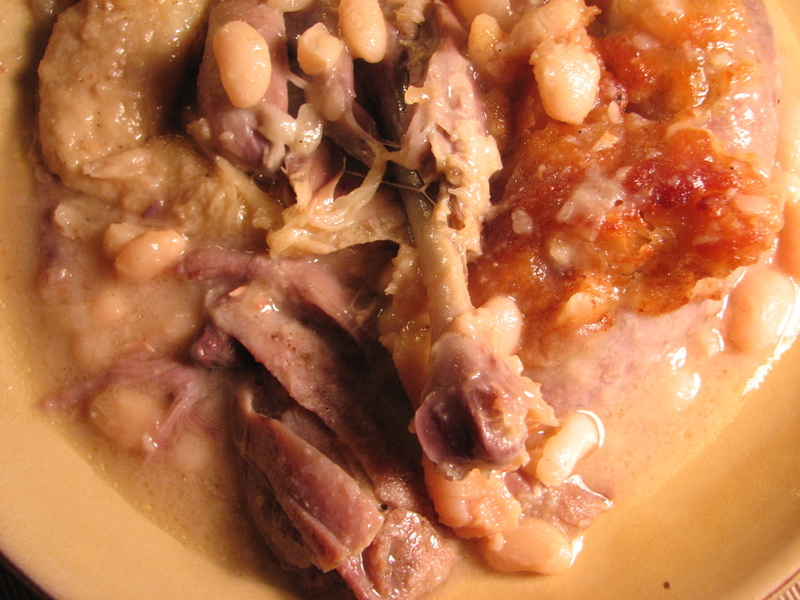 Serve in shallow bowls with whatever assortment of meat comes out when you dig in. A young, on-the-acidic-side red wine pairs nicely. Make sure you like how it tastes, because you'll be eating it for the next month or so.
Comments:
Blog Comments powered by Disqus.