
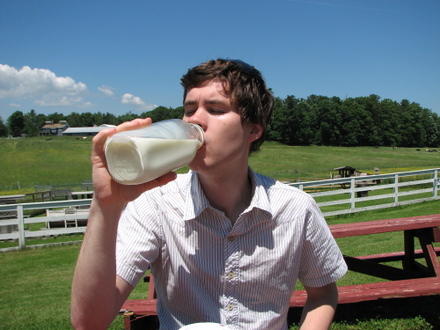
Ever since I started reading about "raw" milk, I've wanted to try it. Illegal in New York and most states, raw milk has a strange mystique about it: proponents claim that unpasteurized milk has remarkable health benefits, is drinkable by even the most lactose intolerant people, and tastes twice as good as the milk you're used to. Once you drink your milk raw, they say, you'll begin to notice regular milk tastes "cooked" and flat. Others claim you'll catch half as many colds per year. What to make of these claims? Could something as mundane and simple as milk really hold this power, if only our milk producers didn't constantly subject it to high temperatures?
Why is most milk pasteurized? Well, it's much safer. But so is a well-done steak, and I'll never eat that. The problem is, in the process of pasteurization, raw milk enthusiasts say many good pathogens bacteria are destroyed in the effort to ensure against bad ones, especially those that help the human body digest milk (hence why many lactose intolerant people can drink it without problem). The story of milk pasteurization dates back to the 19th century, when "city" cows would live in cramped, dirty quarters in Lower Manhattan, and farmers would build their dairies next to whiskey distilleries to feed cows the leftover mash. The cows got sick, bad milk was produced, people got sick. Milk was the scapegoat, and rightly so. But is the situation the same today?
Sadly, the answer is in some ways, yes. These days, producers pasteurize our milk because it's become standard, it lengthens shelf life, and, frankly, it allows factory farms to be less careful and spend less money (which includes feeding cows an improper diet of corn, and using hormones). Pasteurization is really the only economically viable way to mass-produce milk safely. Certainly, pasteurization still saves many from sickness. I would never drink raw milk from a corn-fed cow that normally supplies large milk producers. But when it's a small farm that lives with its animals, cares for them, and has been making dairy products for generations? That's different. Pasteurized milk is all I have ever known. But I've been beginning to wonder what raw milk really does taste like. In New York, at least, raw milk is only attainable by secret, speakeasy-like means ("The first rule of Milk Club is you do not talk about Milk Club").
Smiling Hill Farm, outside of Portland, Maine, is where Danny Meyer, we heard, buys his butter. You can walk in and buy milk, cheese, ice cream, and other foodstuffs. On the way in, a giant fiberglass cow named Moo-chelle is there to greet you.
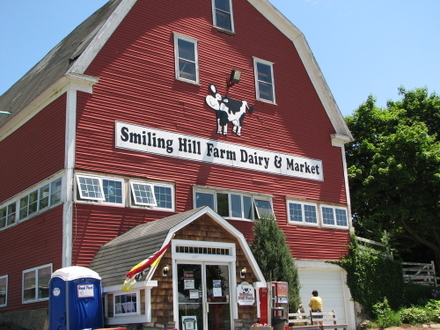
Inside, the back wall is lined with refrigerators full of milk, cream, and cheeses. We picked up a quart of whole milk, some cheddar, butter, crackers, and a scoop of coconut ice cream. When the woman who
checked us out began ringing us up, I stopped her immediately. "You just charged us one dollar for the milk. This is a quart size."
"Trust us," she said. "It's not too hard. The cows make it, and we just bottle it up. You must be from a city." She smiled knowingly. We talked for a while longer--the family has been running this farm for generations, and she met her husband while milking cows. Though the milk at Smiling Hill is not raw, it's hormone-free and very, very fresh. She told us, however, that we could walk into Whole Foods and buy raw milk right off the shelf, from local producers. In Maine, a store can sell it with a special license.
Outside, we found a table next to the John-Deere-o-saurus sculpture (which I unfortunately don't have a picture of). The milk was ice cold, just slightly sweet, rich and fresh. The butter was also excellent--it tasted at first like a tangy cheese.
But we were still curious about raw milk. What did it taste like? On a dairy high, we drove straight to Whole Foods and walked straight to the milk section. Sure enough.
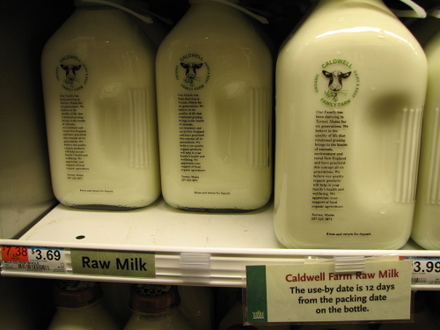
After all the shrouded mystery over raw milk, the stories of secret societies and meeting places, it was unsettling to see it right on the shelf in front of us. We asked a Whole Foods employee for help deciding, and he began telling us that his kids all drink it and haven't caught a cold since they started. He helped us pick out a smaller container, then we picked up a chocolate chip cookie and sat at a table ten feet from the registers, unable to wait any longer.
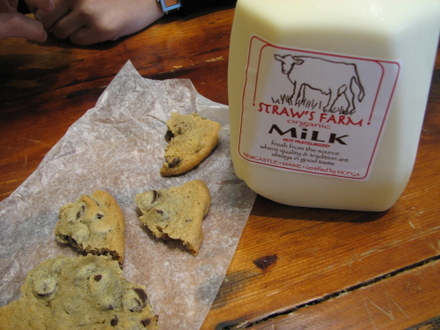
Elin politely broke up the cookie, and let me take the first sip.
Well, it was the best sip of milk I've ever had. Admittedly, part of that might be the 6% fat content, which gave it an rich, rounded taste. But it was also sweet and complex, without any hint of chalkiness...well, you may have heard Julia Child describe the roast chickens she ate in France as so..."chickeny!"? This tasted milky, like milk is supposed to taste, natural and fresh. After the hype, I was not at all disappointed.
I should mention that Elin can only enjoy limited amounts of dairy--no ice cream, no cream, and limited amounts of milk (as much as you'd put in a cup of tea). She drank half this container, and we bought another the next day. The luxury of gulping down fresh, good milk was wonderful for her.
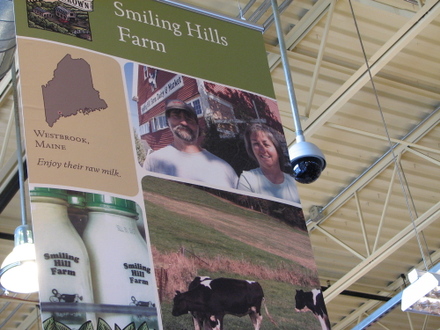
As we finished, I looked up and noticed a sign hanging from the ceiling of our friends from Smiling Hill Farms, and had a moment of true satisfaction at the sustainable, local, good-feeling quality to our whole experience with milk in Maine. Add that to our meal at Chase's Daily where we ate a combination restaurant/farm, and the revelatory experience that was Fore St., and Maine itself equals quite the trip. It made us, more than once, wonder if we could move to Portland. Fantastic, fresh milk for one dollar a quart? World class restaurants? An arty vibe and young people? Affordable rents? These are all things we could get used to.


{ 16 comments… read them below or add one }
The word pathogen is not a synonym for bacteria, it means a bacteria that causes disease, i.e. there's no such thing as "good pathogens."
I appreciate this food renaissance that portions of our society are engaging in, but it seems to me that many of the vocal groups are throwing the baby out with the bathwater in terms of the scientific understandings we have nowadays, c.f. the Nina Planck article that primarily referenced 80 year old scientific articles, and single recent one that was inconclusive.
Recent science understands a great deal more about milk and the things are in it, that get into it, and their effects on people. All of which is a very detailed, specific understanding. The lawmakers provide the blanket rulings that kill all the harmful bacteria, deactivate the enzymes that cause spoilage, and keep you and others from your precious raw milk.
While I appreciate your lack of vitriol towards the scientists who invent these processes, I can't say the same for those authors you reference: most of which seem to be full of piss and vinegar at a consumption trend that doesn't suit them. The truth they don't mention is that E. coli O157:H7, an extremely common bacteria that is frequently found in milk) causes an estimated 73,000 illnesses and 61 deaths annually in the United States. (Emerging Infectious Diseases, 1999;5:607-625).
Don't get me wrong. I go out of my way for raw milk cheese. I love the stuff. But as a trained food scientist, I am also acutely aware of the risks and reasons for the laws, and it's not all as closely tied to big industry as some zealots claim. It's more the economics of metropolises if anything. And next time I'm in Maine, I'll give raw milk a try.
Hi Ogreteeth:
Thanks for letting me know about the mistaken use of "pathogen"; I updated the post. I think for the most part we're in agreement: raw milk can only work on a small scale for those with a special interest in it. As I wrote in the post, pasteurization is the only possible way for milk to be mass-produced on a scale that meets our demand, and raw milk could and should not be mass-produced. You're also probably right about the economics of metropolises, which I take to mean the problem of establishing a safe, widespread distribution network.
However, I've read that the number of E. coli deaths related to milk is very minimal. And I think the risk of E. Coli in grass-fed cows is small on top of that. The thing is, these food safety laws are designed for food coming out of factory farms, and based on the presence or potential of disease in those places.
Being on a farm in Maine or buying it so locally, I felt pretty safe.
great article. I have to look around for this stuff. Its a shame that in this country we have lost touch with the local farmer, and its great that you highlight this connection. It illustrates a transparancy from the farm, to our food, unlike big business agriculture with everything behind closed doors.
The book, the Omnivores Dilemna highlights this, and a great read.
Also, one of the reasons why e-coli can be lower in grass fed cow milk is because corn fed cows are on antibiotics. Why? Because they were never meant to eat corn and their rumen cannot process this as well (causing acidic ph conditions etc). As a result, these cows immune systems are always kept at a much lower level than there healthier grass fed counterparts.
I have to admit, my own experience with raw milk was not as pleasant as yours. I spent a few days on a small farm in southern Mississippi when I was eleven. They had cows and sold a little milk to a local dairy. For their own use, the milk was kept in a milking bucket in the fridge, straight from the source. That was weird enough for this city boy. But the deal breaker was a few little green moths floating on top. I'm sure they did no harm–had just gotten in as the bucket was transported to the house. The family just ladled around them [why no one could be bothered to actually remove them I'm not sure]. I avoided milk my entire visit there.
I am just surprised no one has talked about the magical combination of milk and cookies. Good call.
What was the price? I'm surprised you failed to mention it, considering your blog's title….but from the picture, I gather it's about $8 a gallon. Cheap compared to Chicago, where raw milk is $16/gal.
Oh the memories. I grew up in rural, central Wisconsin and we purchased all of our milk from our friendly farmer next door. I remember taking the clean milk jugs to the farm, by bike in summer and by foot in winter, and filling them with incredibly fresh, unpasteurized milk. Around the holidays I was requested by my mother to fill the containers before all the cream was mixed into the milk; thereby, upping the milk fat percentage probably into double digit range.
There is nothing like the taste of fresh, raw milk.
Thanks,
haywood jay
Hi!
My name is Chiffonade. I am a professional CHEF because I went to Krump's cooking school in New York City.
But right now I am living in Clearwater, Florida, because I moved here to live with a guy (in his trailer house) who I met on the internet.
Of course, because I am an obese, 50-year old, uneducated Italian female, he dumped me (just like my OTHER three husbands) so now I don't know how to get back to NYC.
But as soon as my daughter gets out of prison here in Florida, I will do ANYTHING to get back to NYC, EXCEPT drink raw milk.
That is almost as nasty as my tattoos and body piercings, which caused my Hep C.
You people shouldn't drink that RAW milk, and I should know because I am a PROFESSIONAL CHEF from New York City.
Great article. Great blog.
You are probably too young to remember, but the milkman used to leave milk on your doorstep. The cream on the top was the best part.It's true.(Ask the cats who raced you to the milk box on delivery day)And no one in the family died of E.coli..hmmm.
I'm linking:)
http://www.findingladolcevita.blogspot.com
To Chiffonade:
Babe (chiffonade@yahoo.com), you really need to attend to your problems down there in Clearwater, Florida.
We all know who you are, what you are about, what your hundreds of "screen names" are, what your "legal problems" are about . . . as well as your "psychological problems", etc.
I would ask that you leave this particular website alone.
Get my drift?
Whole Foods sells unpasturized milk!?! Go to: http://www.wholefoodsmarket.com/foodsafety/dairy.html and see their website comments on milk.
Hmmmmm.
you need a cookie from two fat cats bakery on india st. to savor with your raw milk.
Just bought some raw milk in Allentown, PA thanks to your post. I love it!
I live in CA. I buy raw milk from Organic Pastures. The cows are all grass fed, and he drives his special milking truck out to the cows. They are not factory farmed. He also tests each batch and stays below the mandated allowable "pathogens" I also drive by a few "factory" dairies when I go visit a friend. They stink horribly, the cows lay in thier own excreatment, the udders dragging in it.Cows are meant to eat grass, not grains/corn. I've drank the raw milk for years and have not gotten sick. I also eat the spinich I grow and don't worry about getting E-Coli from it.
Hey everyone - the post dated August 3, a rather excited ranting, is not by me. I am actually "the real chiffonade" as spelled out in my myspace url. The individual who posted the nonsense on August 3 is a deranged person who has a lot of time on his hands and enjoys impersonating me all over the web. In any case, I am actually an accomplished cook who loves to discuss anything culinary. I guess if anything good has come of his stalking me, I am introduced to new websites such as this one!
The real author of the post under my name on August 3 is LadyE. I guess they call that schizophrenia.
Happy Cooking All!!
<3 Chiffy