

When Cheaper is Better: How to Season a Wok
by Blake Royer on August 10, 2007

Img_3268

Usually, when you're buying cookware, the rule is this: spend more for better quality.  Sure, those big boxed sets of cheap, thin pots and pans at IKEA or Target are tempting, in that pre-packaged, one-stop-shop sort of way: but how good can you really do with pots and pans that average out to $5 a piece?  Your sauces will burn, your food will stick, you'll be unable to simmer anything because only a small circle right above the flame will actually heat up.  In the end, the thinking goes, your investment in All-Clad or Le Creuset will provide not only better cookware, but it will have a longer lifespan and you'll take better care of it.  It reminds me of the line from the late, great comedian Mitch Hedburg: "I bought an 7 dollar pen, 'cause I always lose pens and I got sick of not caring."

It was to my surprise, then, as I was reading about buying a wok, that many say  buy the cheapest wok you can find, as long as it's made of carbon steel.  Most you see at restaurant supply stores or Asian markets are made out of carbon steel.  The idea is, when you're cooking with a wok you'll never be simmering anything over long periods of time.  A wok is designed to serve as the quickest possible conduit between the raw flame of the stove and the food you're cooking--the thinner, the better.  You want the wok to respond to changes in heat right away, not like a big dinosaur dutch oven that will keep cooking your food for ten minutes after you turn off the heat.  The wok should be nimble and quick.

The only catch is this.  Like that other well-known bastion of cheap, reliable cookware, the cast iron skillet, a carbon steel wok must be seasoned.  You can't take it home from Bed Bath & Beyond and cook a little stir-fry with no oil on your nice, shiny non-stick surface.  The wok comes home from the store smelling like steel and machine oil, requires scrubbing and cleaning and burning large quantities of oil over the stove, which will fill your kitchen with oil smoke and turn your wok colors.  But you'll only have to do this, in theory, once or twice, and you'll have the personal satisfaction of having created your own homemade nonstick surface made naturally.  From then on, the more you cook in the wok the better the seasoned surface becomes, and the less oil you'll have to use.  And unlike a teflon commercial non-stick surface, a wok's seasoned surface will begin to add flavor to what you're cooking as it builds up.  And you never have to worry about having the heat too high and releasing strange chemicals.

Best of all, the wok should cost about 8 dollars.


How to Season a Wok

Img_3261_2

First, you have to clean it like there's no tomorrow with hot, soapy water and scouring pads.  This is the only time you'll ever use soap to clean your wok, as once you've seasoned it you'll only need water.  Mine came with stained metal and machine oil residue, so I took a steel wool Brillo pad to it and scrubbed like crazy, until it was a nice, shiny mirror.  Rinse it completely and dry thoroughly.

Next, open all your windows, turn on the hood ventilation, and aim a fan out of your kitchen window.  Put the wok on the stove and pour a little oil in the bottom (corn or vegetable).  Turn the heat on and let the wok begin to heat.
Img_3263

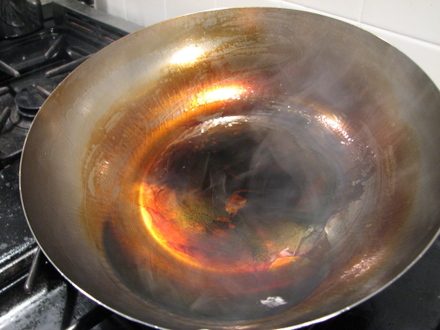
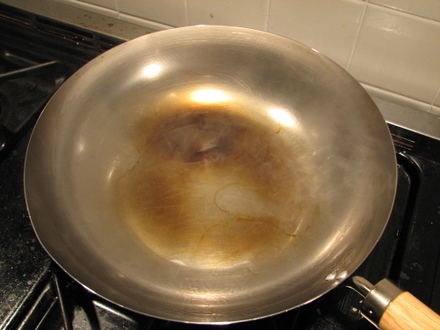
Almost immediately, the bottom of the wok will begin to turn brown (you'll also see where any hotspots are in the bottom).  Tilt the wok constantly to redistribute the oil all over the insides of the pan. 

Img_3266

One method is to take a paper towel and tongs to wipe the oil all over the interior surface of the wok, so it's coated.  I found, though, that it was better to put more oil in the wok so that you could just tilt it to coat.
Img_3268_2

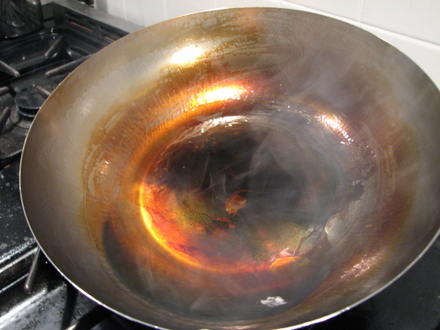
At this point, it's just a matter of time.  I found I could tilt the pan to coat everything, then relax for a little while and let the thing smoke. 

You probably won't have a wok that's completely black by the time you're finished--that only comes after many uses in the kitchen, as the seasoning builds up more and more.  I let it cook for about 15 minutes, then turned off the heat and discarded the oil.  After it cooled, I started the process all over again. By the time I was finished every part of the wok's inside was discolored in some way: the bottom was darkest, the sides more of a golden orange.

To take care of the wok, you should never use soap or any abrasive scrubbing, which will dislodge the seasoning layer (especially in the early life of the wok).  After you cook something, rinse the wok with hot water and, if there are any stubborn food particles sticking, use a paper towel and a couple tablespoons of salt to dislodge it.  Rinse thoroughly.  In the beginning of a wok's life, a paper towel dipped in oil and rubbed all over the inside of the wok will keep it from rusting.


  • Share/Bookmark

{ 16 comments… read them below or add one }

clumsy August 13, 2007 at 11:20 am

Wow, I was completely unaware that I should season my wok! I bought one in Chinatown that I was told was perfect, and even though I thought it might be too cheap, I took the guy's advice—now it all makes sense!! Thanks!

Oh and by the way, how do you discard your oil? I was discussing this with friends over the weekend and we all came to the conclusion that we don't know the proper way!

Matt August 16, 2007 at 3:57 pm

You can dispose of your oil any way you want! Cooking oil is biodegradable, as it is made from plants ;) I often dump any large amounts of spent cooking oil in my backyard.

E-wok October 11, 2008 at 11:43 pm

This was fantastic. I loved that you had pictures with your instruction. I just seasoned my $10 wok and it looks great! A few more seasoning sessions and it should be really black!

Thanks a ton.

Erik

Addie November 11, 2008 at 1:59 pm

I have a wok that was sort of rusted in spots. How do I clean it out with out taking off too much metal?

Macossay November 18, 2008 at 1:37 pm

When you first season the wok, throw in a handful of chopped ginger and/or scallions — they help remove the metallic taste.

Oil the outside too, and let the oil burn on. It will help the wok resist rust.

That "never use soap" business is fine it you're going to use it every day. But if you're not going to use it for a while, any oil on the surface will get rancid or moldy or both, not to mention it will attract roaches. So go ahead and wash it with A SMALL AMOUNT of dishwashing liquid — just strong enough to take off the surface oil. Then rub it will oil the next time you use it and heat it up to the smoke point (which is what you would do for stir frying anyway).

Brian December 31, 2008 at 12:48 pm

Regarding cleaning a rusty wok, just use fine steel wool. A Brillo pad with soap is fine, but be patient, as it will take a lot of scrubbing to strip the rust. Once clean, then just follow the seasoning steps above. Blake says to use corn or vegetable oil, but personally I prefer peanut or lard.

It is also a good idea to rub a dab of peanut oil on the inside and outside prior to putting the pot away.

And as Macossay has said, if your wok goes months between usage (which honestly kind of defeats the purpose of cooking with a traditional carbon steel pan), then it is ok to wash with a dab of soap, but remember to rub in a bit of oil prior to storing again.

Michel Jansen January 29, 2009 at 7:06 am

Funny thing, I have the exact same wok and even the exact same tonsils you use in the pictures. Your guide was helpful to me a few months back. I still should write a post about it myself, come to think of it :)

Tim February 14, 2009 at 6:21 am

hey, thanks everybody for these fine comments. My wife and I were just discussing our old (rusty steel) wok last night. We stir-fry a lot but banished the wok to the pantry years ago, in favor of a 14" Calphalon fry pan. It's not a wok but the rust on the wok really bothered my wife. The fry pan is is pain, though, because it's not deep enough and somebody has to clean up the stove after every use! So, armed with this great information, I'm off to the pantry to hunt up the old wok. I know I've got some steel wool somewhere…

Thanks again!

Anje February 14, 2009 at 9:42 am

Hello Everyone and Thank you Paupered Chef. My Joyce Chen Steele Wok also got rusty on a regular basis. I have been scouring this wok with steel wool for more than 2 days and simply could not get all the old seasoning off. I did however get all the rust off. I read elsewhere that I could also use peanut oil since I do not have corn oil. So great I put the wok on high heat and the colors begin. I turn the vent on high add my oil tilt to distrubute and after some black it starts to bubble…???I took tongs and a towel and wiped it out. Turned it off and what next? Any insight? Thank you all, Have a Happy Valentine's Day.

jim June 5, 2009 at 8:46 am

About cleaning a Wok.
Here is the tool that most use to clean after cooking.
A cleaning wish for a few dollars.

http://www.wokshop.com/HTML/products/accessories/access_brush.html

Lewis August 9, 2009 at 12:11 am

Hi! Thanks for writing this post! I seasoned my wok yesterday and I wasn’t sure I had done it correctly because the sides hadn’t changed much in colour, but now I know it just needs some proper using and pehapse another blast with the flame. I used groundnut oil for my seasoning.

Candy Lynn November 7, 2009 at 7:58 am

Teflon is toxic to birds & parrots….very deadly. Would carbon steel wok be the same as teflon?

Jonathan December 28, 2009 at 8:13 pm

No, carbon steel is absolutely not toxic. and by the way, teflon is carcinogen for humans too. For example, using steel instruments on a teflon stove can scratch it off and you might eat it. carbon steel is natural, so it wont be dangerous unless you have a carbon steel wok with a teflon layer.

Jason February 4, 2010 at 2:21 am

Question!!! If you have a brand new wok and use it one time and not season it properly does it ruin the wok

Jason February 4, 2010 at 2:30 am

I left the question above this one and forgot to press the notify me button via email so please respond to the question using this blog entry

Jonathan February 4, 2010 at 10:49 am

I wouldn’t say its ruined, you probably only ingested a lot of burnt anti-rust coating which isnt the best. but its not too late to do it, follow the instructions above and your wok will tough the ride

Leave a Comment

Previous post:

Next post: