

Cheese Making Part 1: 30 Minute Mozzarella
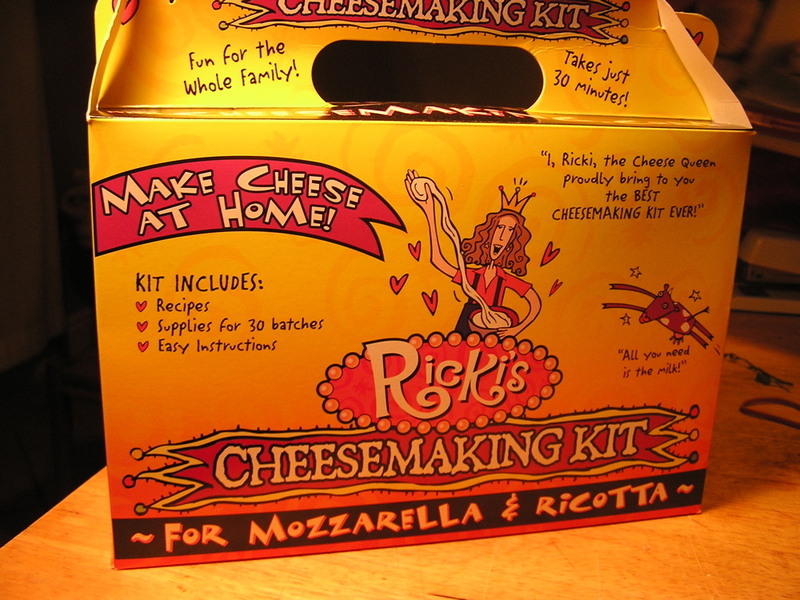
I had read about making cheese--like a lot of people, I assume--in Barbara Kingsolver’s Animal, Vegetable, Miracle . It had never really occurred to me that cheese could be made easily at home, but once I read the passage where they made mozzarella in 30 minutes, I rashly bought the recommended kit . And a three days later I had a bright yellow box from the New England Cheesemaking Supply Company .
I spread the tiny zip-locked bags across my kitchen table and wondered what I had gotten myself into. Sure enough, each packet of white powder was something I couldn’t make at home. The contents were one package of citric acid, cheese salt, and rennet. It would be ready in 30 minutes.

I will admit, the contents made me look more like some pharmaceutical house (or something horribly worse), and it didn’t make me feel any easier about the prospects for success. This looked like a science project and less like an authentic preparation of an age-old delicacy.

The rennet confused me the most. Rennet appears naturally in the stomachs of certain mammals , and is probably the reason cheese was first discovered . But the rennet came in tablets that looked exactly like aspirin. Yum...
My kit had the right ingredients to make mozzarella and ricotta, and can only be described as the beginner's kit. I’m fine with that. I’ll save the aged Parmesan for later. I wanted something with immediate results, because I had no idea if this was going to be a complete disaster or the beginning of my new cheese making life.
It was not without its stresses and momentary disasters, but the whole experience was completely worth it. I walked a way with a large ball of mozzarella which was extremely tasty and melted perfectly on pizza. Not quite the best mozzarella I’ve ever had, but miles ahead of the hard stuff used at most pizzerias around this nation.
30-Minute Mozzarella
- 1 gallon milk (not ultra-pasteurized)
- 3/4 cup cool non-chlorinated water
- 1 1/2 teaspoons citric acid
- 2 teaspoon cheese salt

I started with the only thing I knew I could control: the milk. So I bought my favorite local milk. They just recommend not using ultra-pasteurized. Mine was unhomogenized and only slightly pasteurized. It was perfect, if slightly expensive. A gallon of regular milk usually cost under $4, and these cost $3.50 a quart, making this little experiment a costly one.
Anyway. I started with a 1/4 of one of the rennet tablets. It needed to be dissolved in 1/4 cup of non-chlorinated water. I wasn’t sure whether our local supply was or wasn’t, so I just played it safe and bought some bottled water.

Then I poured 1/2 cup of the water into a big pot and added 1 1/2 teaspoons of citric acid (pictured above) and stirred until dissolved. Once ready, I poured in the four containers of my fancy milk, turned the heat to medium and waited. The temperature needed to get to 88 degrees, which didn’t take too long.

Once the temperature was right, I turned off the heat, poured in the rennet solution, stirred until combined, and waited for 8 minutes.

You’ll know the curds have separated from the whey when you can press on the top and it bounces. It will still be very delicate, so don’t go ramming your finger in. Just a gently nudge.

I sliced the curds into little squares using my very large knife. And then, very carefully, I tried to transfer the curds to a colander. And here’s where things started to go off course.

The curds are so fragile that if pushed too hard they disintegrate into the pot, which doesn’t help the cheese any. I attempted to use a spoon with holes, but it let too much of the curd slip through. So I moved on to a small metal strainer which did a much better job.

I bet I lost 1/4 of my cheese because I was too hard on the curds. It’s sad.

Anyway, my curds drained in the colander for a few minutes. Then I (gently) moved them to a bowl, stuck them in the microwave, and cooked them for 35 seconds.

I was so worried about my cheese the moment it entered the box. I rarely use my microwave, and it felt wrong to break it out now when I was going to making something as lofty as cheese. But when I pulled it out, I realized why. More of the whey had separated, and the curds became elastic. So I drained the whey into the sink, kneaded the curds into something resembling a ball, and then plopped it back into the bowl and into the microwave for another 35 seconds.

I repeated the same procedure as above, draining the whey, and kneading into a bowl, but this time the curds were hot. The instructions tell you they’ll be hot, but they were scalding hot. And I wasn’t done. They had to be at least 135 degrees, which meant I had to repeat the same steps above, only this time zapping it for only 15 seconds.

Once it was at the right temperature, I formed it one last time into a bowl, sand then stuck into a bowl filled with cool water and let it rest in the fridge until cool.


The perfect cheese needs the perfect presentation. Make clean cuts with quality cutlery , and get together the right glassware to enjoy your cheese with a little wine. Some elegant wine glasses with the right flatware set will help your friends and family feel like they're experiencing something truly delectable!
Cheese, Cheese, Homemade Cheese, Milk, Mozzarella
Comments:
Blog Comments powered by Disqus.