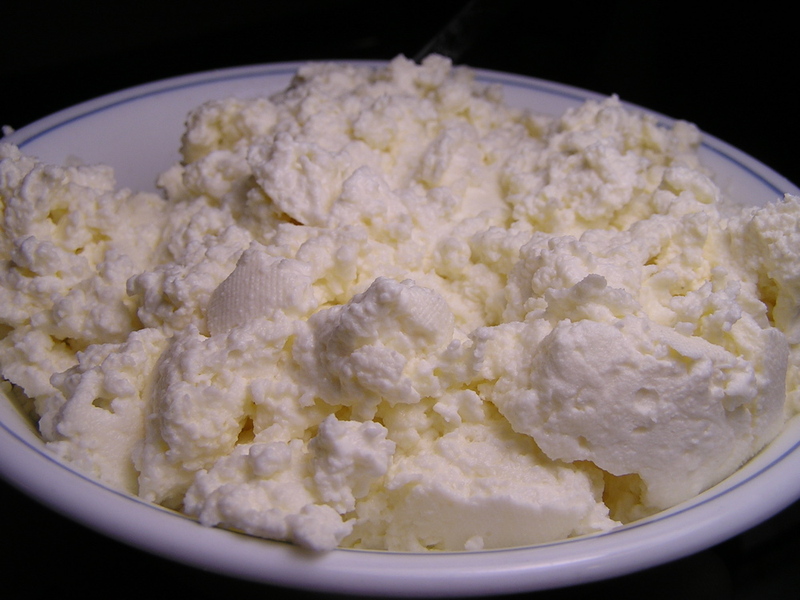

After I miraculously created a ball of mozzarella from a gallon of milk and some powdery substances, I declared it a miracle and couldn’t wait to do it again. And true to my plan, I tried to make it twice since that date and failed bitterly both times. Much could have gone wrong. I believe the first failure happened because I used cheese salt instead of citric acid at a crucial step, which was completely my fault. But the second time...well, it just didn’t work. Instead of combining to make a smooth ball, it curdled and made a cottage cheese like substance. It was time to pack it up; I couldn’t make cheese.
But there is another cheese that my kit could make, and it was supposed to be easier. I could also make ricotta. I probably don’t eat ricotta as much as the next man, but it does make great gnocchi and pancakes, so I thought “what the heck”, and set out to by some more milk.
This time I used Ohio Organic, which isn’t nearly as fancy or divine as Hartzler, but was about 1/4th the cost. That’s important. I can’t keep dropping $15 buck on a ball of cheese that would cost about $4 at the store. It will make this whole cheese making process more of a curiosity than something I’d regularly engage in.
So I pulled out my gallon of milk and my kit of substances, and got serious. No failures this time. I lined up all the bags and got my milk ready. And then I poured the milk in the pan, tossed in some citric acid and salt, cooked it, drained, and ate it. I mean, mozzarella did only take thirty minutes, but it’s a frantic, physical time. Ricotta requires a pinch of citric acid, and some hanging time. I’ve made cold cut sandwiches that required more effort.
Even though it wasn’t the hardest thing I’d ever done, it did make some fine ricotta. And it was used it to fine effect as pancakes and some rather tasty gnocchi. What else can I do?
Whole Milk Ricotta
- 1 gallon milk
- 1 teaspoon citric acid
- 1 teaspoon cheese salt
Combine all the ingredients in a large pot. Turn the heat to medium, and cook until the tempeture hits 195 degreess F. Turn off the heat.
Let it rest for 10 minutes.
Tranfer the curds, carefully, into a colander lined with butter muslin.
Tie up the butter muslin and hang. They were pretty unspecific about this point, so I just hung it from a cabinet knob. Put a bowl underneath and let it drain for 30 minutes.
Remove the cheese and fluff with a fork to break up the curds. It will apparently keep for 2 weeks in the fridge. I can’t vouch for that.


{ 9 comments… read them below or add one }
Looks good – I've used this method with good results:
http://www.crinellawinery.com/family_cookbook/ricottachs.shtml
pretty much seems the same, but no need for anything that isn't found in any kitchen.
Nick!
Don't give up hope!
I too have the same kit and had a similar experience of it working beautifully once –then not so much-
After many times of putting the cheese in the microwave and having it still look like ricotta instead of fresh moz.–I put it in one more time–again at 30 seconds and that did it–all of a sudden it became smooth and taffy like.
Did you nuke it enough times?–I could be completely wrong but–try it again!
bestest
e
Did you buy different milk for the subsequent mozzarella? That could also make a difference and make it come out like ricotta.
Great site! Love the pics, very process oriented…great to see. Thanks!
seriouscheese.blogspot.com
one reason it failed, i see NO mention of rennet being used
thats crucial in making cheese.
I suppose you made some curd cheese.
Ricotta is made by re-boiling the whey that is the substance left from the first processing of the milk. What you have done is to extract the curds of cheese. If you reboil the whey you should get the ricotta. ("ri – cotta" in italian means "boiled two times". The first time you get the cheese at 37C with rennett. The second time you get the ricotta by bringing the whey up to 92C and adding a pinch of citric acid and 20% of warm milk). Ricotta is very different from what you show on the pict. and taste different from cheese too.
Sal.
You are missing one thing for making cheese from store bought milk. Try adding food grade liquid calcium chloride. That is most likely the reason the cheese refused to sieze. Look at the next package of store bought cheese you get. It is a common ingredient used and a real secret. Also real rennet is import. Use either vegitable or animal based versions. Rennet tabs in the store are better for ice cream and don't usually make good cheese. One last thing to remember is that store bought milk is different from gallon to gallon. Thus each batch may come out a little different than the next.
Best of luck!
Well! now that you made Mozzarella and ricotta, I want to see you make Burrata! (from Puglia, Italy)
What a great site guys! you are my new true heroes!
A
Thanks so much for posting this. I was in the middle of trying to make the ricotta and didn’t think the curds had separated enough (thinking of the mozzarella I’ve made twice now.) I guess I forgot what the finished product was supposed to look like.
Thanks for saving me from dumping the cheese down the drain. I decided to give it a chance and hung it, and viola. Yummy ricotta. Had already sent my darling spouse to the store for ricotta that went into the lasagna, but am going to have this with a little honey it it as dessert. Yum,