

I recently took a 3.4 pound pork belly, rubbed some salt and spices on it, and a week later, it emerged from my refrigerator as the most awe-inspiring bacon I've ever eaten. I feel simultaneously triumphant and confused: why is this so good, and why was this so easy?
I knew I was going to make bacon at some point once I began curing meat. People devote entire blogs to the subject of bacon; it's considered a pinnacle of eating, and a vegetarian converter. But if you haven't made your own bacon, you're missing out on even further worlds of deliciousness. It's like going from a store-bought pie to a real one. Have you seen the way commercial bacon is made? Huge brining machines filling the bellies with liquid to speed up the curing process to the shortest time possible. Then, liquid "smoke" goes in. It's an unnatural process. Making it yourself, after your first time, seems the most natural thing in the world. Yet hardly any of us know how to do it. Bacon comes from the grocery store.
Again, like all of our meat-curing projects so far--and this is probably sounding like a broken record--homemade cured meat is remarkable not only because of its superior flavor, but also its confounding easiness. To make homemade bacon, I did almost nothing, except find myself some pork belly and decide on some spices.
Which isn't always easy--though any butcher would probably order it for you, and many ethnic markets stock it. I'm lucky to have access to meat from Fleisher's butchers, a purveyor of exceptional pork and other meats in upstate New York, through Tom Mylan at Diner/Marlow & Sons. Fleisher's are real trend-setters specializing in organic, pasture-raised meats that are raised kindly and sustainably, and therefore have a superior taste. They sell Berkshire pigs, the pig equivalent of Kobe beef, whose meat "is dark, meaty and richly marbled with a distinctive lush, juicy taste," compared to regular commercial pork which, in comparison, tends to be white, lean, and flavorless.
Every week Tom gets his meat from them for his restaurant group by ordering entire animals and butchering them in-house--so I called ahead, then stopped by to pick up my belly that same day. When I arrived, he was moving at high speed because his meat order had come in late. As I stood in a tiny square foot corner of the butchering room, just behind the door to the walk-in cooler, Tom took an entire half pig, which had been split right down the middle, and, using a combination of a saw and knife, broke it down into ham, shoulder, ribs, a stretch of pork chops running the entire back length, and finally, the belly. Seeing this happen so matter-of-factly in the back of a restaurant felt very unceremonious. But it was also an astonishing sight: here was a pig, and minutes later, here was a rack of ribs and some pork chops. The pieces of meat I was seeing weren't abstracted; I saw, literally, where they came from.
Tom needed most of the belly for the restaurant, but he sliced me a 3.4 pound triangle from one end, and sent me on my way.
The bacon most of us know it is made from pork belly, but there are also variations made from other cuts, notably the cheeks and jowl, which makes guanciale--a porkier tasting, fattier cut that's a staple in properly-made Spaghetti alla Carbonara and Bucatinia alla Amatraciana. Hog jowls are difficult to find, though, especially because a butcher would probably need to order an entire head in order to get them for you--and unless you're willing to buy the whole thing and make head cheese, that might be a tough one (you can also try buying them online). Making guanciale also requires a period of hanging and drying--the most difficult part of urban meat curing, I'm finding. Hanging requires temperature and humidity control, which are possible but difficult without space. I need that closet for my coats, thank you very much.
So I chose the belly. A number of different things can be done with the belly, however, to arrive at bacon. You always start one way: coating the pork in salt and spices, allowing it to draw out moisture for a week or so, after which you're left with a slab of what's sometimes called "fresh" bacon. From there, the belly could be hot-smoked to create American-style bacon, or, as an alternative to that, slow-roasted in the oven to mimic smoking. Or, it could be rolled tightly and tied, then hung and dried to make pancetta.
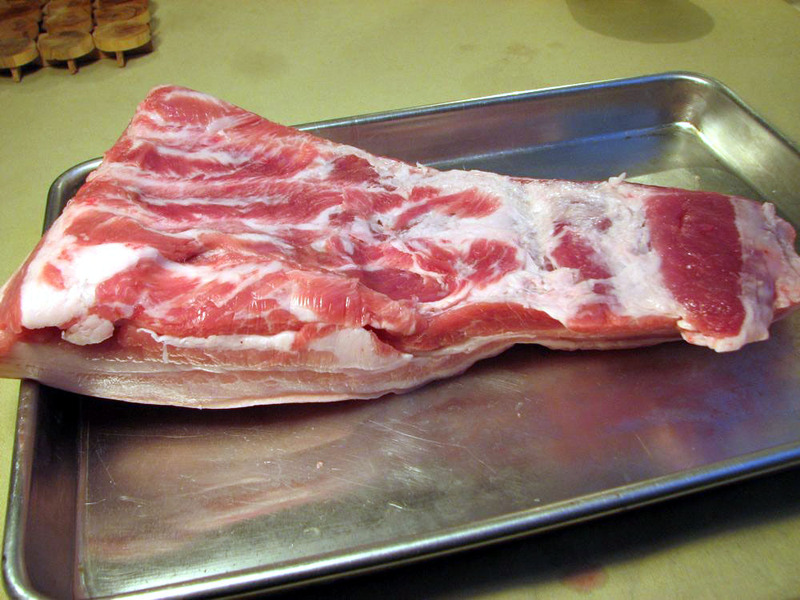
You can also stop right there with the "fresh bacon" out of the fridge-cure and use it as-is, rinsed of its salt and spices, sliced into strips or chunks, and cooked as you would use American bacon. According to Paul Bertolli in Cooking by Hand, the Italians call this Tesa, meaning "extended," which refers to its long length and the fact that it's cured flat. This seemed to be the fastest, simplest solution to having usable bacon--just over a week of curing time and it would be ready to use. I started this way, with the option of roasting or smoking it later on, depending on if, in fact, I could locate a smoker or concoct one in mid-Winter.
I mixed up the cure first using the indispensable Charcuterie as a guide, as well as Bertolli's Cooking by Hand. Bertolli's recipe called for many spices, and I used all of them, scaling the recipe from a 12 pound full belly to 3.4. Peppercorns, cloves, allspice berries, nutmeg, red pepper flakes, and juniper berries were ground up together, then mixed with salt and pink salt (pink salt is nitrites, which, though there are different schools of thought here, is essentially an additional curing ingredient that prevents against botulism and helps the meat maintain a pink hue--read all about it in Charcuterie). I rubbed my dry mixture all over the belly, then chopped garlic and red wine to be sprinkled on top.
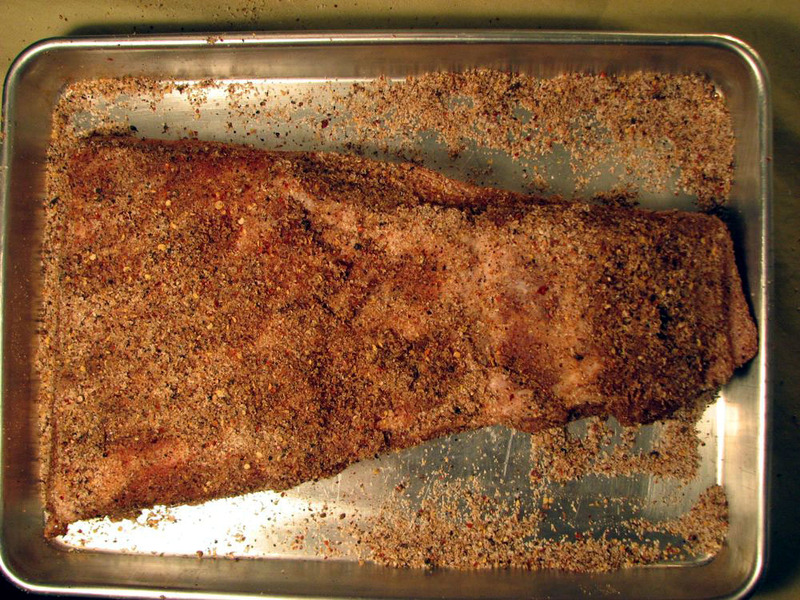
Into a freezer bag it went, to cure for 8-15 days, depending on the belly's thickness (mine was from a lovely heritage hog, so it was nice and thick). It's done curing when the salt has penetrated to the center of the belly and it's no longer squishy. You flip it over every other day to make sure the resulting liquid which leaves the meat is distributed evenly and all parts get a roughly equal cure time.
In the meantime, I started researching what I would do with the belly once out of the cure. I ruled out pancetta because I had a very small amount of belly that wouldn't really roll up well. I knew I wanted to keep some of the bacon fresh. But I also wanted to try to smoke it.
I woke up that Saturday morning and plopped on the couch with a cup of Yorkshire tea, half groggy, to tune into Jamie Oliver's fantastic new show on the Food Network. After making a roasted pepper dish as well as a goulash of some kind, he started talking about a dish with a chili salsa and hot-smoked salmon. I heard the word "smoked" and perked up: then I watched as he proceeded to create a stovetop smoker out of a cookie tin, some chicken wire, and the sawdust-like wood shaving for rabbit cages. Perfect.
The cookie tin I had; the chicken wire wasn't hard to find; but the wood shavings were problematic. I ended up buying some regular woodchips that are designed for smoking meat in a grill among coals,
thinking maybe I could chop them up into smaller, usable pieces. This didn't really go as planned--and by "not really" I mean "not at all"--so I resigned myself to just using whole pieces and seeing how it went.
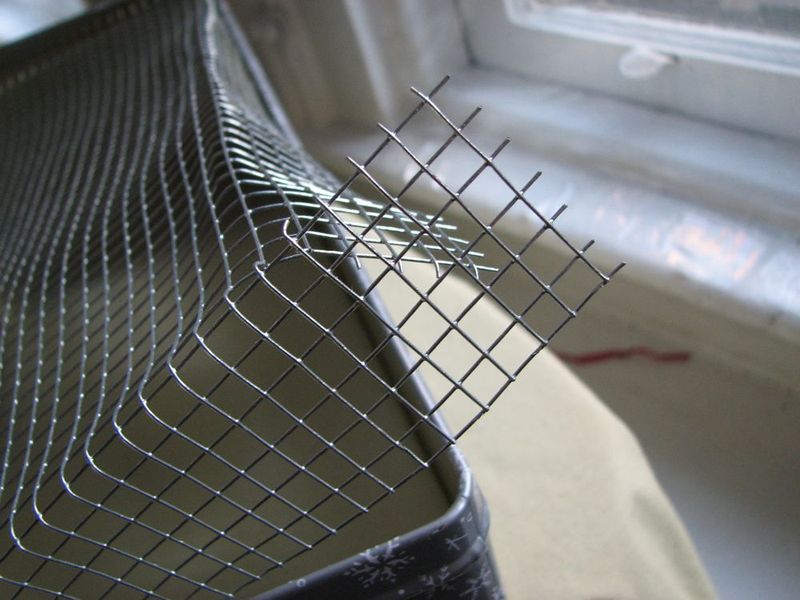
Building the smoker wasn't difficult--just snipping the chicken wire to the appropriate width and length, making extra slits in each corner to fold over one side.
Once the smoker was built, I removed my belly, which I had checked the day before and decided was ready. It got a good rinse and a very good dry. Then, I cut off about a pound and a half of it to test out my smoker.
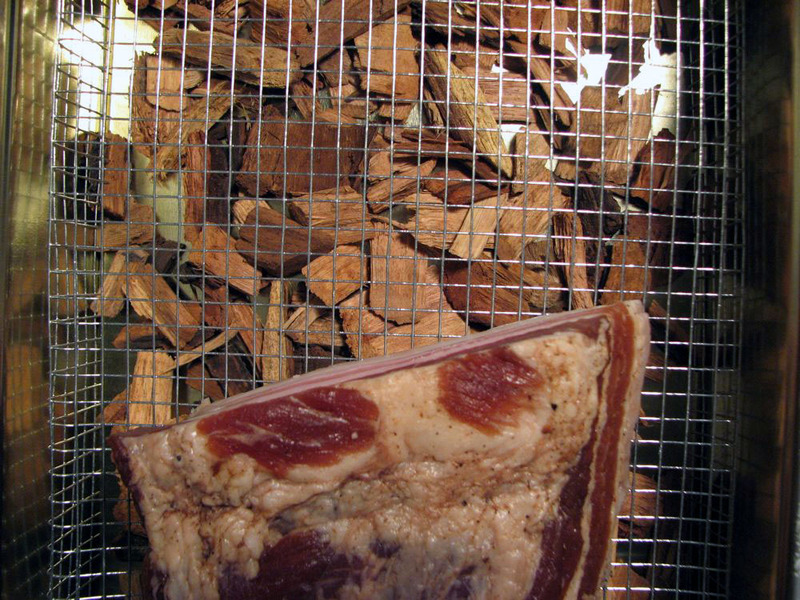
I filled the smoker with a handful of wood chips, then punched a little hole in the top, which allowed me to stick the thermometer directly into the meat and monitor its progress, then I put the top on and put a wet rag around the hole.
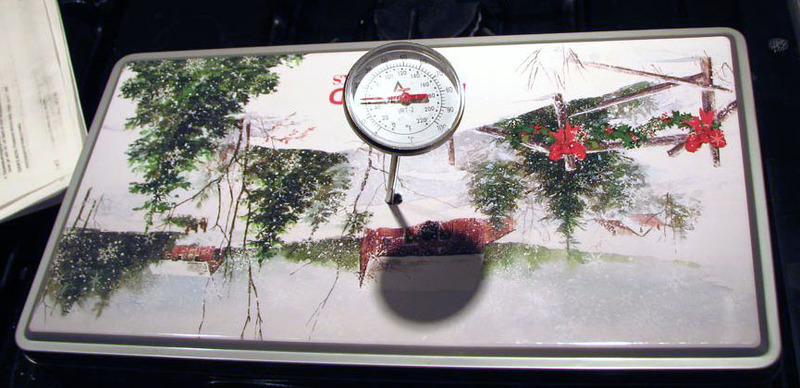
Then I placed it across two burners and turned on the flame.
At first, the metal popped and groaned as it reshaped itself under the sudden temperature change. Then slowly, I began to smell smoke, and it began to pour out the sides of my cheap cookie tin. I lowered the heat, then set about trying to cover any smoke leaks with more wet rags. My kitchen started smelling like a campfire.
In fact, it wasn't a very pleasant smell at all--rather acrid and charred. Soon, despite the heat being low, too much smoke was pouring out. I took it off the heat, worked the top off slowly, and had a look inside. There were some charred chips, and the meat had gently cooked on the outside. I flipped it over.
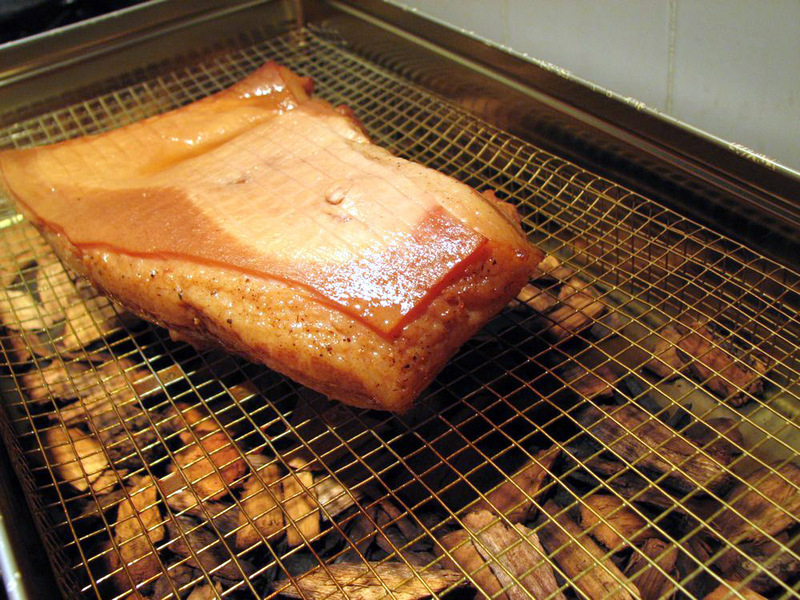
The skin-side of the belly had shrunk somewhat, and was quite hot. The temperature inside the meat, though, hadn't changed much, at least according to my thermometer. Most importantly, the overall smell wasn't a pleasant woodsmoke, but more like charred campfire. I was nervous that the belly was getting ruined by my amateur stovetop smoking. Was I supposed to soak the chips in water first?
I decided to quit while I was ahead--and stick with one piece of fresh bacon and one piece of slightly smoked.
Here's what each piece--unsmoked and smoked--looked like side-by-side. As you can see, the hot smoking softened the meat a little bit.
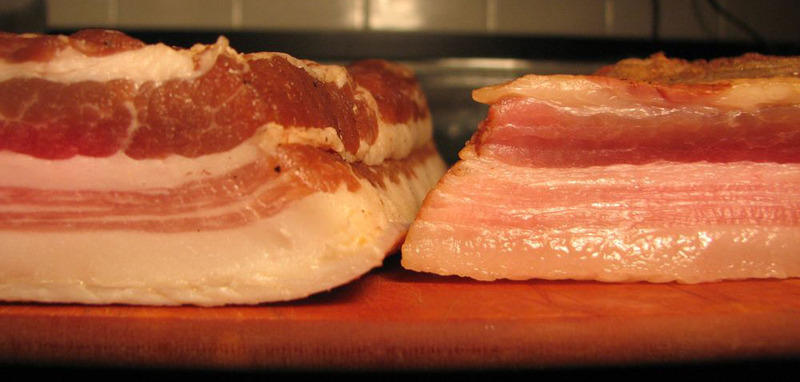
I cut a small strip of each, warmed up a skillet, and cooked them gently until they rendered their fat and just started to go crispy.
This was my first taste of homemade bacon--and like I already said, it was a revelation. The recipe I used was a very savory cure, however, which is more suited to using the bacon for cooking with other ingredients, rather than tasting on its own or next to some eggs. For that, you'd want a sweeter cure with some brown sugar, molasses or maple syrup in it. I've already put my bacon into some into a bolognese sauce that pretty much blew my socks off, and made my best Pasta Carbonara yet. But nevertheless, the flavor may have been too strong in my cure.
It touches on one major lesson I've learned so far in beginner's charcuterie: use the simplest cure possible your first time around. I went too complicated on my Duck Prosciutto, and then made the same mistake with this bacon. Too much seasoning obscures the delight of the cured meat itself, and
also makes the taste more difficult to distinguish. Master the basics, then move one to other recipes.
Maybe in the warmer springtime, I'll cure another piece, and make one of those homemade smokers made out of a garbage can. I'm pretty sure that stovetop smoking--especially janky, cookie-tin smoking--is not ideal for doing something for long periods of time--which the bacon requires.
But go pick up Ruhlman's Charcuterie and use his very simple bacon cure (the recipe is also adapted online at the NYTimes--but buy the book, it's worth having) to make a batch. You know how ex-vegetarians call bacon the gateway meat? Bacon is also the gateway charcuterie.


{ 26 comments… read them below or add one }
Look for a Lure Jensen Little Chief smoker. I've used one for years. Never for bacon, but still… it works great for jerky, burgers, fish, etc.
You are completely right about bacon as a gateway to a quick charcuterie addiction. I'm hooked. I just posted about my own bacon results today too, so we must be on the same schedule. I'm thinking about the merguez lamb sausage next; what about you?
I second the Luhr-Jensen suggestion. It will cost approximately the same as all the fixings for a garbage can smoker, but be easier to store and use. I use mine for fish, of course, and cheese, jalapenos, eggplant, garlic, onions, salt etc. You can even cheat a hot smoke with it by smoking a few panfuls and then finishing in a low (225F) oven. If you think bacon is good, try a ham.
Although beware, a Little Chief is a gateway smoker and soon you'll be thinking about an offset rig for hot smoking and real barbecue.
As you've probably noticed by now, the smoke flavor mellows nicely after about 24 hours of rest. This is particularly true of cheese. I've had the best luck with mozzarella as it'll hold its shape. Cheddar tends to melt.
Your bacon looks delicious! I might have to visit the pig ranch this weekend.
Blake! How exciting! I will be smoking my pork belly tomorrow, with some apple wood and hickory. After reading this I am a bit nervous that I may have over seasoned my cure. I also left it in the cure for pretty long, it will be 15 days when I remove it tonight.
I have a cast iron oven smoker that I have not yet used, this will be it's maiden flight. One idea you might try for your next apartment smoking venture, is to proceed as you did on the stove top, but once the wood starts smoking, transfer it into the oven at 200 degrees. This way the heat wont be so intense and the wood will smolder but more slowly than it did over the direct heat of your range top.
Soaking those big chips then pulsing them in a blender to break them down might also work. Finely ground wood for these purposes can also be obtained on the internet.
Wish me luck!
(oops, didn't see that sarah had already suggested the oven thing, sorry for being redundant.)
Brandon: Thanks for the recommendation for a smoker–I'll be sure to check that model out.
Charcuterista: Congratulations on your bacon! Judging from your name, you must be an expert. I don't think I'll be curing sausage anytime soon, though–I'm still enamored of the process of curing whole muscles. Maybe just because it seems so simple?
Saara: Gateway smoker, eh? We're all on the road to true food dorkiness. I checked out your blog, and look forward to reading more. How was that book "Root Cellaring"?
SP: I seem to have be completely ignorant of the concept of oven smokers. What gives? It sounds like the perfect solution. Is yours this thing from Emeril? It seems to have gotten great reviews. I especially like the "doesn't leak smoke" part, because my kitchen needed airing out for at least 2 days. Not to mention the apron I was wearing. Good ideas about wetting the chips and chopping in a blender. Good luck with your bacon and report back!
Yes, the official Emeril Lagasse oven smoker. I was a bit embarrassed to mention the endorsement. But I guess, as Seinfeld said, there's nothing wrong with that. Glad to see it's well regarded. Like I said, I've never used it, so despite it's being a pretty straightforward device, there's always that spectre of skepticism there before getting to know it.
Do you ship to Ohio?
Blake,
Oh man, how can I NOT smoke my own bacon, now? This looks amazing!
One really practical question: how did you slice your bacon, and make it a uniform and thin slice? Did you just use a chef's or serrated knife, or is there something special you have to help?
From one budding foodie to another: thanks for all you (and Nick) do!
Jason
My first (and most certainly not the last) bacon attempt was not nearly as successful as I had hoped. However, I am not disappointed in that I have learned an enormous amount that should contribute towards the next batch's success.
My number one mistake, and warning to other would be curers: I over cured the meat. I left it in the salt for too long. The meat was too dry, and the flavor has absorbed too much of the salt. I had also neglected to turn the meat over in it's cure as often as prescribed (should have been every 3 days) and now I realize what the benefit of turning it over really is: you get to see the meat progress, and can monitor the amount of curing. I will be much more diligent next time. Also, 2 weeks was way too long for my piece of meat, it should have been 7 – 10 days max.
My second mistake was in using the oven smoker. My oven can not hold a low temperature. I had it set at what I thought would hold at 225, but when I came back to check it, it had climbed to 300. The meat was beautifully smoked and had taken on a dark red color, but the internal temp had reached 170. Too warm, and too "cooked" for bacon. It was perfect as a roast.
I ate some of it on the spot and after getting over the saltiness it was wonderful, especially with my hand made miso flavored fettuccine with sauteed shitake mushrooms and butter braised leeks. I am saving the rest of it for use in a coq au vin where I think it will be excellent, since I can omit the rest of the salt called for in the recipe, and it should all balance itself out.
So lessons learned: do check on the meat often, more importantly do not over cure. There is no turning back once its over cured; if it's under cured you can always pop it back in. And, I will use the smoker on the stove top next time, with my remote sensor thermometer for good measure, in order to smoke it at lower temperature.
Nick: At a 100% markup, that'll be 5.99/pound.
Jason: It was indeed amazing; I highly recommend the process. As far as the slicing, I just used a long boning knife that I had to hone with a sharpener at least 3-4 times during the slicing–it got dull fast. I can't imagine how many knives a butcher must go through on a regular basis. I couldn't get the slices super thin, but they're what you might find in the store labeled as "thick cut." It's a perfectly delicious thickness for frying up at breakfast.
SP: Thanks for reporting back, and for your tips for future curing endeavors. Umm, miso-flavored fettucine? With shitake mushrooms and butter-braised leeks? Please send me a recipe immediately! Also, funny enough, I was planning on making coq au vin in the next couple weeks. I purchased a frozen "stewing hen" from the local food coop, one that's had a nice long life laying eggs. Apparently the meat is less tender than your typical roaster, but has tremendous flavor when cooked long and slow. So that will probably show up as a post sometime soon!
Blake–You never fail to impress and entertain me with the cooking adventures you tackle. And you're totally right about vegetarians–when they fall off the wagon, it's never for a skinless, boneless chicken breast. Its always bacon.
Miso Fettuccine
3/4 cup AP flour, plus more for kneading.
1/4 miso paste. I used white but I'm sure it would be good with any miso.
2 tsp ground white pepper
1 tsp ground black pepper
1 tsp ground red pepper flakes
1 large egg
2 tsp mirin
1/2 tsp dark soy sauce
1 tsp dashi broth, stock or water
1 tsp sesame oil
Combine everything in a bowl and mix it thoroughly, kneading it into a smooth silky slightly tacky ball, adding flour little by little if the mixture is too wet, liquid (dashi, stock or water) and oil little by little if too dry. You should knead it for at least 5 minutes. Again, you want to end up with an elastic, uniform, smooth, shiny and slightly tacky ball of dough. Put a drop of oil in a bowl just slightly bigger than your ball of dough, roll it around to coat, cover with a clean dish towel, and let it rest unrefrigerated for a couple hours.
Then proceed to roll out your sheets and cut your noodles as you would with any pasta dough, either in a machine or by hand, dusting the dough with flour so that it doesnt stick.
They cook very fast, about 5 minutes. Toss them with some reserved pasta water and butter. I like to saute some shitake in butter and shallots to top these noodles, with some kind of grated aged hard crumbly cheese, like parm or aged gouda.
The leeks are simply trimmed, cleaned, cut into either julienne or rounds depending on my mood, and braised on the stove top with olive oil, butter, or better yet some of that salted duck fat from the duck breast prosciutto, salt, vermouth, fresh herbs (marjoran, thyme, etc) and some lemon juice (or white wine vinegar). You could blanch them to help them keep their vibrant color, but thats not really necessary, and the acid in the lemon juice kinda helps with that.
PS: spices are kind of approximate, I like my noodles to have some pep, so you can of course adjust the seasoning to taste. There is no salt added because the miso and the soy sauce are plenty salty on their own. And the miso is 1/4 CUP, sorry for the typos.
If I wasn't a dude, I would be so hot for
you right now
I can't wait to give this a try.
Not been reading your blog long but I presume you've seen Pig In A Day from good friend Mr Fearnley-Whittingstall?
GM: What an amazing 2 hours that show is.
For all who aren't familiar with "Pig in a Day"–it's Hugh Fearnley-Whittingstall of The River Cottage on DVD, with a hog, a butcher, and a bunch of people watching. He breaks it down, demonstrating the butchering processes, then uses the meat to make hams, grinds some into sausages, makes bacon, etc. Unfortunately it's not available in the U.S. but you can order it from their website if you have a multi-region DVD player.
Thanks, Blake! 'Root Cellaring' is great and is giving me lots of ideas for places to stash the harvest despite the impracticality of digging a hole in the Great NorthWet rainforest. I'm nearly finished with it and will soon pass it on to 'engineering' for study and implementation of some minor retrofitting to our existing pumphouse. If it all works out nicely, perhaps I could hang a side of bacon in there even.
Hopefully, I can soon get my time back from work to get to some more writing.
Great write up!
This looks amazing. How long does bacon keep? Is it similar to store bought in that regard, and can it be frozen, etc.? Or does smoking it lengthen the shelf life? Looks like I'll need to order Charcuterie!
Saara: Good luck with the root cellaring. That's seriously impressive.
BaconHeather: Thanks! Wow, your blog is a true labor of love.
Mary: You can store this bacon for a couple weeks in the fridge, closer to 3 or 4 weeks if it's smoked. And yes, it freezes well; most of mine is in the freezer so I can use it as I need it. Enjoy Charcuterie.
I've been reading all of your culinary adventures, and, guys, I gotta tell you, I am thrilled and inspired! I just ran to our local butcher today to see if he could get me pork belly to make my own bacon. Have you ever thought of doing a suckling pig, and if you have, do you have any advice? It's going to be one of our next projects, along with sausage making, prosciutto and bacon. I love pigs!! And this blog. It's genius.
I love this! There's a cafe that I like that does their own bacon with maple syrup and pickling type spices. Any suggestions how to do it? I have a Vietamese market near me that sells pork belly and I've been wondering how to do my own bacon. I love pork anything! Thank you for being.
Thanks, I should try it, coz I don't know where to buy a smoker in Indonesia
seriously fantastic post. Am currently 3 hours into probably a 8 – 10 hour cold smoke on my first bacon attempt. I thought I would try bacon after successfully cold smoking a pastrami last week with a totally make shift smoker. Just a cardboard box, some old duct work, aluminum foil and my little weber grill. I stuck a hot plate in there with an aluminum pie pan to hold the chips. The box may not survive another smoking but it has worked great so far. Something to try for those without access or, like me, to cheap to spring for proper equipment. Again, great blog.
Thanks for the tips of Bacon I ll try it at Home. I wanted to know what pink salt meant , I do not know its the same as salt peter.
Regards Olinda /Goa/India
For the BBQ (i.e. cooking by indirect heat) novice, try a Weber kettle, which were designed exactly for smoking (not grilling) and will enable you to do a variety of BBQ/slow roasting applications.
Thanks for the bacon tips. This is something I’ve been meaning to try. Never realized how simple it was.