

Turducken: Live Poultry to Culinary Grotesque to Epic Stock
My friend Matt's email arrived in my inbox, forthright and serious.
"This coming Saturday, March 22, a turducken will be assembled and cooked in my apartment...in the Greenpoint neighborhood of Brooklyn. Beginning at about 12 or 12:30, the birds will be deboned, the stuffing will be made, and the ingredients layered and sewn up...resulting in the creation of a delicious culinary grotesque."
Its candidness was matched only by its resolve: a turducken was going to be cooked on Saturday, March 22, in the Greenpoint section of Brooklyn, whether there was anyone there to eat it or not.
I'd never eaten a turducken before; I'd only heard of its lowbrow legend. For those unaware, the email went on to clarify: " A turducken is a de-boned chicken placed in a de-boned duck placed in a de-boned turkey, with the two inner birds swaddled in stuffing ."
Calvin Trillin has traced turducken's origins to Morris, Louisiana; in his article in National Geographic he describes a shop called Hebert's Specialty Meats , "a stuffed-fowl specialist" practiced in the art of poultry de-boning. In 1985, at the behest of an unnamed local farmer, who had one of each bird--turkey, duck, and chicken--and wished to eat them all at once, inside one another, Hebert's obliged to create the first turducken. Due to popularity, today 3,300 vacuum-seeled turduckens leave its doors yearly; a 14-16 pound turducken, which feeds 23 people, goes for $74.95 .
Multiple bird roasts have a longer tradition; they go back to the early 19th century France, where they apparently aspired to make a seventeen bird roast. Most people couldn't even name seventeen kinds of edible birds (apparently the smallest was a "garden warbler"). Hugh Fearnley-Whittingstall , of River Cottage fame , cooked a ten bird roast for a Christmas episode of his pastoral television show, made up of turkey, g oose, duck, mallard, guinea fowl, chicken, pheasant, partridge, pigeon and woodcock. He declared it delicious.
Matt was serious about the venture, in unraveling Turducken's convoluted layering into its irreducible parts. Not only would we eschew a premade, pre-boned Turducken like Hebert's sells--we would also visit a live poultry market and buy each bird while it was still alive (though we wouldn't have anything to do with its slaughter). We would then hang them, brine them, debone them, and assemble the monstrosity in time for its many-hour cooking process.
I'd heard of New York's live poultry markets, but had never been to one. They are strange places: usually in more industrial neighborhoods, often a spare warehouse, where you can buy a live animal, wait for it to be slaughtered and plucked, then leave with the freshest meat imaginable. The location we chose, which sold us all three birds, was under the Brooklyn-Queens Expressway, next to a used car parts shop with stacks of rusted car shells and shipping containers.
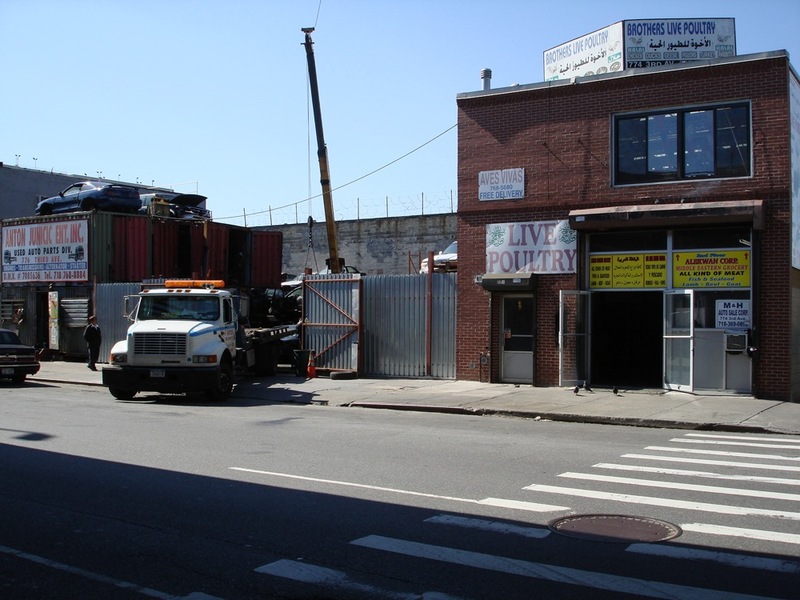
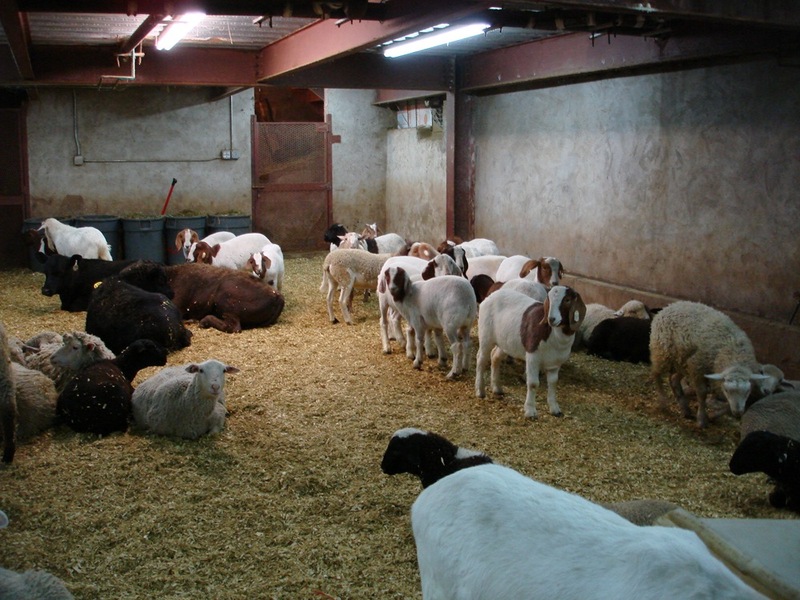
In its main room were three or four rows of cages full of varying types of chickens, turkeys, ducks, pigeons, geese, and rabbits; downstairs in a large, open room carpeted with hay were live lambs, goats, and even two cows.
None of the animals are raised in the market; they are purchased from other sources and brought temporarily until they are slaughtered. The conditions, while far less than ideal and certainly not pasture-like, were quite clean and dry. None of the animals seemed stressed. Mostly just curious about their visitors.
Upstairs, the birds were chosen, then weighed, taken in back, slaughtered, bled, and plucked. We collected all three and brought them home in large plastic sacks, each with its feet and head still attached, each warm with the residue of body heat.
 What follows is our adventure in creating the turducken--deboning the fowls, assembling it, cooking it, and, finally, making an epic stock from the bones. If you're not interested in seeing what a chicken, duck, or turkey looks like before its meat was shrink-wrapped (i.e. with its head and feet still on ), you probably should stop reading right here. The pictures are quite graphic . But they are also, in my opinion, a healthy thing to see.
Part I: Hanging
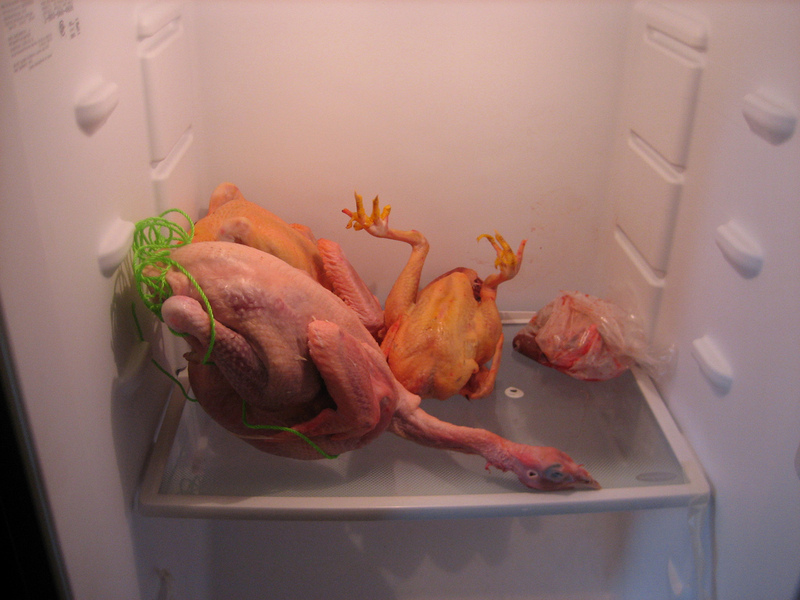
Our first order of business was to hang the birds as best we could: hanging allows the natural enzymes present in meat to tenderize it and develop flavor. This is the same principle as aged beef. While it is technically the first onset of decay, it's a controlled process, and is nothing close to rot. Matt emptied a fridge and set up the best system he could.
Part II: Brining
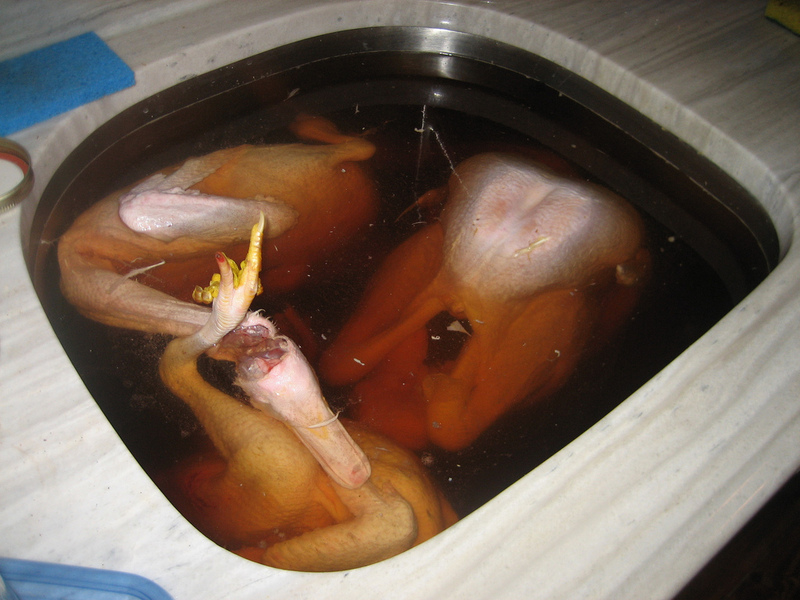
Next, the birds were brined in a solution of salt and brown sugar--this would flavor the meat and also tenderize it further.
Part III: De-boning
The following day, we set aside a few hours to de-bone the chicken and duck; the turkey would be partially de-boned, just enough to allow the others to fit inside snugly. I arrived at Matt's apartment late, and he had already begun. A turducken takes forever to cook; people would be arriving. There was no time to lose.
"I've just done something really stupid," was the first or second thing he said to me as we climbed the stairs to his apartment. Then I saw his hand--wrapped up in sharp strings of dental floss and a piece of plastic garbage bag. He'd sliced it open shortly before, but, amazingly undeterred, was still at work removing a thighbone from its flesh. "I might get stitches tomorrow," he offered, head down and focused. I was highly impressed, and almost went along with his utter determination and devotion to the turducken. Then I came to my senses. I quickly sent him to the local Polish apothecary for hydrogen peroxide, butterfly bandaids, and gauze. When he returned, it turned out that the cut, after cleaning, wasn't all that bad. We sterilized it, bandaged it up, and moved on--with latex gloves. Carefully. De-boning a bird is, I would come to realize, a very, very difficult process. It's no wonder Hebert's, that poultry-de-boning expert, is so respected.
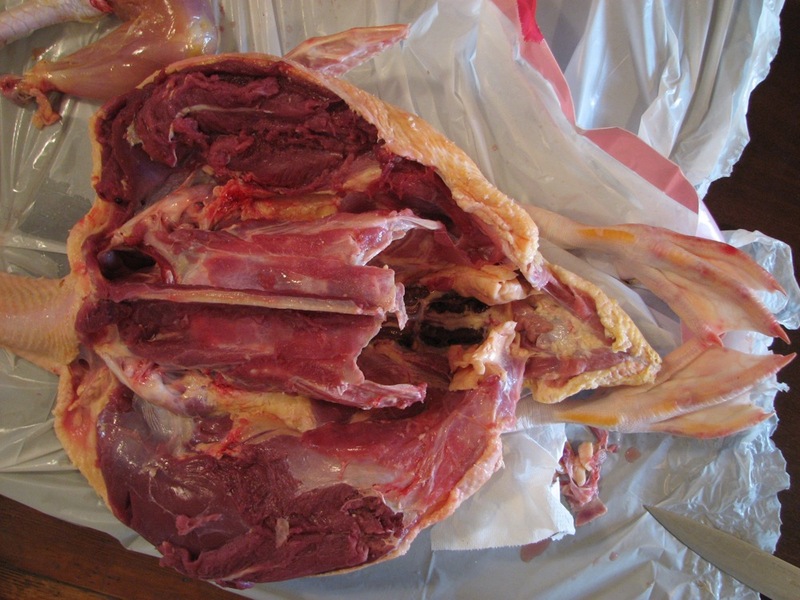
Above, the duck; it's flesh has a much richer, red color compared to chicken and turkey. To debone each, we laid them on their backs and made an incision along the breast bone, cutting down and around each side of the rib cage. Then we cut around the backbone, doing our best to keep the skin around the spine intact. After removing the backbone and ribcage (and the head along with it), we were left with two breast halves attached to thighs and legs. An incision along the leg bones bone and then around them allowed us to pull the leg bones out. The turkey was cut up similarly, except we left the backbone in to give the eventual turducken more structure, and didn't de-bone the thigh and leg.
Part IV: Assembly
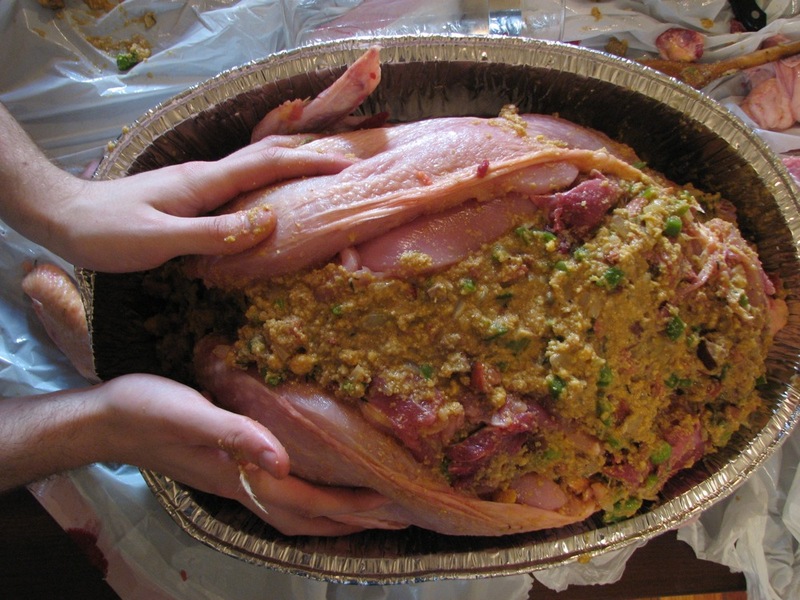
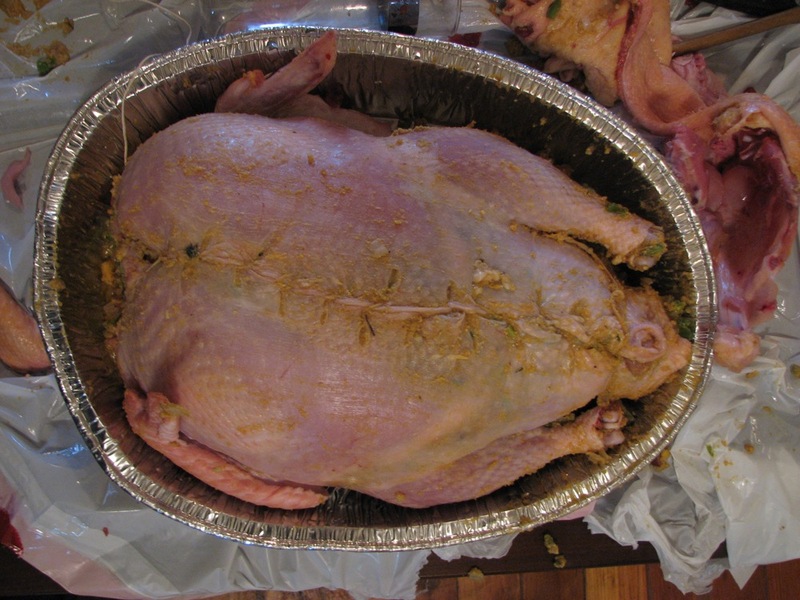
By the time our amateur de-boning was finished, we had many pieces of duck, chicken, and turkey, most in disarray. First, we filled the turkey cavity with a good helping of stuffing, which was made from cornbread and andouille sauasage.
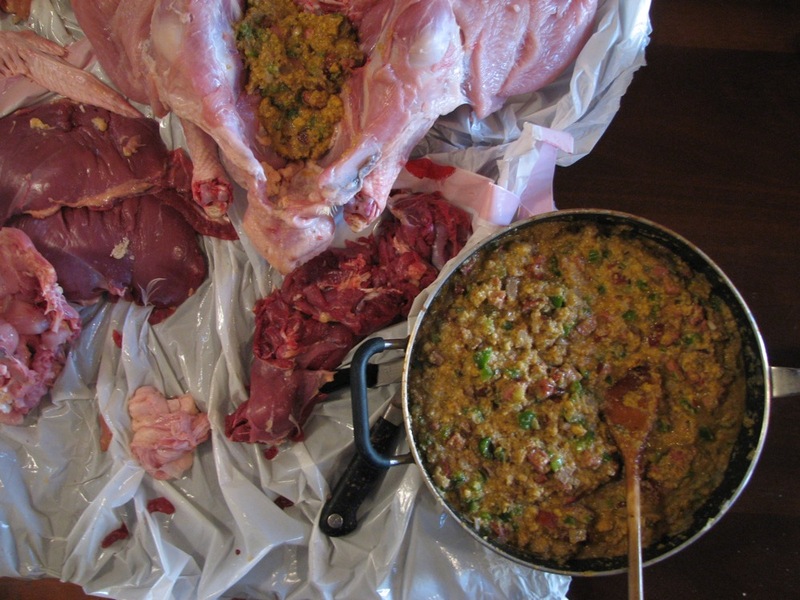
Next, we layered in the duck breasts and leg, adding more stuffing between. The chicken followed in the same manner.
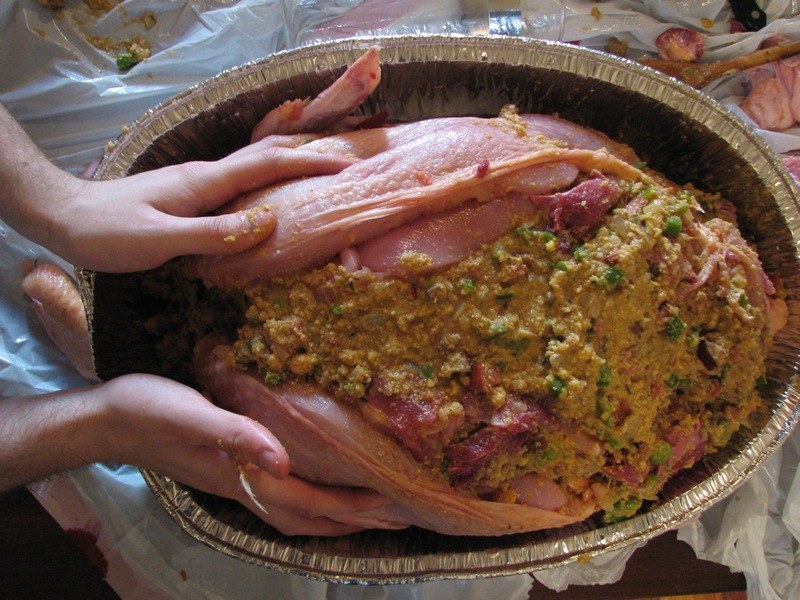
At this point, the assembly was very daunting. There was no way any of this would fit. Also, we had not yet figured out a system for sewing. After some ill-advised attempts using a bobby pin, we devised a combination of using a meat thermometer to puncture the skin and some kitchen thread to finish the job. Remarkably, it all fit quite well.
Part V: The Cooking
Instructions for cooking a turducken vary; some call for 19 hours of cooking at 190 degrees, a temperature which Matt remarked as "a hot day in Arizona." Already a bit harried, we just threw the thing in at 325 F, shut the door, and promptly left the apartment to get some fresh air.
Upon returning, we arrived at disaster: the turkey sewing job had completely failed; the bird was totally split open. Quickly, we revised our cooking times, which ended up being a blessing, since guests had already arrived and began asking regularly when we would actually be eating . But how would we know when the turducken was done?
We had no idea. Every 15 minutes, we jabbed a thermometer into the molten center of the roast, aiming vaguely for a temperature above 165F. The outside continued to blacken. Eventually, we gave up and pulled it out.
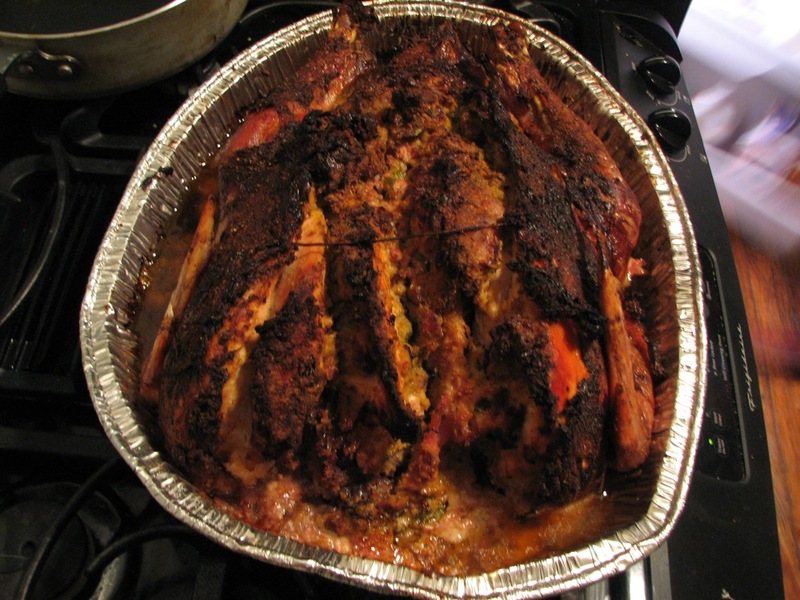
It looked ugly and horrible, truly a culinary grotesque. We had no clue how to carve it or serve it. The solution ended up being cross-wise cuts, which gave a vague sample of each meat. Stuffing was plopped on top of the pile.
And how did it taste? It tasted like you'd imagine, a muddle of flavors and textures, vaguely like poultry, extremely rich and heavy. It was certainly not high cuisine, but it wasn't bad. The fact that it had split open during cooking had led to a lot of dryness. The chicken was tender and delicious, but the turkey and duck were rather tough.
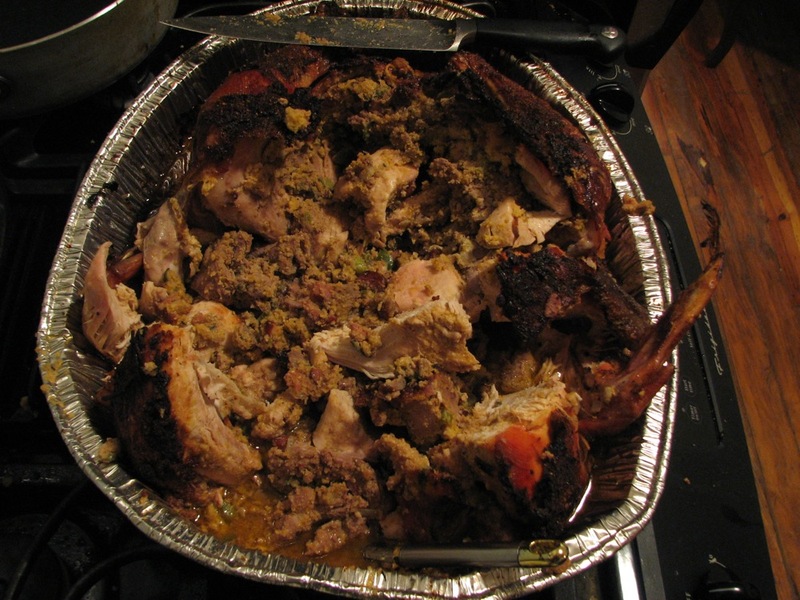
But I can't say that we were expecting anything else: and to be honest, it was really fun to create this absurd meal and eat it with a crowd of friends. This was about the process more than anything else. We had taken these birds from slaughter to meal in just one weekend; we'd become intimately familiar with them and done all we could to honor their lives in a fitting, grandiose meal.
Which leads me to the final part of this post: what to do with ten pounds of bones, wings, backs, necks, heads, and feet. We put the parts into a garbage bag, and I carried them home in the cab.
Part VI: Turducken Stock
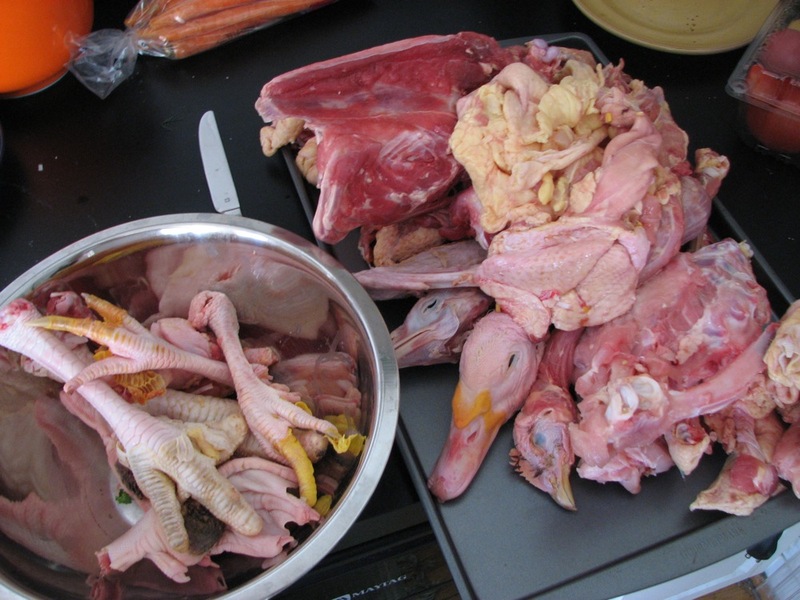
While in theory each bird could have been made into its own separate stock, it would have been a giant hassle, and I don't have enough pots. A duck stock, especially, benefits from roasting the bones first. But in the interest of ease, I cooked them all together from raw parts, aiming for a clear, light poultry stock. First I separated the feet from the rest of the parts and covered them with boiling water--after a ten minute soak, the outer layer of scales on the feet were easy to peel off.
Then I put everything into my two largest pots, covered them with cold water, and slowly brought them to a simmer.
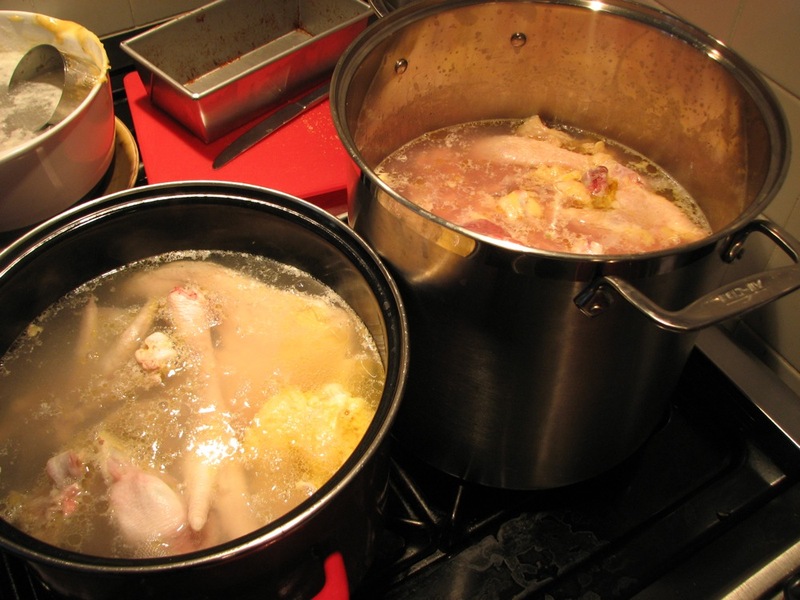
Immediately foam and scum began to rise to the top; I skimmed off as much as possible until it started to subside. Then I added a bag of carrots, sliced, a few ribs of sliced celery, a couple quartered onions, and a few tablespoons of salt. I turned the heat as low as possible, so that only the occasional bubble would rise to the surface, and let them sit for the rest of the day, about 6 hours, stirring occasionally.
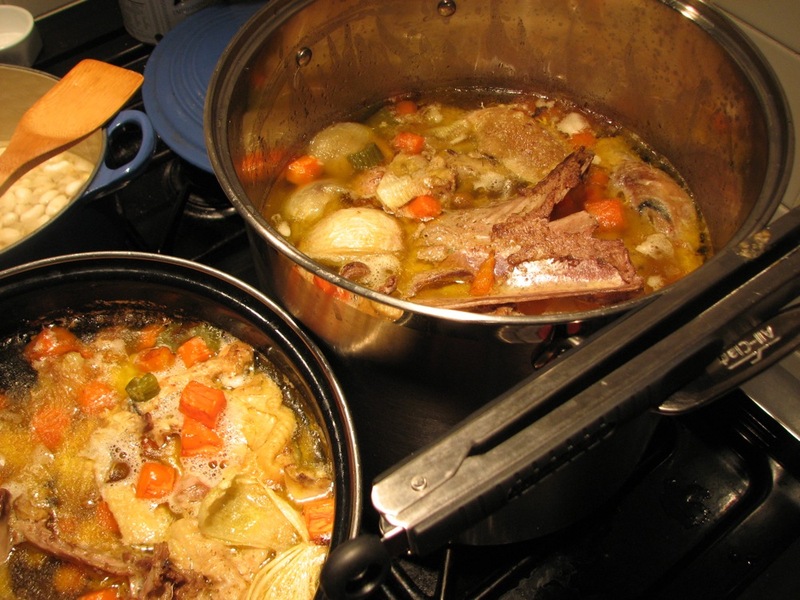
Then I removed all the parts with tongs, pressing them in a colander over a bowl to extract all the stock they held, and, finally, poured it through a strainer into some tupperware vessels which were bought at 11pm at the local grocery store. I let it cool, covered it, and put it in the refrigerator.
In total, the birds offered up 9 quarts of stock, enough for 20 healthy servings of soup. It was a very impressive showing. The birds had given us all they were capable of giving. They had provided us with adventure, a turducken, and now many nights of sustenance and cold remedy. To be perfectly honest, and to risk sentimentality, I was quite moved by the end. I'll think of all three of them as their stock enriches many meals to come.
Chicken, Chicken, Chicken Stock, Duck, Duck, Hugh Fearnley-Whittingstall, Stock, Stuffing, Turducken, Turkey
Comments:
Blog Comments powered by Disqus.