
Homemade Yogurt Mistakes

by Nick Kindelsperger on June 12, 2008

yogurtmistakes01

Before I start detailing this ridiculous project, I’d like to point out that I fail in the end.  There is no great yogurt recipe hidden in here, no surprising technique that changes everything.  I tried some methods, some reasonable and some quite stupid, and none of them worked.  I just want to make some respectable yogurt at home, and I’m hoping some of you can help. 

I thought this would be an easy exercise resulting in containers of beautiful white yogurt in my fridge ready to dip into at any time.  But making yogurt is hard.  It requires careful watching and measuring, and the results weren’t really worth the effort.  Actually, one of the experiments was edible and pleasant, if not particularly exceptional, and the other...well, I’ll get to that later. 

The basics of the project that I developed from various sources included warming the milk to 185 degrees Fahrenheit, cooling it down to between 86 degrees and 113 degrees, and then adding the yogurt starter.  Let it all ferment for a while, and then you’ll have yogurt.  Easy, right?   

homemadeyogurt02

Using a simple recipe from Farms and Foods of Ohio, I heated a 4 cups of Snowville Creamy's excellent milk up to 185 degrees, and cooled it to 110 degrees. 

yogurtmistakes03

Then I added 3 tablespoons of yogurt--the starter--whisked it together, then poured everything into a clean glass jar, wrapped a towel around it, and set it aside on the counter for 6 hours.

yogurtmistakes04

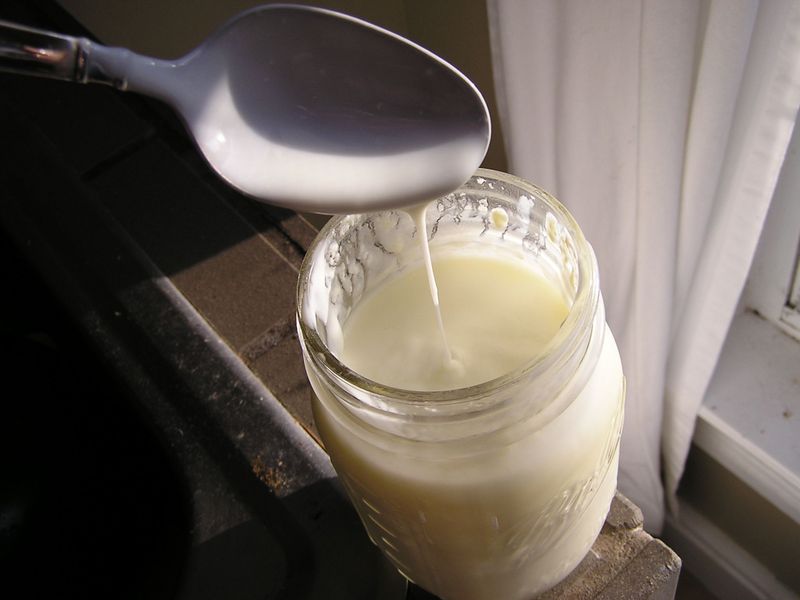
When I opened up the jar I had yogurt.  Albeit one with many major flaws.   

First off, the yogurt wasn’t firm enough.
My cheesemonger who sold me the yogurt warned me, and even the caption in the Farms and Foods of Ohio stated that the yogurt would be “smooth” and “silky”.  And since I used whole milk, eating it felt akin to mixing granola with heavy cream.  Instead of feeling healthy and refreshed, I felt fat and slow.   

Also, the yogurt didn’t have much tang.
Perhaps the most distinctive attribute of yogurt is that wonderful tang which marries so well with fruit and granola.  The yogurt I used as a starter had such a great flavor, but none of that really translated into my version.  The faintest hint was present, but it paled in comparison to the starter.  It felt like I had just diluted the little yogurt I started with with lots of milk.

It wasn’t a complete failure.  I haven’t thrown it away, and it’s doing an amiable job for breakfast, but I probably won’t make it again because I can buy relatively cheap tubs of excellent yogurt at the store. 

If I was going to try make yogurt I again I wanted something outlandish that could hopefully solve these problems.  In Harold McGee’s On Food and Cooking he gives some guidelines for how industrial yogurt is made and I figured I could pick up some good tips.  It contains the same outline as the above recipe, but it just takes things a little further.  Instead of just bringing the milk to 185 degrees, and then turning the heat off, the temperature stays at 185 for 30 minutes.  After that it, just like the previous recipe, it cools things down.  But instead of 110 degrees, McGee opts for 86 degrees.  Oh, and it has to stay there for 18 hours! 

His reasons seem important:
Rapid gelling produces a relatively coarse protein network whose few thick strands give it firmness but also readily leak why: slow gelling produces a finer, more delicate, more intricately branched network whose individual strands are weaker but whose smaller pores are better at retaining the whey.

How, exactly I would maintain that temperature was beyond me.  But that didn’t stop from bringing a batch of milk to 185, cooking it for 30 minutes, and then cooling it down to 86 (or there about).  Then and only then, did I think about how I could get this done.  I realized early on that sitting a pot on a burner over low heat just wouldn’t work.  I had to get more creative.

yogurtmistakes05

First try:  a griddle set to low, with a pot stuck on top.  But that had too much heat. 

yogurtmistakes06

Second try: I diffused it with an iron skillet.  But still, too warm.  I even added a little water to the iron skillet.  Not good enough. 

yogurtmistakes07

Third try: I busted out my faithful slow cooker and turned the heat to “stay warm”.   Then I dumped the yogurt into a ceramic bowl, and stuck it in.  That was still too high, so I added ice cubes to cool down the pot.  This kind of worked until the ice melted.  Then I’d have to add more.   But I was able to keep the temperature close to 86 degrees as long as I checked it regularly.

yogurtmistakes08

Did I mention this lasted for 18 hours?  I checked this thing constantly, trying to maintain some kind of consistency.  But it was fleeting.  And when the marathon session was over, what came out looked exactly like cottage cheese, albeit some that looked disgusting, yellow, and potentially dangerous.   I threw it out.

I don't doubt that McGee is right, but just not for me.  He was talking about how things are done on high tech equipment, not slow cookers diffused with ice cubes.  And because I didn't cover it, all kinds of dangerous bacteria could have landed on it and done bad things.

So the question begs, without fancy, devoted equipment, can good yogurt be made at home?   

{ 28 comments… read them below or add one }

1 w. 06.12.08 at 12:53 pm

Was your starter yoghurt one that was made with live cultures? Some of the supermarkety sorts don't specify so maybe it didn't actually do its work as a starter?

I've never actually made yoghurt on my own but I've been wanting to try and I remember reading online that some people add in a bit of instant milk powder to make it thicker - so that could help with your consistency, and you could probably just use skim milk if you want it lighter, but i'm not sure about the lack-of-tang/flavour.

I'll see if I can give it a try one of these days and will let you know how my experiment goes. :)

2 ttm 06.12.08 at 1:19 pm

This may be "fancy, devoted equipment," but a PID controller (available here and here) is pretty cheap and can be used with your slow cooker. As a bonus, it probably would do a better job at cooking the hard-boiled eggs from a few posts ago than the slow cooker alone.

3 Schlake 06.12.08 at 1:27 pm

I put a few inches of my hottest tap water into an ice chest, then a platform to rise above the water. The yogurt goes on top of the platform for 8 or 10 hours. Works great for me.

4 litza 06.12.08 at 2:04 pm

I've had great success using lowfat milk with extra nonfat powdered milk added to it for thickness; using a couple of tablespoons of Greek yogurt for the starter; and putting the jars in a small picnic cooler with an ordinary heating pad set on "low." I leave it there all night and in the morning I've got nice thick yogurt! The first time I did this, I used an instant-read thermometer to keep an eye on the temperature inside the cooler to make sure it was in the right range.

I had an informal yogurt-making seminar with Ali at Astoria's Kebab Cafe a couple of years ago; all he does after he's heated the milk is stick the pot on a shelf above his stove for a day. He then strains his to get a very thick final product.

Good luck!

5 Nick Kindelsperger 06.12.08 at 2:20 pm

litza: That's really interesting. I didn't even think about staining. I guess this means that I'm going to have to try again.

6 Christine in Minneapolis 06.12.08 at 2:23 pm

I've had success going off the recipe in my 1960s era Joy of Cooking. I pour the warmed (scalded? can't remember) milk into my big mason jar with the 3 T. of yogurt and whisk them together (last time I used Stoneyfield Farm brand lowfat plain yogurt and 2% milk). I then wrap the jar in two kitchen towels and wrap the bundle in a plastic garbage bag. This worked great the first time I did it and took about 8 hours or so for the yogurt to gel. It never got as firm as some supermarket yogurts, but that was because I put it in the fridge after 8 hours so it wouldn't get too tart. It was definitely more firm than heavy cream, though, so this might work for you.

I've also heard that you can create the warm environment using a heating pad placed under the jars, perhaps with something in between so the heat source isn't directly against the glass…

7 meg 06.12.08 at 2:32 pm

The longer you let the yogurt incubate the tangy-er and firmer it will get. I use a yogurt maker (not very expensive) and incubate for at least 12 hours, sometimes up to 20. I also don't bother with heating the milk before adding the starter, but I do bring all ingredients up to room temperature before incubating.

Have heard on top of the fridge also works, as well as in a gas oven that's turned off.

8 Erocs 06.12.08 at 3:07 pm

You can buy a yogurt strainer or just use cheese cloth. I often do this with store bought yogurt to get a very thick consistency for when I make Lebanese foods.

9 egs 06.12.08 at 3:28 pm

My Armenian grandma used to make yogurt all the time…we put it in a small closet for about a day after making it and the closet was pretty warm…so maybe a warm, small space?

10 DocChuck 06.12.08 at 3:38 pm

We cheat.

We use a Eurocuisine Electric Yogurt Maker which one of my wife's employees gave her.

It is almost fool-proof. It is (I am told) inexpensive, and is said to be highly energy efficient (green).

Before we got this new gadget, we had an old model (and I cannot remember the name of it) for over 20 years that worked wonderfully, but was large and clumsy.

Home-made yogurt, in my opinion, can be so far superior to the commercial crap, that attempted comparison is useless.

Keep trying, guy.

11 Jan 06.12.08 at 3:52 pm

This site: http://fiascofarm.com/dairy/yogurt.htm has some good info. I've had very good luck with adding powdered milk, and using the heating pad in a cooler method (keeping it ~105F-115F). Mind you, I've had even better luck w/ the $30 yogurt maker I bought.

12 Hillary 06.12.08 at 4:38 pm

Love the title of this post and I love a person that can admit a mistake! Thank you for sharing with us and walking us through.

13 gaea 06.12.08 at 4:54 pm

My husband and I have been making our own yogurt about once a month for a while. We just bring the milk up to 203, then let it cool to just above 108. Pour into sterilized mason jars, and add starter–about 1T yogurt from a previous batch per 1C warm milk–to each jar when its temperature falls all the way to 108 (it will lose a few degrees while you're pouring it).

Line an ice chest with a towel or blanket, put the jars inside, and wrap them up with more towels or blankets if necessary to fill up the ice chest.

I think since we make it a gallon or two at a time, the jars themselves help keep each other warm for a while, letting the cultures eat and screw and whatever else they do in the milk for longer. If you're making a smaller quantity you might want to put a heating pad under the ice chest or something; I'm not sure. If four quarts of yogurt seems like a lot, remember that you can drain some of it to make cheese, give some away, make some Indian food, rub some on your mom's dog's rash–whatever floats your boat.

Leave everything sealed up and forget about it until the next morning. You should end up with nice, firm yogurt that is sweet at first and gets tangier the longer you keep it in the fridge.

Once we tried just bringing it up to 108 and adding starter, but ended up with runny yogurt, so now we always bring it up to 203 first. Every other time has been a complete success, so the high temperature must do something to make the proteins more easily digested or . . . something. :)

Good luck!

14 irena 06.12.08 at 8:31 pm

My Ukrainian family has two ways of maintaining heat on yogurt as it brews:

1) Heating pad on low inside an ice chest filled with pre-warmed blankets (toss them in the dryer). It should maintain steady at around 100 degrees.

2) Leave the yogurt in the oven with the light on. That's it. :)

The longer it brews, the tangier and thicker it gets. Straining, as mentioned above, is also very effective.

Also consider that industrially produced yogurt does not make a good starter. The best starters are ones you grow yourself. You can buy yogurt starter probiotics online (google "yogurt starter"), but even then, go through 1-2 cycles of yogurt and reserve a bit of the results as your starter, similar to maintaining a mother for sourdough. The third to fourth generation is usually stronger and adapted to your environment and methods.

15 Paul 06.12.08 at 8:49 pm

I think you are on the right track with the slow-cooker… I tried this method myself recently with good results. I raised my jar off the bottom of the slow-cooker to keep it from overheating and also only partially filled the slow-cooker with water. My yogurt was in an earthernware jar… filled with 1 litre of milk, and surrounded by about a litre of water in the slow-cooker. Let it go for 10 hours at least…

16 Brian 06.13.08 at 7:57 am

We've been making our own yogurt for the last year. The key is buying a good thermos. Heat the milk up, (no need to keep it at this temperature for any length of time) then cool it back down, add the culture and put it in the thermos. Close it up tight, and leave it over night. This method has consistently produced yogurt that is as good or better than the best stuff I've ever gotten at a store. One note though: I had a friend who had some problems making yogurt with non-homogenized milk. Once she switched to homogenized, it came out great. Other than this, I can't stress how consistently this method produces a great result. Email me if anyone needs any more details.

17 Anna 06.13.08 at 2:00 pm

Just found your site and I love it!

My GF gave me a yogurt maker and I've had mixed results…the recipe that came with it said to use non-fat milk powder but I ended up with yogurt that is more like wall paper paste, tastes okay but so stringy.

Many trial and errors later I have found that the best results have been with raw milk, no non-fat powder and remember to stir in the starter verrrry gently.

Good luck!

18 Nick Kindelsperger 06.13.08 at 2:06 pm

Thanks everyone for your yogurt support. I can't wait to try this again.

19 Lisa 06.14.08 at 9:31 pm

Hey Blake…I met you today at Blue Ledge Farm! I'm the intern. I love your blog! I wanted to give you the link to my blog…it's about my experience working on the farm, and the food I am eating while I'm here. Check it out if you're not too busy!

http://lisa-blahg.blogspot.com/

20 Ann 06.15.08 at 2:59 pm

Please do post again when you perfect your yogurt-making technique! I've never managed it, so I'll be interested to see how it works out for you.

21 Natalie Sztern 06.15.08 at 6:10 pm

I agree with DocChuck..if u factor in the hours spent at what u would be earning or charging, with the cost of the ruined ingredients and the gas to buy them, you are probably better the next time with a yogurt-maker…

22 Natalie Sztern 06.15.08 at 6:22 pm

btw, did i ever mention that i love your site….i used to go under another name…but i love and follow most of your recipes….however going back a few posts we disagree on poutines…je t'aime ya anyway

23 Karen 06.17.08 at 4:05 pm

Hrm. Interesting. So far I've not had a problem with yogurt–the first batch I did I just heated the milk up to simmering–small bubbles around the rim. [My understanding is that's all that's required to re-pasturize the milk]
Let it cool til I could hold my finger in it for 15-20 seconds comfortably, pitched the warm milk into jars along with some live yogurt, and placed them in a cooler full of quite hot water [tap water, not boiled] so they would be warm enough to let the culture grow happily and not too hot that'd it kill it off.
Half of it I took out after 8-10 hours when it was still runny as my partner prefers drinkable yogurt, and the rest I kept in overnight [the water cools, naturally, so it will need more time] to get a firmer, more tangy product.
The 2nd go was a week ago when things were disgustingly hot and I just left them on the kitchen counter in the sunlight from the window for 8-14 hours.

I've found the results to be great for eating or using in recipes. Making yogurt cheese [straining yogurt through a cheesecloth/bag hanging (the whey can be used in cooking as stock or to start a new yogurt batch) over a container to catch the whey] is also a fun thing I've toyed with…

24 Tina 06.18.08 at 4:01 pm

Look at 101cookbooks.com and search for yogurt. Heidi and Co. has a recipe that I use all the time. I use a yogurt maker to maintain the temperature (at $15, it's already made back it's money) and I use the microwave to heat up milk as the results are always consistent. Strain your yogurt for thicker results too. Good luck!

25 Rosie 07.14.08 at 11:37 pm

Hailing from Australia here! I have used the same method as many other people here, for years:

Heat your wideneck thermos with hot tap water for 5 mins while you deal with the milk. Heat the milk (say 500ml) to simmering/almost-simmering and then let cool to just hand-hot. Mix in 3 teaspoons of live-culture bought yoghurt, pour into pre-warmed thermos and put on shelf for 6-8 hours. Don't move it around as this can disturb the curd. When it sets (check on it), put it in a container and refridgerate. I have tried adding flavourings at this stage, but beware that some jams for instance will make your yoghurt go totally runny! Now I just add flavourings to my cereal bowl at breakfast!

I have done the following just as following:
make yoghurt quark (quark is a German soft cheese) by straining your yoghurt through a fine cheescloth. Put a bowl underneath to catch the whey and add it later to bread, or give it to your potplants or chooks (or drink it, you know you want to). When it stops dripping you should have yoghurt quark in the cheesecloth. This is yummy spread on toast with apricot jam! You can eat it in any way you like, it's just like a soft cheese. You can alter how thick it is by how long you let it drip.

Hope this works for somebody! Two of my friends started doing this too and it works great for all of us! And I don't have a thermometer :P

26 Alec 05.17.09 at 3:30 pm

Hello Nick,

I think you’ve scared me off of making my own yoghurt (yours turned out how I think mine would), but there’s something easier and equally fun which I though you might be able to help me with.

I’d like to make some frozen yoghurt. Not just yoghurt frozen, but something really tasty. I’m keen to just use maple syrup, honey or fruit for sweetener and not too much.

The goal is to cut down on my sugar intake via the (excellent) Vienna ice but to continue to have cool treats for this summer after a hard cycle…

Perhaps you could do a separate post on the best way to make frozen yoghurt, starting from high quality yoghurt either bought or home made.

27 Ellen 05.18.09 at 9:48 pm

I read with interest your assessment of the yogurt situation — as I have too, failed MIZerably at making yogurt — and it was only my first attempt, this weekend.

I followed Alton Brown’s recipe (from http://www.foodtv.com) using his “surefire” method of heating to 120 degrees, cooling to 115, adding the yogurt to the warmed milk (in fact, I used whole milk, organic, to the tune of $6.50 for the half gallon) and my yogurt was more yo, and less gurt.

Lots of stringy slime after a night in the oven (wrapped in blankets with the heating pad) and refrigerated for 8 hours. I’ll use it — but it’s not yogurt.

I’ll try once again, with 2% next time — and see what happens. I’m upset, because I’m an accomplished cook — and why should any of us be stymied by some ridiculous microorganisms!

Ellen, NYC
5.18.09

28 patrice 06.21.09 at 1:04 am

I made two batches and the end product looked stringy not eatible.

Leave a Comment

You can use these HTML tags and attributes: <a href="" title=""> <abbr title=""> <acronym title=""> <b> <blockquote cite=""> <cite> <code> <del datetime=""> <em> <i> <q cite=""> <strike> <strong>

Previous post: Our First Year at the James Beard Awards

Next post: Homemade Guanciale, the Verdict Is…