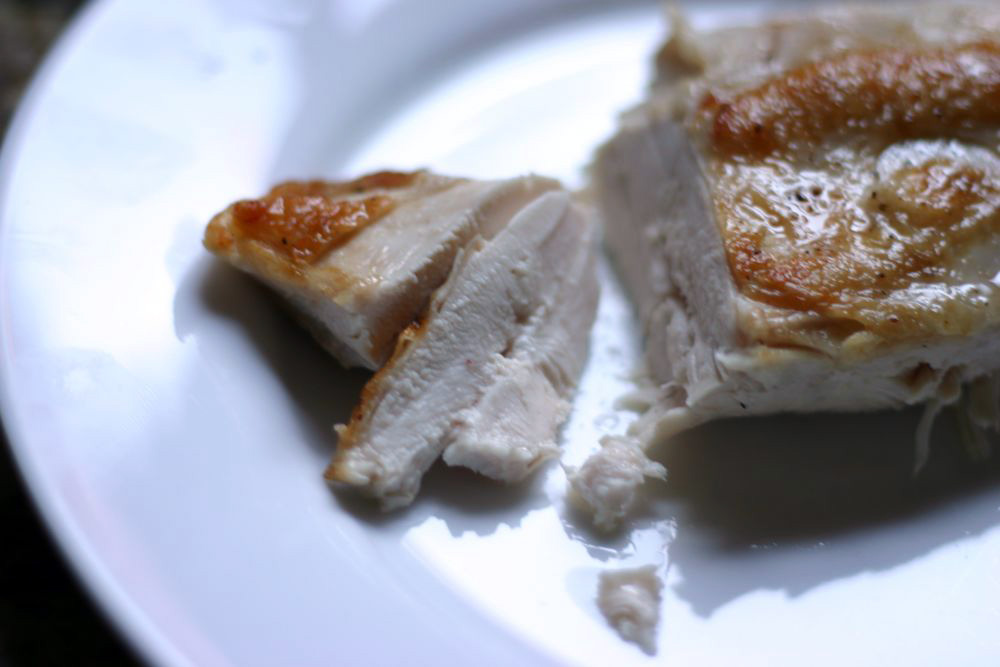

In my opinion, the best chicken is chicken sous-vide. Each bite is tender and succulent in a way I never thought chicken could possibly be. It's kind of changed everything for me. Even the appearance of the meat is different, instead of stringy and tough, a fork can simply cut through the meat. It's enough to make anyone convert.
So for the past few weeks I've been proselytizing about the powers of sous-vide, a process where you vacuum-seal food (that's where it gets its name, as sous-vide French for "under vacuum") in a plastic bag and cook it at a very specific temperature in water. The temperature should idealy be the exact temperature you want the food to be when it is done. The result is a piece of meat that has retained the maximum amount of its juices, while still being done. It's an astonishing technique, but all my rambling has done miraculously little to convince anyone. Trying to explain what sous-vide is and can do to someone who has never tasted the results is a losing proposition. Either it elicits complete incomprehension and glazed eyes ("food cooked in a plastic bag?") or straight contempt hidden as back-to-basics food evangalism ("I actually prefer cooking the old fashioned way, thank you very much."), even if he or she has never tasted the results. Well, let me try again....
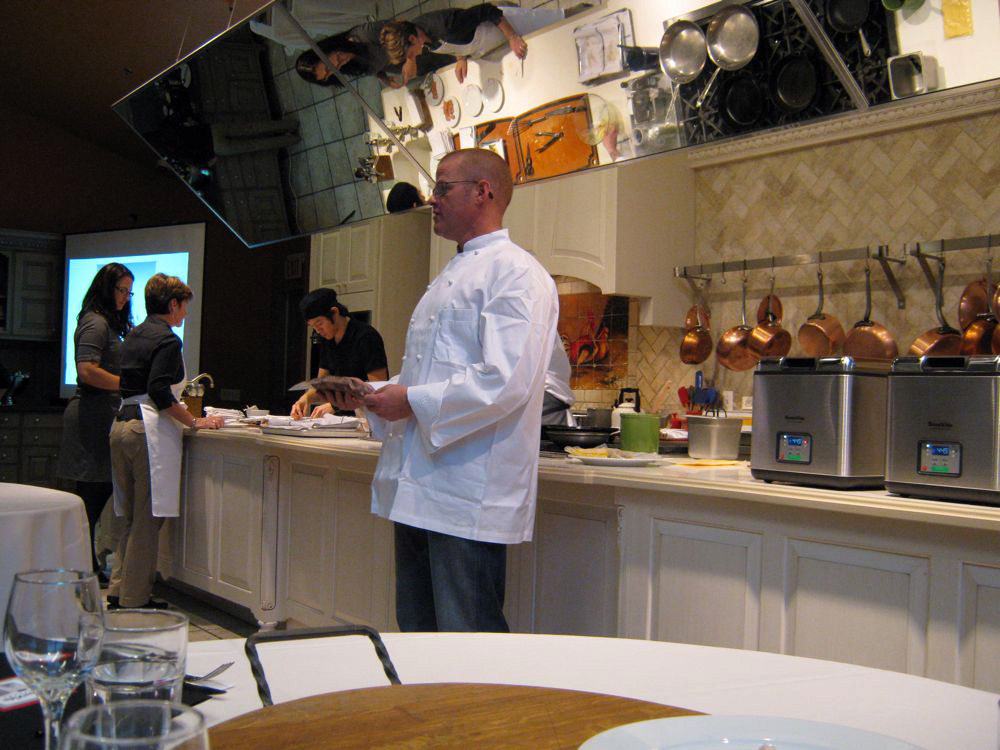
I first sampled this chicken a few weeks ago. SousVide Supreme was having an event in Chicago where world famous chef Heston Blumenthal cooked an array of proteins and vegetables using the new product. Vacuum-sealing food is easy, but finding an accurate way of cooking it in water is not. Expensive restaurants use thermal immersion circulators that can cost well over a thousand dollars, and also look more like something a Mad Sciencetist would use to cook dinner.
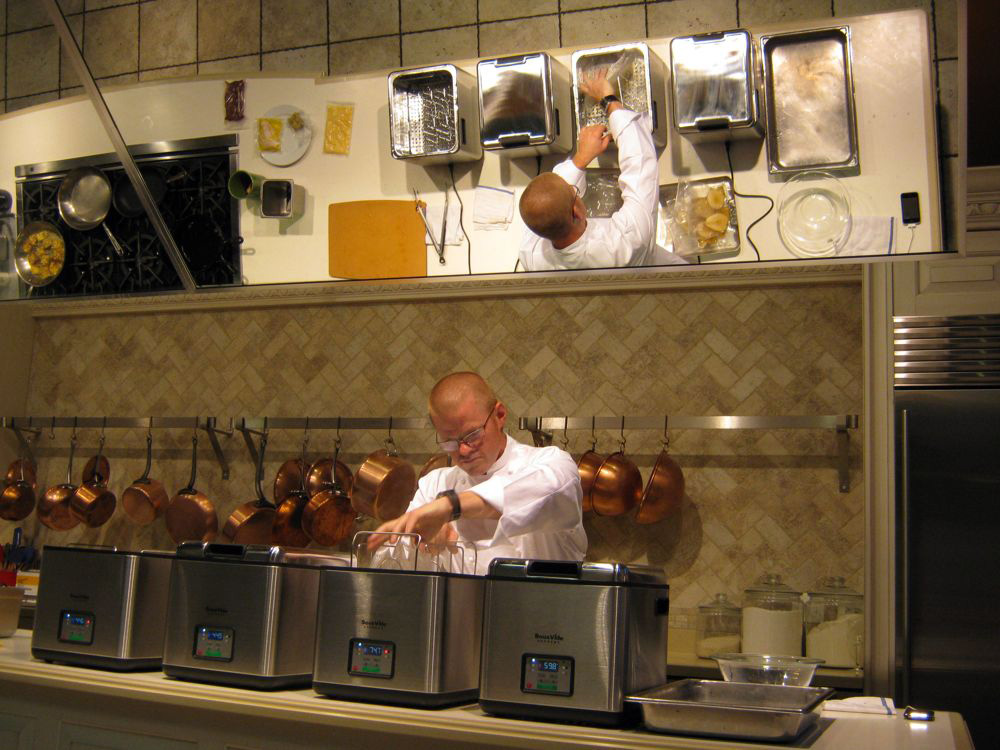
As advertised, the SousVide Supreme is the first machine built specifically for home use. It certainly looks better. It is sleek and gray and about the size of a bread maker. It's also relatively more affordable, (introductory price of $399). Though it's much smaller than a restaurant unit, Heston claimed it was just as accurate as the more expenisve machines. He seemed smitten. He talked empahtically about how this machine would change home cooking, and that it was the most important kitchen innovation in the last thirty years.
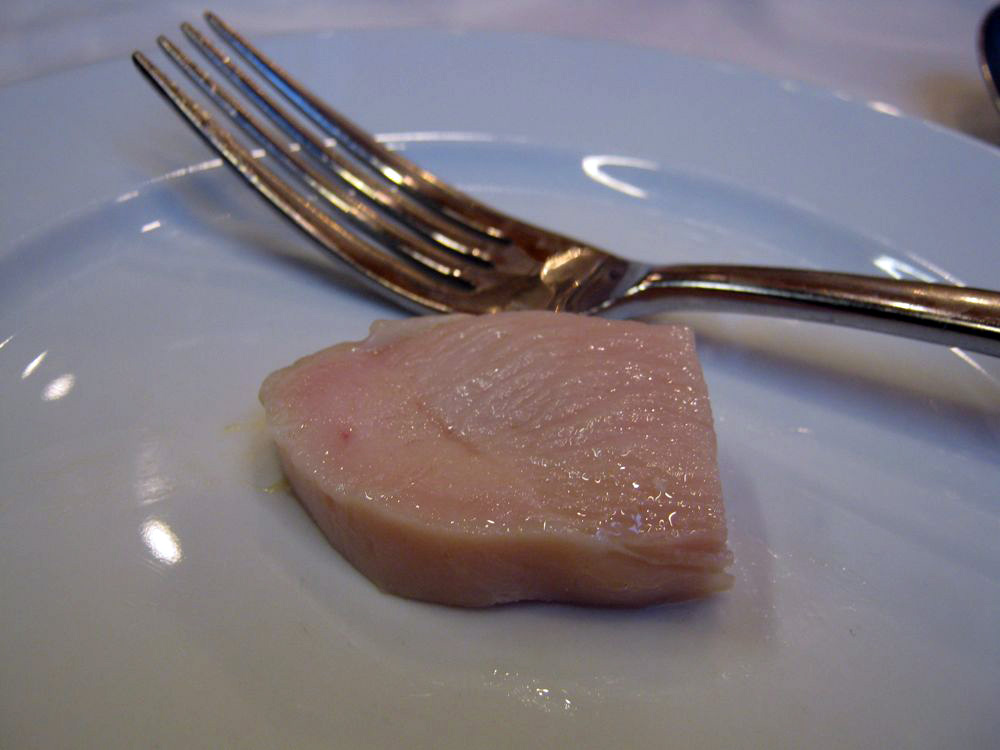
To say the food that came out of the machine tasted good, is something of an understatement. I ate flawless scrambled eggs that had the texture of a fine custard, a steak that was perfectly medium-rare from edge to edge, and a few bites of the tenderest, juiciest, most perfectly cooked chicken I'd ever witnessed.
I dreamt of that chicken for weeks. See, I've done a lot of crazy experiments with chicken over the years on this site. To date, I've roasted a chicken using roughly 10 different methods, all in the search of that elusive perfect bird. That's included all kinds of combinations of low heat, medium heat, extreme heat, and even one where I cooked it in a crockpot for six hours. All of these experiments were done in the hope of creating a bird that was moist and delicious with gloriously browned skin. But here was my answer. Or at least I thought.
As the event went on I sat back and smiled, happy from the food, and pleased to listen to one of the most acclaimed chefs on the planet talk about this new gadget. My only question was whether it was the man or the machine. Obviously the machine had a hand in what happened, but I had also just tasted food served by Heston Blumenthal. Of course it would be delicious.
After the event I requested a demo unit of the SousVide Supreme to see if I could replicate the results at home.
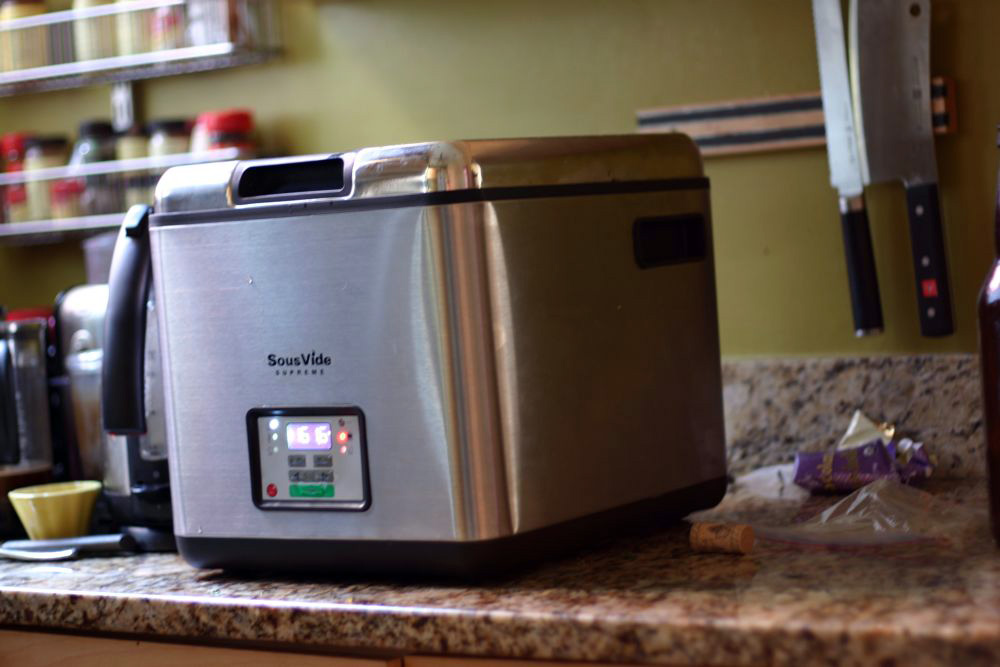
The box arrived in the mail a few weeks later along with a little Reynolds Handi Vac and plastic bags. I only had 9 days to experiment before I had to send it back, so my first experiment had to be chicken. I looked in vein for a true sous-vide chicken recipe, but it was really hard to find. Finally, I just decided to follow the recipe given in the instruction manual. It said to cook a chicken breast at 146 degrees for 1 to 2 hours.
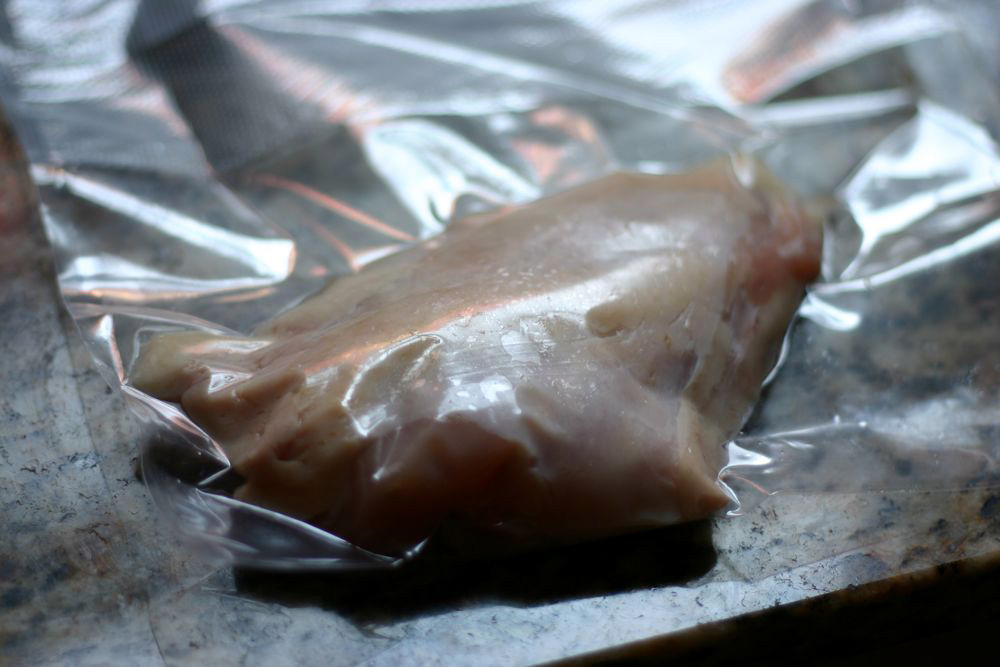
I bought a bone-less, skin-on chicken breast and vacuum-sealed it. Then I filled the machine with water, set the temperature to the suggested 146 degrees, and when water was ready, I dropped the bag in. I decided to wait the full two hours, for my first experiment I wanted to make sure it was cooked. Like cooking something in a slow cooker, there is nothing to do. I watched TV, cleaned up a little, and took a nap.
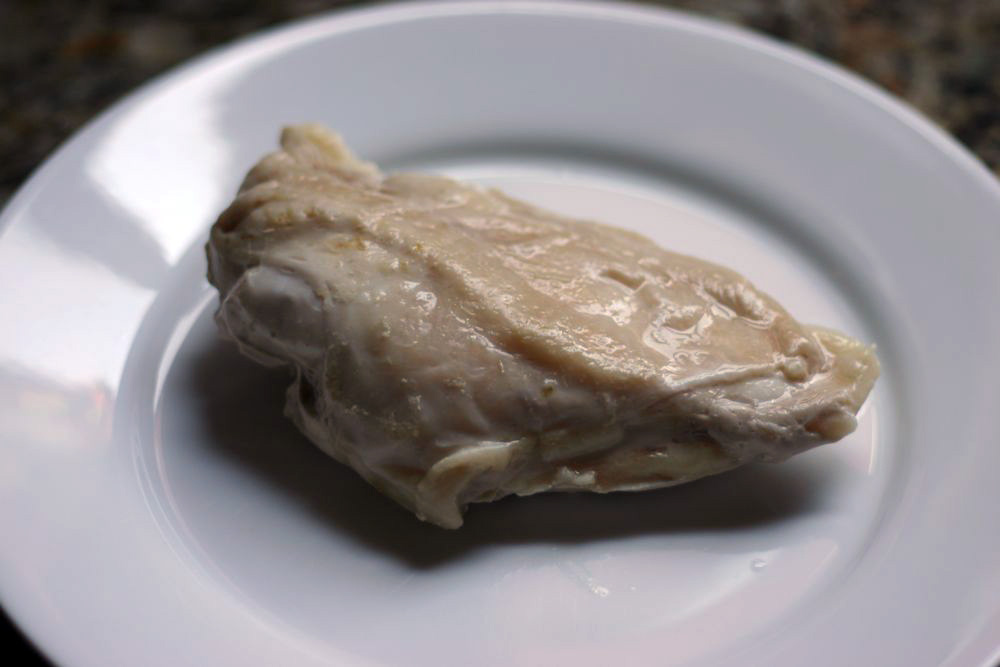
When I unsealed the bag and placed the chicken on a plate, it looked like one of the most unappealing sights you can imagine. Pale chicken, jellied around its edges, and with a texture that felt like it was still raw. But a temperature probe confirmed that it was done and a small cut proved that the flesh was perfectly white throughout.
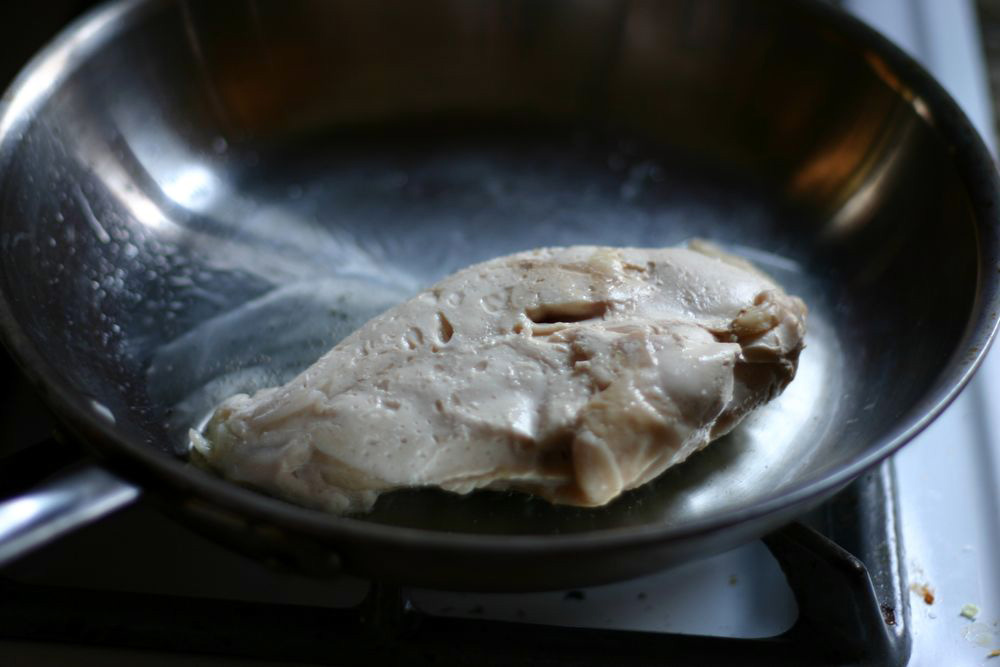
One of the issues with cooking something sous-vide is that you can never brown food. To do so, you have to sear it afterwards in a skillet. So I dried off the breast with some paper towels, seasoned it with salt and pepper, and then sautéed it in a little oil just to color the skin.
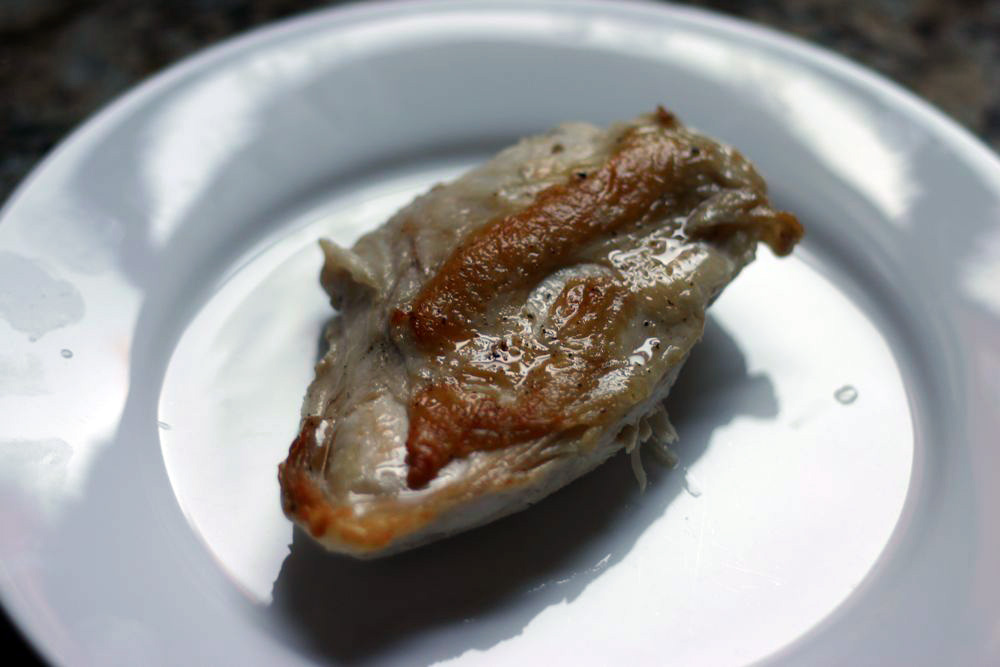
I didn't quite get the even browning I was looking for, and the flesh wasn't quite as fork tender as the one I sampled at the event, but that was just a bit of nitpicking. After just one try with the machine, I was eating the best bites of chicken I'd ever cooked for myself. It is astonishing, espeically so when you consider how simple it is to use. I didn't do anything to the chicken. I didn't brine it or stuff it full of butter. I didn't even season it with salt before I put it in the bag. All I did was sprinkle with salt and pepper before I sauteed it. That's it.
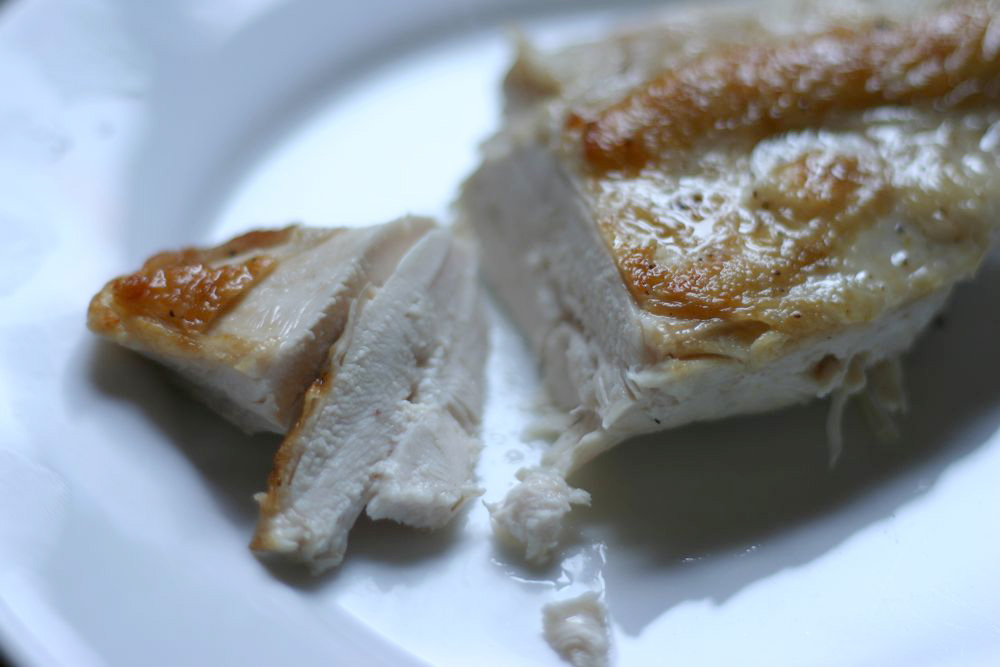
I figure the cooking temperatures presented in the booklet that comes with the machine are higher than those that Heston used. And looking around, I've found temperatures that hover much closer to 140 degrees than the 146 that I used. That may help. I'm off to try a few more experiments before my time with the SousVide Supreme is done.
(Full Disclosure: I recieved a free test unit from SousVide Supreme, which I'll regrettably to have send back soon. I didn't receive any money for the review.)


{ 2 trackbacks }
{ 27 comments… read them below or add one }
Nick,
I’ve followed the writeups/blog posts with much interest! I’ve been told the texture is off-putting, but your follow-up with the SousVide Supreme has me on the brink! I appreciate your passion!
Your mention of sous vide eggs grabbed my attention; I’ve been an egg lover all my life. The last egg innovation I know of was the microwave. What temperature did you use for the eggs? More details!
I enjoyed pork prepared at Indigo in Honolulu and chicken at a little bistro in Seattle called Picnic. Both presented me with tender and flavorful meat that was, near as I can tell, similar to the revelation you’ve expressed. Very interested in this method so thanks for the post.
Was the chicken served at the event brined? Looks like it was.
Instead of brining before cooking, as one might do it, I wonder how the chicken breast would turn out if you sous-vide’d it in brine.
John: The texture is can be different, that’s for sure. The chicken I ate at the event was a tad different than the one I cooked at home, and that had to do with mine being cooked at 146. Perhaps this is a good place to start. Then you can keep going down to 140 to see what you like (below 140 and the meat is not cooked).
Jumper: I have been experimenting with eggs, but I don’t have many answers. I cooked them at 167 for between 15 and 30 minutes. But I could never nail the right texture. Sorry….
Barry CB Martin: Thanks for checking in.
Marc: It was definitely brined. That’s a good point, because it would have definitely changed the texture as well. I haven’t even gotten to the point of exploring marinades in the bag. But they are all the rage. I need more time to experiment. But that’s where a lot of recipes are already jumping to. Not content to have a perfectly cooked filet, they are already seasoning it with all manner of things. Exciting stuff.
I have two questions:
Aren’t you supposed to cook chicken to somewhere between 160-170 degrees? I’m assuming that if you cook it at 140 that it never gets anywhere near 160. Or is the whole 160-170 thing a sham? I’m just not sure I can eat chicken cooked any lower than that- it’s too ingrained in me.
Also- I wonder if you could get a similar effect by turning your oven to about 150 (or, “warm” in my case) and putting the sealed chicken in a water-filled baking dish?
Hmmmmm.
The recent cookbook “Sous Vide” by Thomas Keller has tons of recipes. I need this product, thanks for the info.
rhiannon: I am not much of a scientist, but here is a helpful link for any questions you may have about food safety. http://amath.colorado.edu/~baldwind/sous-vide.html
As for the oven, that would work only if you oven can go that low. Mine can only got down to 200. As well, the SousVide Supreme maintains a specific temperature to within a tenth of a degree. One degree difference can completely change the texture of the dish.
DavidTFitz: Yeah, I’m going to need to pick that up. They also are supposed to have a great chart to show how long different cuts of meat take to cook. It’s really fascinating stuff.
Thanks for the review. I have ordered one and can’t wait to get it!
Instead of “Sous Vide” by Thomas Keller I would recommend “A Practical Guide to Sous Vide” from Douglas Baldwin. This is for free and can be downloaded here http://amath.colorado.edu/~baldwind/sous-vide.html
After brining them in an 8% brine, we cooked the chicken breasts for the demo you attended at 140 degrees for 1-2 hours. We added only butter to the bag and a little cracked pepper before we seared them.
The scrambled eggs were cooked for 8 minutes at 167 degrees. We pulled the bags out of the bath every couple of minutes and mashed them around a little to ’scramble’ the eggs.
Hope this helps.
After seeing this on a few shows and reading your review, I’m intrigued by these home units. Nice write up.
And for the record, I think they should let you keep the test unit
(Sorry, I tried)
I’ve made really nice lemon custard in my sous vide setup by mixing egg, sweetener, lemon juice in a blender and pouring it into a ziplock and getting out as much air as possible. I put something on top so that it submerges completely. Then I cook it at 155′ for about 20-30 minutes. The texture is amazing. Going longer doesn’t seem to hurt it, I once forgot about it for over an hour and it was still fine.
That’s a lot easier than standing over a double boiler and making a stirred custard!
I love cooking sv. I use a PID from Auber Instruments, an electric hotplate and an aquarium pump. The entire rig cost me about $180. One of the best things I made with it was beef short rib steaks, trimmed off the bone, bagged with a spicy garlic lemongrass oil. I cooked them for about 8 hours at 145. All the connective tissue had dissolved, the meat was tender and succulent. A little kosher salt and pepper, quick sear in some very hot clarified butter to make a crust, and we had something magical on our plates.
I agree with the comment above re: custards. No more worrying about scrambling yolks when making an ice cream base. The only difficulty is with cooking things that have sharp edges, such as bone in poultry parts. Be very careful with stuff like that, the smallest puncture will create leaks.
Controlled temp water baths are a great tool, not just for cooking sv. You can make cheeses, and cultivate sourdough starter in them too. It really is an amazing tool.
I rescued an old waterbath from work (it wouldn’t go any lower than 30°C which made it useless for the lab) to use for cheesemaking. Then I realised I could use it for sous vide cooking and tried it with a pork chop because I always have problems with pork loin chops being dry in the non-fatty bit. I cooked it at 55°C overnight, which nicely pasteurises it as well as cooking it, then salted and seared it and it was absolutely delicious and moist everywhere. I’m never going to cook pork chops any other way again.
It was an odd breakfast, mind you.
I knew the techs would jump in soon!
(PID = proportional, integral, derivative controller
http://en.wikipedia.org/wiki/PID_controller
Many top of the line ovens now will control at lower temperatures. I wish I had one. But I don’t.
(Useless for sous vide but a great yeast grower and yogurt heater is an aquarium heater. I make yogurt with this little $7 wonder, keeping a large pot of water at 100 F. and the yogurt inside a glass jar and metal lid, sitting in the water bath.)
awesome tip, thanks jumper. now if only someone could come up with a cheap solution for a chamber vac…
Guy: Let me know how it works for you.
Jean-Francois : I actually did consult that document. It’s was very helpful.
Michael Eades: Thanks for the that. I’ve been looking around various websites for days.
Chris: Thanks, I’m looking into buying my own unit very soon.
N. Milligan: I completely agree. If guests show up half an hour late, you can keep whatever you are doing warm in machine without much worry of overcooking it.
SP: We’ll have a post up about short ribs soon. Promise. You’re right about the other uses, too. This really opens up a new world.
Bronwyn: Yeah, during the steak post next week, I’ll talk about eating steak for breakfast three days in a row. I love to hear how everyone else is trying to make their own machines. This is great.
Jumper: I need one of those ovens. I also need to start making my own yogurt again. but that’s a whole other thing…
One tip for your sous-vide chicken skin: try searing the skin before cooking and then afterwards as well. It will keep the skin from shrinking so much during the final browning. I don’t remember why this is the case though. Also, you could try removing it completely and browning only the skin, recombining when you serve it.
Most of the meat I buy lately seems to come vacuum sealed in heavy duty plastic. This may be a dumb question, but couldn’t you just put that in your water bath?
What a really weird way to cook!!!!
Ian
Easy Caribbean Shop
phenomenal pieces of equipment, but also one of the most dangerous cooking methods. Users should fully understand the dangers and complications associated with sous vide. While I appreciate the culinary concept of trial and error, I suggest thoroughly reading up on the technique and if possible taking a class before embarking into the sous vide realm. Many cities even require chefs to be “sous vide certified” before using one in a public establishment.
Hi guys
I am fond of sous-vide cuisine and it is true that chicken is the best cooked that way
Anne sophie Pic the only 3star woman michelin in France cooks that way the fish and this is really delicate !
keep going with your blog
i have created mine with french creatvie food so you are welcome to have a vist !! cheers from paris
Pierre
Hi Nick: Just following up as you requested. I have been using my Sous Vide Supreme and just love it! I use it almost every day to make something and have become a culinary rockstar in my home.
While the top geek chefs are using SV to devise creations simply not possible in traditional cooking, the real strength of the SVS is allowing everyday folks to make the world’s best steak, chicken, pork chops and the like with consistency. Even when you mess it up, it’s still way better than it would have been had I cooked it on the stove top. And since I try to use grass-fed beef, SV helps hold in the healthy fats for which I am paying a premium.
It also allows us non-chef types to make things like custards that are otherwise quite tedious and messy. Just what you can do with eggs and chicken alone is worth the price of the machine. I wish I had another one so I could do veggies, too!
SP. use a ziplock freezer bag, suck out all the air from one corner of the bag and seal quickly. it works well, might need to practice the suck’n/sealin’ thing a bit, but it works.
Hi Nick,
I would recommend that remove the skin off the breast before you vacuum pack it so you can crisp it up separately either under the grill of your oven or with a blow torch and serve it as some kind of chicken chips as a garnish with your perfectly cooked chicken. The skin takes some time to brown and crisp up in a pan, and you want to post sear as fast as possible as to not destroy the wonderfull texture that sous vide gives you. Done separately you get wonderfully crispy skin and the tenderest, juiciest most amazing chicken flesh.
Also for the colour, with pork and chicken I notice that cooked sous vide they often have a pinker colour that you would imagine for meat perfectly cooked, but they are.
I’m waiting for the european version of the sous vide supreme to be able to test it as well. Can’t wait
Cheers
N.
I just cooked a burger sous vide, which I never thought would work and it did. I posted the pictures on my blog. It was great food. I would recommend everybody who can to try it out.
N.