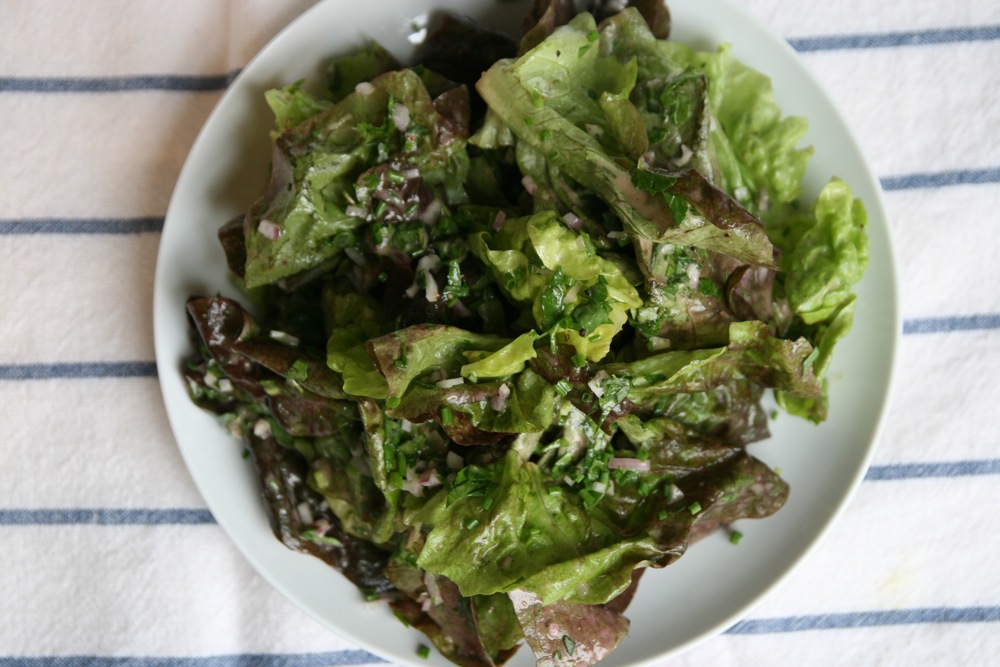

I've been thinking about salad a lot lately, which is strange, because how inspiring can a salad really be? The salads I grew up with were made of lettuce with a bunch of chopped vegetables--carrots, mushrooms, peppers, whatever--doused with a dressing from the fridge door. Everyone put their favorite dressing on, and that worked pretty well. It was the typical "your-choice-of-dressing" side salad, and it was just a way to sneak in some vegetables next to the main event.
But in a French bistro setting, a salad is carefully balanced, based around a good vinaigrette and an opportunity for greatness. There is nothing more required than fresh lettuce and a perfect sauce. Elin and I splurged on a meal at Thomas Keller's restaurant Bouchon this summer when we were in California, and we both ordered the bibb lettuce salad, which is tossed with minced fresh herbs and shallots and the house vinaigrette. The lettuce was rich and glistening, tart and refreshing, and the dressing clung to the leaves with this almost milky quality to it. This humble salad is among the dishes we most vividly remember from that fantastic meal. Can you imagine, dreaming about a salad?
A vinaigrette essentially means a combination of fat, acid, and salt--usually oil and vinegar standing in for fat and acid--vigorously mixed so that they emulsify into one. Mustard is a common addition because it aids in the emulsion process, gives the dressing a creamy quality, and tastes great. Made correctly, a vinaigrette wakes up your tongue and feels round in the mouth. It is rich yet bright. As Thomas Keller's Bouchon cookbook notes, "you might even call it the perfect sauce."
Hold on a minute. The "perfect sauce"? Not hollandaise or mayonnaise or beurre noisette? There are people who devote their lives to sauce--sauciers--who are often considered the most talented cooks in the kitchen, the person Michael Ruhlman calls "the magician and sorcerer" in his book Elements of Cooking. Could it be that the perfect expression of their art lies in a salad dressing?
When we got home, I dug up my Bouchon cookbook and found the recipe, and have been making the recipe for vinaigrette since. It's quickly become a staple in my fridge. What I love about it is its room for invention: the base recipe is just oil, vinegar, and Dijon mustard, which is actually mixed in a blender so that it turns into an incredibly creamy concoction that looks like a sauce. Using the blender chops up all the fat particles so that they bond with the vinegar particles (which is basically what an emulsion is, defying the traditionally wary oil-and-water relationship), but does it so thoroughly that it stays as an emulsion for weeks in the fridge. Because there is nothing else in the recipe that could spoil--herbs, garlic, lemon juice, etc.--you literally can keep it for weeks and use it as you go. Then you can simply spoon it out and mix it with whatever seasonings you like on the spot.
Bottled salad dressings may be one of the worst deals in the grocery store. They tend to be overly processed, gummy, expensive, and a fraction as tasty as what can be made easily at home with a few pantry ingredients. I learned early on when I started cooking that olive oil, red wine vinegar, a clove a garlic, a sprinkle of basil, and a touch of Dijon mustard blew every bottled "Italian" dressing out of the water. From there, you can just improvise: a sprinkle of grated Parmesan instead of the mustard became a favorite, sort of a riff on Caesar, especially with mushrooms. For a real Caesar, add an egg yolk, and some minced anchovy, minus the basil. A good salad is built from good vinaigrette, bottom line, which was a revelation to me.
Making this recipe results in a creamy sauce that lives without degrading for a couple weeks in the fridge. Instant salad dressing, conveniently available when you need it. Isn't that the appeal of the bottled stuff?
Basic Vinaigrette
- 1/4 cup Dijon mustard
- 1/2 cup red wine vinegar
- 1 1/2 cups canola oil
This makes a large amount of vinaigrette (about 2 1/2 cups), but it keeps. The process is foolproof: combine the mustard and vinegar in a blender and blend at medium for 15 seconds to combine. With the blender going, add in 1/2 cup of the oil in a slow stream, making sure not to add it too quickly to keep the vinaigrette creamy. It should now have developed a wonderful emulsion.
Next, transfer it to a bowl and whisk in the remaining oil, which should be absorbed easily now that the emulsion is started. It can now be refrigerated for up to 2 weeks.
Bibb Lettuce Salad
-serves 4-
Adapted from Bouchon
- 1/2 cup Basic vinaigrette
- 4 heads Bibb lettuce, or enough lettuce for 4 of another type such as red leaf
- 2 tablespoons minced shallots
- 2 tablespoons minced chives
- 1/4 cup parsley leaves
- 1/4 cup tarragon leaves
- 1/4 cup chervil leaves (tough to find, optional)
- 1 tablespoon lemon juice
- salt and pepper to taste
If using bibb lettuce, carefully core each head and loosen the leaves from each other but keep the structure of the head intact, which will be reassembled on the plate. Or, gently tear the leaves of another lettuce into bite-sized pieces. Plunge the lettuce in cold water to clean it, then gently spin in a salad spinner until very dry.
Transfer the lettuce to a large mixing bowl and season with salt and freshly ground black pepper. Scatter the herbs and shallot and drizzle the vinaigrette and lemon juice over everything. Toss it gently by hand to dress, and serve.


{ 5 trackbacks }
{ 15 comments… read them below or add one }
Nice looking knife, what kind is that?
I am very frustrated with the bottled salad dressings as I don’t know how to use it correctly. This basic vinaigrette opens up a new way for me to make salads. Thank you very much, Blake!
That’s the 8″ MAC knife I believe. I have the same one and it’s awesome. Really, really, really sharp right out of the box, and it’s held its edge very well.
Brad + RP: Yup, that’s the 8.5″ MAC chef’s knife. It is a superb knife–incredibly sharp, strong, easy in the hand. I couldn’t recommend it more. It’s so sharp that I managed to slice off the tip of my finger in my first week of ownership while lazily slicing through leeks. Amazon link.
Haiyan: Well, bottled dressing seem pretty foolproof to me, but glad I could help!
While I love Thomas Keller I have always been confounded by his use of canola oil in just about everything. I was especially surprised when I read his basic vinaigrette used canola instead of olive oil. This is a case where I’ll be close minded and I will never make vinaigrette with olive oil.
On the topic if it’s the perfect sauce, I would agree completely if your basic vinaigrette included one ingredient. Salt. The other day I was reading about the fundamentals of taste and flavor enhancement. The main ones I got were salt, fat and an acid. Adding these items to many foods doesn’t just add their own taste but gives enhancement to whatever is already there. As I was thinking about these three things it struck me that my vinaigrette is the most basic thing I know that combines those three items. It takes a slightly bitter lettuce leaf and transforms it into something you’ll dream about. So I really think you’re vinaigrette should at least have a pinch of salt to truly be complete.
This theme carries on to a lot of other things. Especially in a lot of Asian foods. Sushi is the best example I can think of with vinaigered rice, soy sauce and oily fish.
Scratch that. I’ll never make vinaigrette with canola oil. I will always make it with olive oil.
Gael: That’s an interesting point. I think that Keller likes canola oil for its neutrality. If you made this vinaigrette with olive oil, the outcome could be drastically different depending on the kind of olive oil used: it could be sharp and spicy or round and fruity or a number of things. By using canola oil, the quality of the vinegar and the complexity of the mustard play a role front and center. And the ingredients in the salad are not overshadowed. In many salads, olive oil would be great, but not all. Keller is looking for a clean taste.
That said, what I’ve done a couple times is make the base vinaigrette with canola oil in the first blender step, then keep that in the fridge. Olive oil can be whisked in as needed to complete the recipe.
As for salt, the vinaigrette lacks salt so that it can be added as needed, in the case of the bibb salad it’s just sprinkled on top. Keller is so perfectionist that he’d leave it out of the basic vinaigrette so each ensuing preparation could be seasoned correctly. But yeah, I love that ideal combination of salt, fat, and acid. Acidity is an under-looked seasoning agent, which I wrote about on this site awhile back.
The canola oil is an interesting call, as Gael points out, but I do see Keller’s point. Regarding salad dressing being “the perfect sauce,” I could really see this being drizzled over roasted or steamed vegetables.
I guess it’s a difference in points of view then. I consider the dressing itself a seasoning. I taste the dressing before adding it to salad to make sure there is a proper balance to the salt and acid. I believe it is salt that brings out the complexity of the vinegar by toning down the acid taste. So the salt should be added as needed to the amount of acid you have, not the amount of lettuce. Then I consider the amount of dressing to the amount of lettuce I have.
In my experience canola has always had a fishy taste which is why I was so surprised. I did some research and some people are genetically predisposed to find that taste in canola oil. That being said I pick olive oil precisely because it has taste, not for a lack thereof. While you argue that olive oil is not fit for all salads I can hardly see how red wine vinegar and mustard are whereas olive oil is just for certain salads. Why not pick just white vinegar for the basic dressing and add red wine vinegar as needed? I mean I honestly can’t think of a salad where olive oil would not work if red wine vinegar and mustard are needed. I can however think of salads where changing the vinegar to balsamic or lemon is necessary.
Just one thing to add. A good way to add a garlic taste to your salad without overpowering everything is by rubbing the inside of a salad bowl with a crushed garlic clove before you toss the salad. Especially nice when making a salad to serve with meat.
Good recipe. For the dressing, I added some honey to take the edge off the vinegar. I’m actually a fan of using mostly canola oil. When I use all olive oil, it sometimes has a bit too much extra flavor for me.
Thanks for the recipe!
Thank you so much for this recipe!! gonna try it this weekend
I have been doing this basic salad dressing for years, not with Canola oil but with cold-pressed grape seed oil. It has a clean taste.
My most simple dressing upgrade everybody likes : basic dressing+a few drops of balsamic vinegar+ crushed shallots.
Recently I found a recipe for a fall salad that involved a vinagrette made from oil, dijon mustard, maple syrup, pepper and chopped shallots. I now make the dressing almost daily. It makes me super excited for my daily salad lunch! Can’t wait to try your recipe as well!
@Gael
Apparently sticking olive oil in the blender can create some really strange bitter flavors, depending on the variety. I’d assume that’s why he went for canola.