

Can Pesto Be Improved?
Not all pesto is created the same.
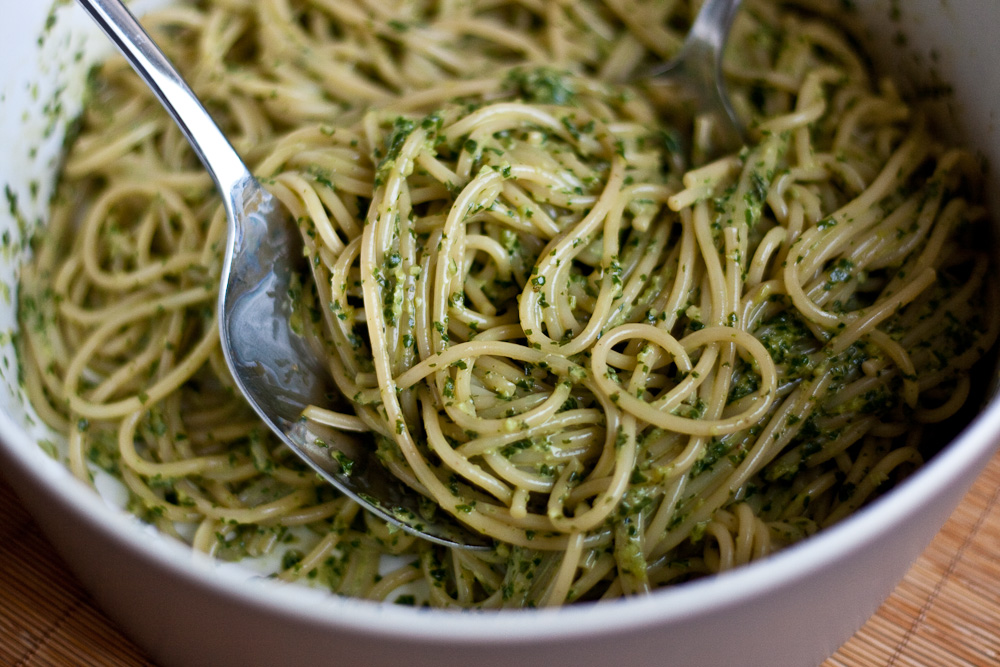
I've been eating pesto with pasta since I knew how to boil water. That dense, fragrant, herb-y concentrate tossed with hot noodles -- it's magic. Even when I had no idea how to cook and bought pesto in a jar, it was wonderful and my favorite dinner. It provides that burst of freshness in the middle of February, and it's delicious enough that the flavor stays in my brain for days.
The only problem I've ever had with pesto is a tendency for it to dry out. The oil in pesto sometimes separates and leeches out when tossed with the hot noodles, leaving a puddle in the bottom of the bowl . You end up with no cohesion: dry leaves clinging to the noodles, all that oil wasted on the bottom, no way to force them together.
This recipe changed the way I think about it. It didn't come from an Italian cookbook, but rather from the French, via Patricia Wells' The Provence Cookbook . The distinct and revolutionary twist was a simple egg yolk.
Though pesto resides in our imaginations as an Italian creation, the French also figured out that fresh basil could be mashed and pureed with oil to become a wonderful ingredient in cooking. Often known simply as basil sauce, but also by a similar name pistou , it usually doesn't have pine nuts or Parmesan cheese, and is a bit heavier on the garlic
But the Italians shouldn't feel resentful that the answer to perfect pesto came from the French. In fact, the very same technique is already in their repertoire.
All I could think about was a good authentic Pasta alla Carbonara . Traditional methods, rather than using cream to achieve creaminess, use a combination of pasta water and egg yolk to create an emulsion that clings to the noodles. Rather than curdling, the egg yolk simply turns things creamy, joining the fat in the dish (from whatever cured porky product was in there) with the water clinging to the pasta. Egg yolks are a powerful emulsifier that defy the tendency of water and oil to repel each other (which is what is happening when the oil leeches out of my pesto).
On a scientific level, the magic of carbonara is the same magic of a homemade mayonnaise, which is made by whisking oil a bit of acid, and water together with an egg yolk. Because of the emulsifying agents in the yolk, the oil joins the liquid in a (tangy, delicious) semi-solid form.
Applied to a pasta, the results are no less effective. In this dish, all that basil-infused oil in the pesto doesn't have a chance to get away; in the same way it is collected and emulsified into a sauce, joined together with another pasta technique, the addition of starchy pasta cooking water. The result is a kind of hybrid pesto and garlicky mayonnaise. You don't taste or notice the egg is there (you don't taste it in a mayonnaise, either), and it acts as a wonderful binding agent.
A creamy pesto -- perhaps even more magical than the original. Recipe after the jump.
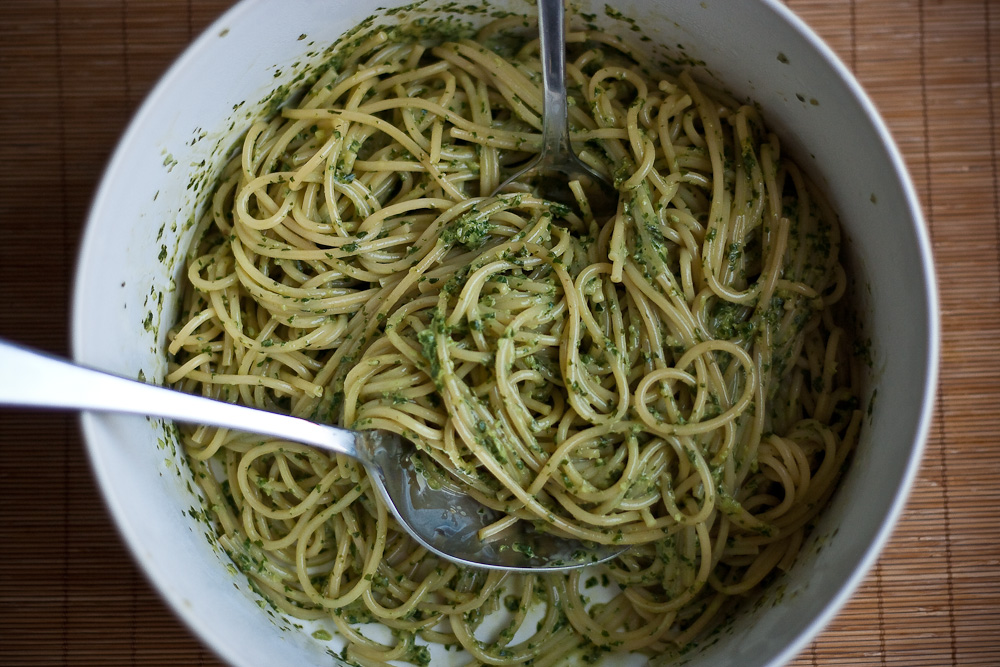
-serves 4-
- 6 cloves garlic, minced
- 1/8 teaspoon salt
- 4 cups loosely packed fresh basil leaves
- 6 tablespoons olive oil
- 2 egg yolks
- 1 pound spaghetti or other long pasta
- additional salt and pepper to taste
- freshly grated Parmesan
In a food processor (or, if you'd like to do it old-school, in a mortar and pestle) puree the garlic, salt, and basil until everything is chopped very finely. Add the egg yolks and pulse a few times to combine, then add the oil little-by-little with the machine on (use the feed tube on the top) everything comes together into a thick sauce. Turn the sauce out into a serving bowl.
In the meantime, bring a large pot of salty water to boil and cook the pasta until al dente. Reserve a good cup or so of the pasta cooking water and drain the noodles. Add them to the serving bowl and toss immediately to coat. Add pasta water as needed, little by little and tossing, to achieve a creamy texture. Season to taste with salt and pepper.
Serve immediately with grated Parmesan.
Food, Vegetarian, Main Course, Basil, Carbonara, Condiments, Eggs, Food and drink, French cuisine, Italian, Italian, Italian cuisine, Italian language, oil, Pasta, Pasta, Pesto, Pesto, Pistou, Sauces, Spaghetti, Staple foods, Vegetables
Comments:
Blog Comments powered by Disqus.