
As we realized on our last post, it was time to stop talking emphatically about the cultural significance of cider, and start getting to the business of making it. Though we had read more websites, emails, and books than we could know what to do with, we were still confused, and more importantly, l didn't have a solid recipe. It was beginning to be a problem.
At its simplest, hard apple cider is pressed and strained apples that are left to sit around until residual yeast on the apples' skin turns the sugar into alcohol. That's the traditional way to do it, how it was done for a long time. But today, most people prefer to use packaged yeast: this ensures that the cider will taste right, rather than being subject to a wild yeast, and it is the only way to succeed if the juice has been pastuerized, which is usually the case unless you press your own apples.
The appeal of hard cider is enormous: all that's needed is apple cider, some yeast, and equipment to ferment it in. But the information available about each part of that process--the juice, the yeast, and technique--ranged from overly simplified to dorky and confusing. Finding good advice was proving difficult.
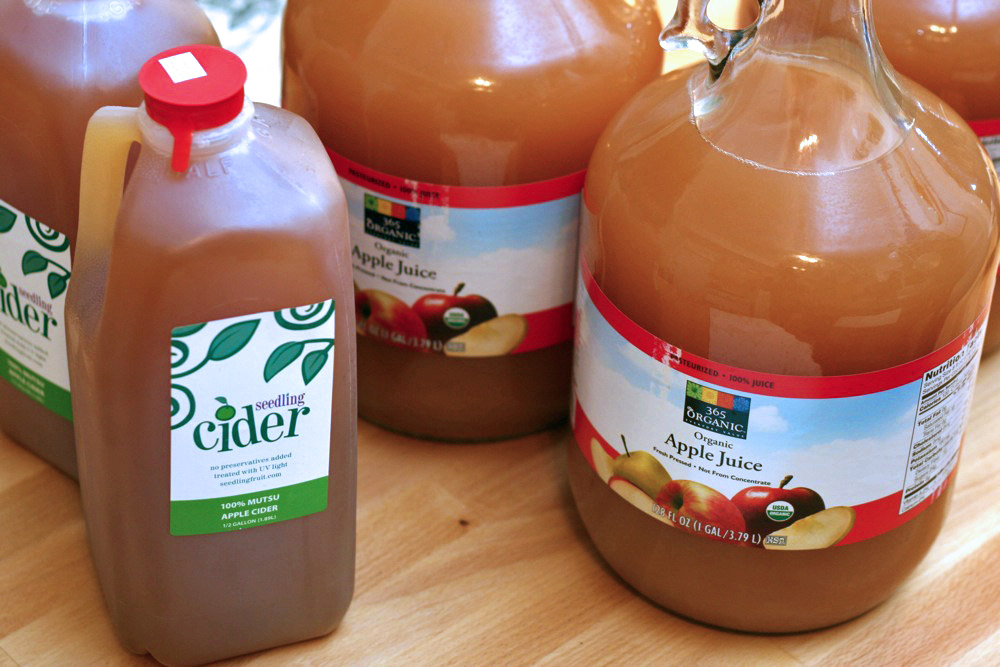
Our salvation came in two forms: first, the fact that Whole Foods Market carries 1-gallon glass jugs of apple juice, for $6.99, which would suddenly supply us with both the container and the juice to begin our adventure. And two, a confidence-boosting e-mail from a reader named Michael, who noted my tweet about using champagne yeast to ferment some cider, and who explained the process clearly via email.
And so we gathered four glass jugs, two kinds of yeast and juice, and some rubber stopper airlocks from the local Brew & Grow store near Bucktown. Our adventure would begin.
The Juice
Our juice decision once we'd found the Whole Foods jugs was easy: we'd experiment with that juice, knowing that a failure wouldn't waste much cash. But we also wanted to try some local, delicious cider from a farmers' market to see how it would differ. Seedling Cider is sold throughout Chicago, and is richly flavorful. It is also pasteurized using a UV light system that doesn't require heating the juice, and thereby preserving as much fresh apple flavor as possible. We went with their Mutsu Apple cider, which tasted the best at the market.
The Yeast
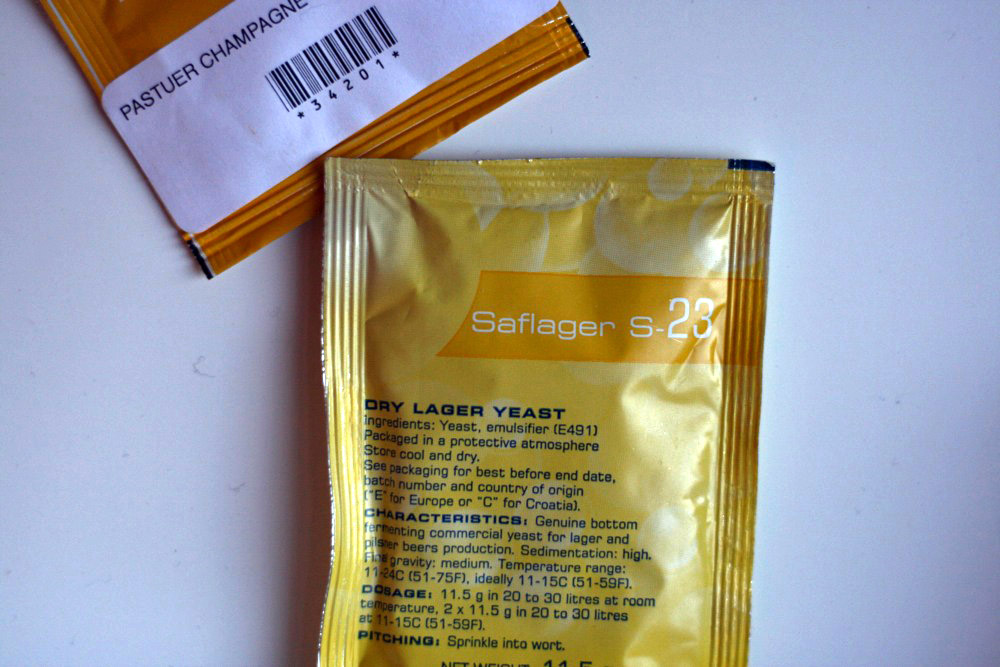
Most Internet sources suggest champagne yeast as the best option for cider-making, and that's what we first bought. Even the local brew store said it was the best. At that point, cider making seemed incredibly simple: toss in the cheap champagne yeast and off we go. But then a reader named Michael wrote us an email cautioning against champagne yeast. "I made my first two batches with Champagne yeast," he wrote, "thinking that this would help me create the crisp dry flavor I was looking for; instead I got a really high alcohol white wine essentially, that never carbonated, and is pretty unforgiving."
"Unforgiving" was not what we needed as amatuer cider makers. Michael went on to recommend ale yeast, which is (obviously) designed for beer-making. There are lots of suggestions at this page on Homebrewtalk.com about types of yeast to use with cider, most of which can be found in brew stores: Nottingham is a favorite, and Safale S-04 and Safale S-05 are mentioned.
But the overall jist was that using a beer yeast would give us a lot more flavor and would also be easier to work with.
The only mentioned beer yeast that our local shop had in stock was Saflager S-23, which is actually a lager yeast (Safale = ale; Saflager = lager). So we went with it.
The Equipment
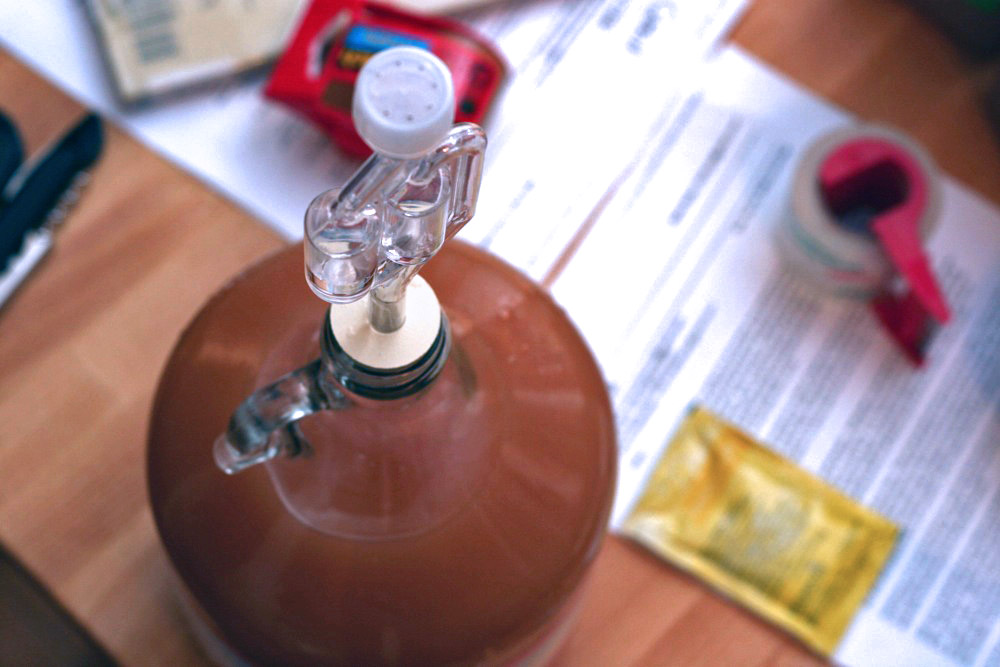
The only equipment for the fermentation is a jug to house the cider, plus a simple airlock which allows the gas produced by the yeast to escape, while also sealing off the container from outside microbes and bacteria going in. The airlock can be as jank as a balloon with a pinhole in it, or any brewing supply store carries the two-chamber airlock device we used, which costs less than a dollar.
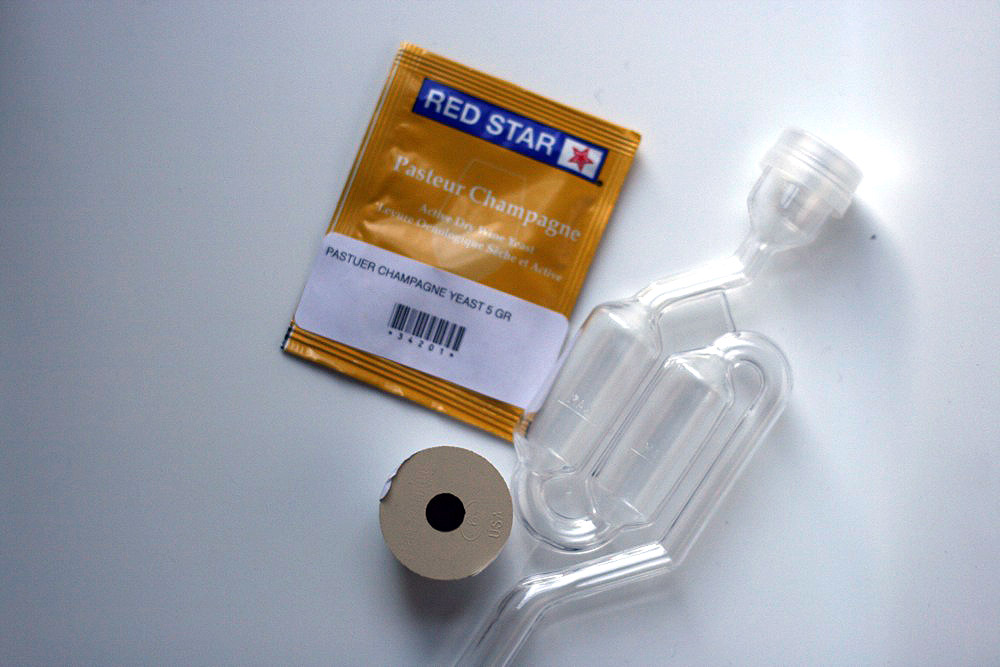
Where to house all that liquid isn't immediately obvious. We wanted to make multiple small batches, and most brewing supplies assume you want to produce 5 gallon batches of everything. The container must be food-safe plastic or, even better, glass. Though a jug of Carlo Rossi was discussed at some of our more desperate moments, with plans to dump it down the sink, we eventually found the Whole Foods 1 gallon glass jugs of apple juice, which meant we'd receive not only a good fermenting glass jug, but could use the very juice inside it for our initial experiments.
There are also tools to help you gauge the sugar levels, but we didn't have them, and it only gets more complicated from there. This is the point in time when our heads started expanding, and we stared out into space for about 5 minutes wondering what to do next.
Eh, forget it. We figured we should just get started. If the ciders failed, we'd loose all of 7 bucks.
The Batches
We decided to make four different batches. We'd have a super-simple control batch of Whole Foods juice plus champagne yeast, a similar version with added sugar to give the yeast more to munch on, then two batches with our fancier lager yeast with two different juices.
- 1. Whole Foods and champagne yeast.
- 2. Whole Foods Cider, 1/4 cup sugar, and champagne yeast.
- 3. Whole Foods Cider and lager yeast.
- 4. Market Cider and lager yeast.
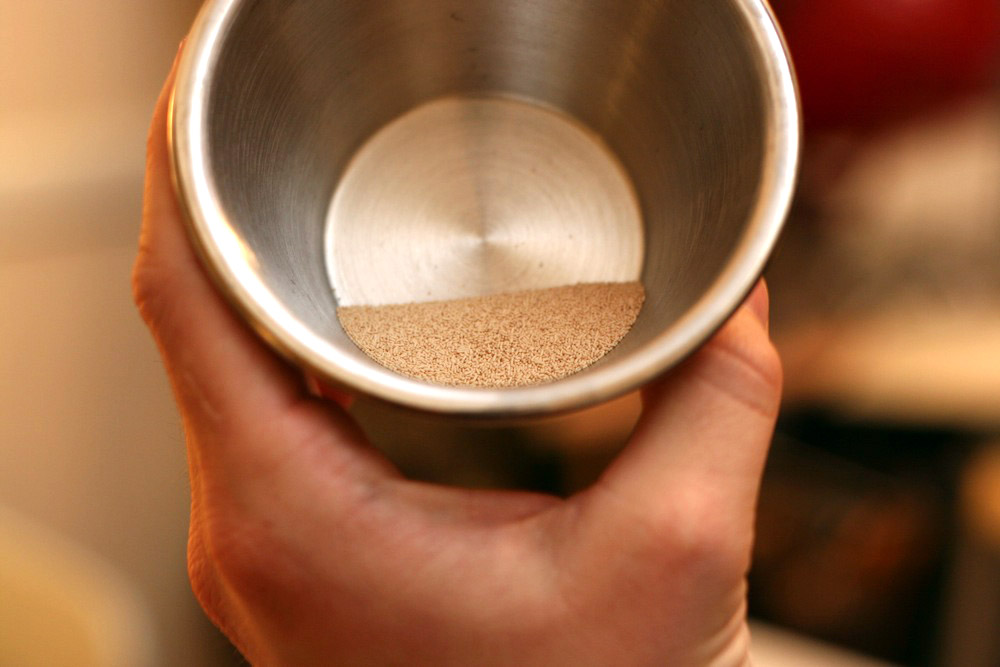
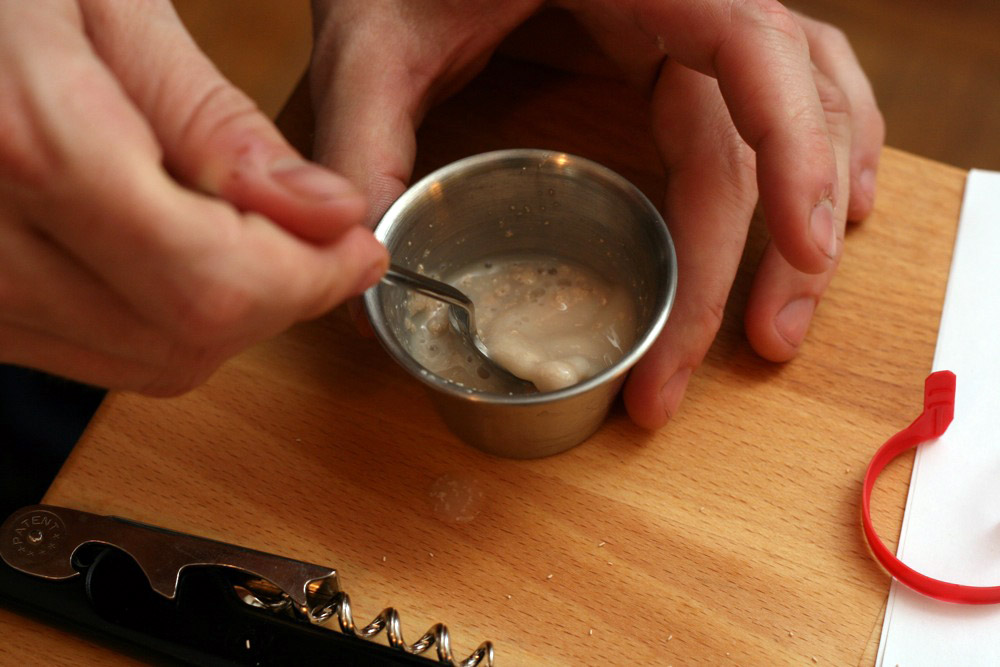
The process is about as easy as you can imagine. With the Whole Foods juices, we didn't even need to sanitize the bottle: just mix the yeast with a little warm water, then dump it in, put the cap back on, give it a gentle shake to distribute yeast. Though the exact amount of yeast to use is not a critical issue (the available sugars in the juice won't change, so what's available to eat doesn't change), most packets are measured for 5-gallon batches. We measured accordingly.
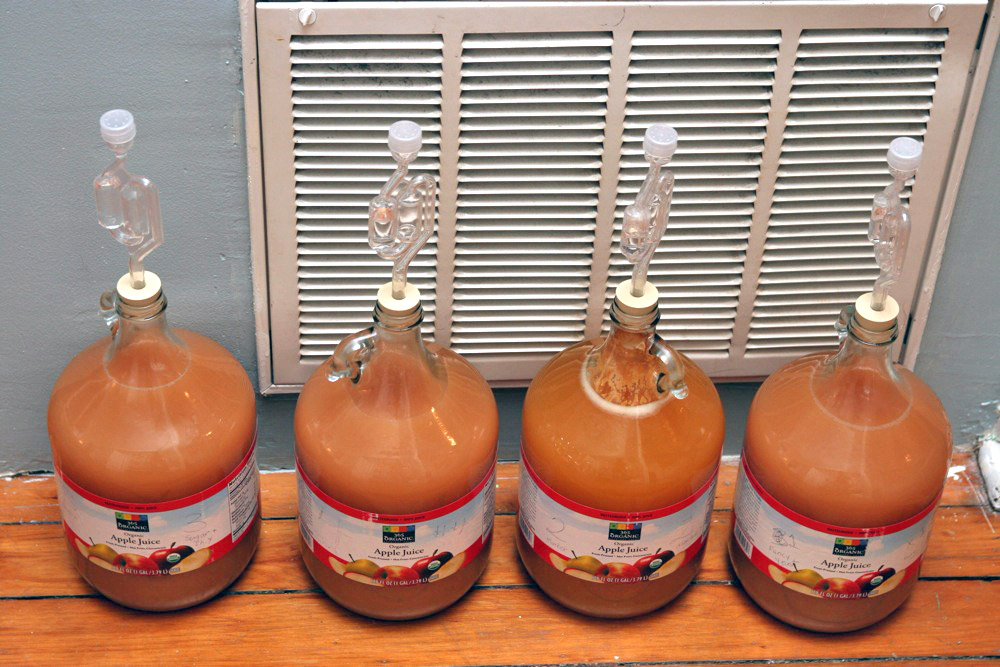
Then, we topped each bottle off with one of the airlocks (you pour a little water into the chambers, which essentially seals off the inside while allowing bubbles to escape). Any homebrewer store should sell them. The plastic parts fit into a rubber stopper which varies in size; in the case of the Whole foods jugs the #6 stopper fit well. The whole contraption is less than 2 dollars.
And, well, that's it. The lager yeast needed a little cooler temperature, so we stashed those in an exterior hallway, about 50 degrees or so. The champagne yeast ones are living in the closet, which is just slightly warmer. We have no idea when they will be done or what they will taste like. But we potentially have cider on the way. We'll keep you updated.


{ 4 trackbacks }
{ 25 comments… read them below or add one }
Great post—look forward to making some of my own.
I have to disagree with champagne yeast being unforgiving. It is extraordinarily forgiving which is why its recommended for beginners. You will always get a flat dry cider but that’s the point. Natural carbonation is tricky business with cider (and mead) and its a fine line between carbonated and explosion.
Those glass jugs are awesome. They make great fermenting vessels.
I also understand that pressing your own apples isn’t realistic for most folks but cider, hard or not, is not cider if its pasteurized. I’d like to try the UV kind but the heated kind just isn’t the same. I assume the heat would effect clarity as well – you end up with hazy hard cider.
A lot of people still make cider with wild yeasts. Patience is the key. Many people let it sit in the basement for 1-2yrs before drinking it. My father knows a guy who tossed a raw t-bone steak in with the cider and called it done with only the bone was left. I never saw it but that’s the story.
well? are you going to share the email from Michael? i want him to explain the process clearly to me, too!
I made hundreds of gallons of hard cider with champagne yeast in college. The only issue I ever had was expoding bottles when I over charged during bottling which was more of an operator error.
It’s been awhile since college, but I always measured the sugar content of the raw apple juice, and then adjusted the sugar to get the result I wanted (sweeter vs. dryer).
I discovered that the apple variety and fermentation speed seemed to have the biggest impact on end result. Since I was too poor to use heating or air conditioning, the fermentation took place at ambient temperature, and I found the longer fermentations during the cold winter had better results.
To follow-up on the comment I made in your last cider post, I’m also underway (albeit with a 5 gallon batch). After hours of searching, the batch that’s bubbling away in my parents basement contains the following:
5 gallons of local uv’d cider
5 cups of white sugar
5 cups of brown sugar
2 1/2 lemons, juiced
Champagne yeast – Lalvin EC 1118
One of the things I’ve been told about using Champagne yeast is that it’s far more tolerant of fast fermentation which cider tends to yield. I also read of many recipes using ale yeast… maybe next year.
We used Campden tablets to ensure there was no bacteria prior to getting underway, a compromise from not using heat pasteurized cider. Lemon was suggested to help with not allowing the cider to brown further, and then to finish with pectin enzyme to help clarify.
Wish you guys were closer so we could throw a cider party and compare notes.
I started two of the Whole Foods jugs, both with champagne yeast. One has 1/4 cup sugar. I don’t know how to tell when it’s done so I hope your cider finishes before mine.
I love hard cider. My family has been in the cider/homemade wine making business for as long as I remember, but we don’t sell it, we just drink it! Last fall my cousin, my grandfather, and myself pressed 18 bushels of apples from my grandfathers orchards. We used a hand crank apple press for the entire thing. Talk about a shoulder and arm work out……. We pressed 54 gallons of fresh apple cider. Of course we took a couple gallons home for consumption, but we put the rest in a 50 gallon white oak whiskey barrell along with 50 lbs of sugar and 2 packages of yeast. The result was a beautiful not semi dry apple cider that was a huge hit among the family.
If you like this I encourage y ou to also try some homemade wines. I just finished three 5 gallon batches of Blackberry, Plum, and Grape wine. Fantastic!
I’m interested to see how the fermentation proceeds with the small amount of headspace available in those WF jugs. I hope it proceeds well, as you said, that’s a super simple system! But, my concern stems from home beer making where it is a good idea to leave a bit of room between the liquid level and the top of the fermenting vessel to allow the krausen (i.e. the foam generated during fermenation) some room to expand and do its work (and eventually fall back into the liquid).
Additionally, a safety issue could arise from little headspace – if the krausen clogs the airlock and the airlock doesn’t blow-off properly, you may be introduced to the phenomenon most homebrewers know as “bottle bombs”, especially with the glass vessel. May be worth keeping an eye on the liquid parts of the airlock to see if you’re getting bits in there.
Interesting yeast take with the lager yeast – it generally produces a cleaner, crisper flavor than the ale yeasts in beers. Although if that is the only yeast a HB store had – I’d trade up!
On the subject of lager yeast….
I’m a homebrewer with many years of experience. Lager yeasts process sugars somewhat differently than ale yeasts. The major consequences of this is that they must ferment at a lower temperature (50 degrees is good, as you note) and they need a long fermentation to properly mature. Note that smelling like rotten eggs during fermentation is a characteristic of lager yeasts, and nothing to be alarmed about. Once initial fermentation has ceased, a lager yeast needs at least 2 weeks to continue improving the flavor of a beer (cider will be the same), 4 weeks is preferable.
What about that initial fermentation? It should be pretty fast as the simple sorts of sugars in juice (fructose) are more easy for yeast to eat than complex ones in would-be-beer (maltose). 10 days at most is my guess for chamagne, 14 days at most for the lager yeast. The way to tell is by seeing whether the airlock has stopped bubbling. “Stopped” does not mean “bubbling once every two minutes”–stopped means that after spending several minutes looking for a bubble on several occasions, you didn’t see one. Note that if you move the cider you will see bubbles, because carbon dioxide from fermentation is dissolved in the cider (it is very slightly carbonated) and shaking will cause it to release the CO2.
Finally, there will be yeast at the bottom of your jug. This yeast will cloud your cider and your guests will politely try “just a little” and then not drink any more because there’s some sick slime at the bottom of the jug. In large quantities, you can also taste the yeast, and it isn’t very good. To get rid of this effect, transfer the cider to a new, very clean glass container. To get the clearest possible transfer, refrigerate the cider for at least 24 (preferably 48) hours before you transfer it, then gently pour the cider from your fermenting jug to a new one. Refrigeration will cause the yeast to form a nice solid cake at the bottom of the jug, minimizing the amount the flows from one container to the other.
Yes, you can tell I’m a homebrewer because all this works seems perfectly reasonable to me.
Hi I’m the Michael mentioned in the article here, wanted to show up and note a few things.
@kasia: I think the guys have done a pretty good job of laying out the gist of my emails, but anything else they care to add they’re free to. I’d say mostly it was long winded and technical and their posts to a better job at laying out the process. Only addition I’d throw in is grab Nottingham yeast. Costs a buck and is fast.
@christopher; exactly, yes it produces a dry flat cider, and as noted, bottle bombs. If you’re a fan of either of those things, great. More power to you. I happen to be a fan of English Cider, semi-sweet, crisp, bubbly, and that was what Blake and co were after. I sent them in that direction. It’s all a matter of taste.
Hey There,
My wife and I are putting down 25 gal. of cider this week I am curouse if you all would look over my recipe and give me your thoughts. Last year we made 5 gal. of cider with champ. yeast and it was VERY dry even after significant back sweetening so we decided if we were going to make a large batch we wanted it to be more fmaily frienly (as in you could sit down and drink a few bottle with out getting totally wasted and getting heart burn). Last year s product we called “apple flavored rocket fuel”. We would like to stay terrestrial this time though still maintain about a 8-10% alc. content since we are making such a large batch and maybe turn SOME into apple jack. So here is this year’s recipe, I would LOVE to get your thoughts.
25 gal. Musselmans Cider
10 Lb Dark Brown Sugar
5 Lb. Corn Sugar
5-10 Cinnamon Sticks
5 packets S-04
Planning to ferment for 1 month, rack and put in secondary for clarification for 1 mo., bottle and let age for 1 day- 365 days. Thoughts???
Great post!! I’m asctually planning on trying it this week. I made a three gallon batch of cider once using champagne yeast, and I have to agree with Michael. Can’t wait to hear more about how they turn out!
what is the difference in yeasts? i have made “moonshine” or corn whiskey with just simple bakers yeast from marsh for about 3 years and no problems. could this also be used? tends to make a very strong yet very flavorful spirit.
“what is the difference in yeasts? i have made “moonshine” or corn whiskey with just simple bakers yeast from marsh for about 3 years and no problems. could this also be used? tends to make a very strong yet very flavorful spirit.”
There are three major species of yeast that are used in fermented beverages: lager yeast, “ale” yeast, and wild yeast (they all have scientific names, but their not important here.)
Lager yeast is the variety that makes familiar “macro” brews as well as the quality lager beers like Pilsner Urquell; it is also called “bottom fermenting” yeast because it does not rise to the top of the liquid during fermentation. It ferments at a colder temperature than ale yeast. Flavor-wise, lager yeast produce a beverage that is called cleaner or crisper than ale yeast: less of the flavor of lager beer comes from fermentation by-products than in ales.
Ale yeast is the variety that makes nearly all American microbrews, imports from the United Kingdom, and non-lambic beers from Belgium. Ale yeast rise to the top during fermentation and are called “top fermenting.” They produce much more flavor than lager yeasts and may be have many characteristics of fruit when the final beverage is produced. Incidentally, “ale yeast” is a bad name (though that’s the literal translation of the scientific latin name): “ale yeast” is also responsible for the fermenation of most bread, wine, and spirits.
Wild yeasts ferment lambic style beers from belgium and sour-dough breads. They tend to produce unusual and strong flavors that are undesirable in most beers but are pretty good in fruit beers and bread, where they create the sourness.
I’m a clumsy amateur and I have a five gallon batch of cider going in my living room. I re-racked it a week into fermentation, then just today I re-racked it again; it’s been a month since I re-racked it the first time. I tasted it and it kinda reminds me of vinegar (sort of sour), although much more drinkable. It isn’t bad, just not really good, and actually it’s pretty bubbly. My recipe was six gallons of store-bought juice (like the whole foods juice in this article) a pound of honey, and a cider yeast from the brew shop. I didn’t heat up the juice, but I did heat the honey for about twenty minutes prior to pitching it all together. The temp in the living room fluctuates throughout the day from 50 to 80 degrees. What is the value of sourness, or of high acidity, attributed to in the fermentation process?
More of a home-brewer myself, but I’ve gone through a gallon or two of home-made cider. I fermented for about 2 weeks, charged by adding more unfermented cider to taste, and bottled.
Came out at the end with something that more resembles a very dry apple champagne. However, if you add some apple juice/cider (whatever is handy) to it, it is really quite fantastic.
So, you used the Whole Foods juice as is? Didn’t pasteurize it or anything?
@Harrison Kroeker
That is almost identical to the recipe I started my first batch of cider with. Left in the primary for 2 weeks, (SG was taken down to 1.000 in about 4-5 days), then racked to secondary where it stayed for about a month-and-a-half. Very little sediment and it cleared on it’s own in about a week. At bottling I decided to split the batch. Half of the batch I did sparkling, so I backsweetened with a small amount of lactose (which is an unfermentable sugar), then added a single can of Old Orchard apple/cherry juice concentrate to add back a little apple and some cherry flavor, and to restart fermentation in the bottles to do carbonation. Abv was 8.5% at bottling, so it’s got a kick.
When I bottled the first half, I added potassium metabisulfite and potassium sorbate to the other half of the batch to kill the yeast off, and then I sweetened that to taste with about 3 cans of the juice concentrate. So it’s a bit sweeter, and a still cider rather than sparkling (although if I had a draft system I would have probably carbonated that one too).
So I have nice x-mas gifts for everyone, a four-pack of cider (2 sparkling, 2 still) and a bottle of blackberry mead (also my first attempt…just started getting into the brewing world this year.). The cider I’ve been sampling as it’s been done for a while now (about 3 months old total) and it is delicious, although when you do a secondary fermentation for carbonation you end up with yeast sediment in the bottles and you can’t really avoid a slight yeasty flavor if you drink it right out of the bottle. I’m about to crack open a sample of my blackberry mead (only at the 5 month mark, but I’ve got so much of it, it wouldn’t hurt to see how it’s coming along).
I started some sourdough starter for baking about a year ago… it makes alcohol from the flour as part of its process. Has anyone had any experience with the yeast(s) from sourdough starter in apple cider?
do i necessarily need to use yeast? i made 8 gallons of hard cider without the yeast, three days later it was working. and has bein bubbling great ever since. thanks , terry
@terry
Yeast is what causes fermentation. There has to be yeast somewhere in order for fermentation to occur. If you started with fresh, homemade cider that’s never been pasteurized, then I can imagine that wild yeasts would take care of the job (this is how wine works.) However, if you started with pasteurized, packaged cider from the store, it shouldn’t spontaneously start fermenting. That would create explosive glass jugs in the grocery store.
Interesting comments! I started a batch using Honey Crisp apples for the base stock. Pressed 24 gallons about a month ago and it is still working in the cellar at about 60 degrees. The biggest mistake I made was filling my 4 x 6 gallon carboys and did they ever produce a creamy green substance in the air locks. About two weeks ago, I started adding brown sugar to each to keep the fermentation going and to sweeten the cider a bit. I purchased another carboy to rack off the cider to try to make it more “clear”. We have lots of honey here –should we add that? More brown sugar — (there is about one p0und in each carboy now)? We would like it to have a “kick” and I had failed to take a hydrometer reading prior to the air lock. The other day, we were at 1.000. This is a bit different then making of wine but similar. First time for everything!
I would not use any more brown sugar; it will leave a molasses taste in the final product if you use too much. Stick with either honey, corn sugar or white sugar. Don’t be afraid of the bland sugars! If you want the flavor to come from the apples, you should use ingredients with neutral flavors to increase the alcohol.
wow sounds like all of yous are having as much as i am. i have good friends that have alot of apple trees and made a slew of cider, we got 12 litres. the first bottle was good untill 3 days later , even in the fridge it fizzed out very quickly out of the bottle and tasted strongly carbonated so i decided to research hard cider and make some. so far ive racked first 1.5 litres and tasted it and tasted like dry, sweet wine i guess since ive added maple syrup that i also make and hope it will finish well. i have 2 other brews goin on, with raw honey and other, maple syrup with wine yeast. i have a sauna to try to keep the temp up to 18-25C. i hope to experiment much more and become very involved, maybe wine soon…..