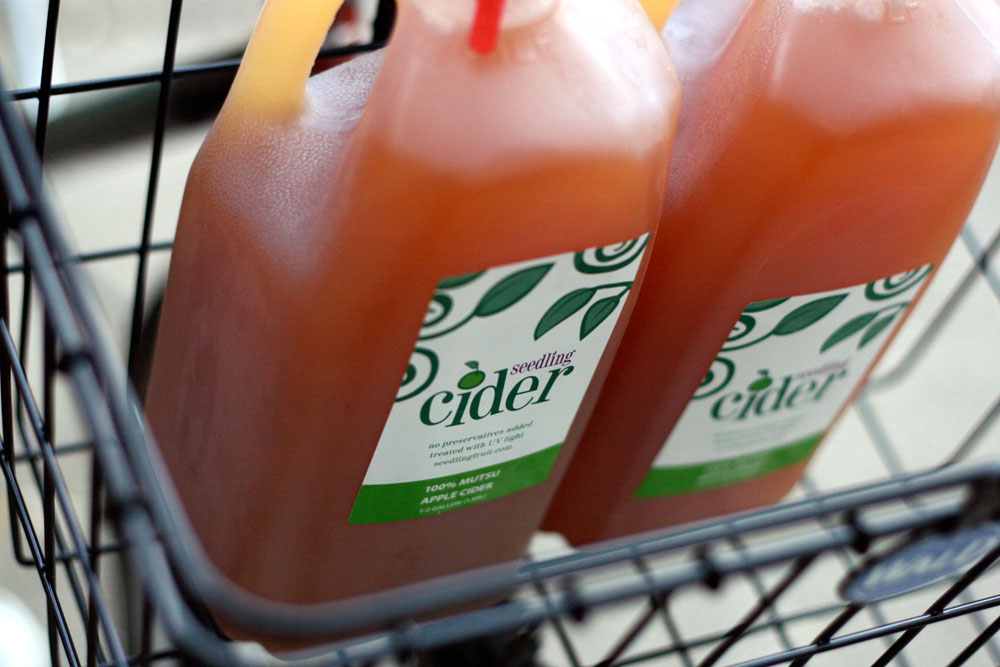

Currently Blake and I have four gallons of apple cider fermenting in the back of his bedroom closet. The hope is that in a few days, thanks to some hungry yeast, we'll have something that might resemble hard apple cider. We're honestly nervous. We've undertaken ridiculous experiments before, but nothing that could potentially get us hammered. If it works, then we'll have made an alcoholic drink for less than it costs to buy a jug of Carlo Rossi. If it doesn't work then, well, we've got a lot of stank apple juice on our hands.
I suppose the first question to ask is "why cider?" It's one that has consumed Blake and I for a few weeks now. It started this fall when Blake was in Michigan, and ended up buying a bushel of apples for ten dollars. A bushel. Which, if you're not familiar, is more than 100 apples. They weren't excellent eating apples, and you can only make so many apple crisps. So we thought, why not make hard cider?
Of course, the turning of apples into juice is not the easiest process in the world: you need a fruit press or a juicer or some other specialized equipment which didn't exactly fit in our Chicago apartments. But we were still intrigued with making hard cider. So in the end, we ended up giving away lots of apples and opting to just buy apple cider to begin with.
What utterly fascinated us was that cider could be made quickly, easily, and cheaply from local ingredients. This same fact has also explained why we've never attempted to make our own wine or beer. About the most exotic ingredient we'll need is yeast, which we purchased from a local home-brewing supply store. Unlike beer, we can buy the main ingredient from the local farmers' market. That's really appealing.
There is also the fascinating history of cider, one that far more extensive than we ever realized. If you're interested in the wild history of cider in America, this article from Slate is a great place to start. In the article, author Brian Palmer uncovers this American drink. Cider was so commonplace in early American history, William Henry Harrison used a cider barrel, along with a log cabin, as his campaign logo in 1840. He won in a landslide. It was the every-man's drink. Farmers' could easily make it in their cellars and store it for months. It was, for a time, far more popular than beer. Cider became a quintessential American drink.
Cider's popularity was increased by a man named John Chapman--otherwise known as Johnny Appleseed--who collected seeds from local cider mills and spread them across the country. These apples were not particularly good for eating, but made very drinkable cider. So Johnny Appleseed's true mission was to plant orchards not for eating, but for cider-making. Again, we've stumbled on something quintessentially American.
The romanticizing of cider, though, flies in the face of one appalling fact that has kept me away from the drink for years: Most of the cider I've had is awful. It's usually overly sweet, fizzy, and cloying. After a few bottles, my stomach churns and my tastes buds feel assaulted. I beg for the dry sip of lager or ale afterward.
But I also remember some glorious pints in England, served in big sturdy glasses, that were utterly refreshingly, fairly dry, with just a hint of carbonation to enliven each sip. I've also had some luck with some bottles from Northern France that I purchased from my local wine shop Red & White.
For the past few weeks we've both been reading books and articles, searching online forums, and e-mailing people in the know, hoping to discern any secrets we could before we decided to make it. In the process, our heads began to swell with so much information, and so many different opinions, that we almost gave up in desperation. Making cider became serious and studious. How could farmers a hundred years ago deal with all this confusion?
Finally, we realized that It'd be best if we just started. We'd read enough and talked about it long enough. Just like our kimchi challenge, we realized that the best way to learn was to try. If we failed, we'd hopefully learn something along the way.
We're going to have a more technical explanation of our process next week, which hopefully details our successful alcoholic potion and not some acrid swill. If you've ever attempted to make cider at home, we'd love your comments and help. The jugs are currently under a blanket in Blake's apartment.
For those really interested in the history of cider, check out The American Cider Book by Vrest Orton and Cider: Hard and Sweet by Ben Watson.


{ 3 trackbacks }
{ 20 comments… read them below or add one }
My husband has made hard cider many times in the past. We couldn’t believe how easy it was. Pour cider into container, add yeast, and ferment.
The cider always comes out dryer and less sweet than the common commercial varieties. We’ve added cranberry juice in the past to give it a little more flavor.
If only I knew how easy this was in my college years… I may not have graduated.
This is a great public service. I look forward to the results. I hope you’re trying ciders made from different apple varieties.
It’s alot like brewing, you can make is very straightforward and simple, or you can go nuts with all the options. I think going the simple route at first is best, the only thing to really look out for is your sanitization (much like brewing). During the time that you open up the apple juice, and all the way up to fermentation being complete you run the risk of infection (pretty much any bacteria or wild yeast out floating around that would love some free sugar from the juice to keep surviving).
I think you guys might also find that if the yeast ferments through well (ie it’s a healthy yeast, you’ve aerated a little bit for the yeast, and maybe added some yeast nutrient (not necessary most of the time)) then you’ll end up with a very dry cider which will taste more wine-like than cider. On the other hand however if the yeast poops out at the right moment than you’ll have a slightly sweet version. Your mileage may vary.
My main point would be to stick with it, most often the first time you make a cider, cyser, beer, mead etc etc it’s not going to come out tasting how you would want it to, so it’s important that you stick with the original process and perfect a good “base” cider (if you like it), and improve upon that version.
Also +1 to the comment on back sweetening the cider (thats the phrase most often used), because the sugers in cider are very well digested by your army of yeast it’s usually beneficial to add some sort of sweetener post-fermentation..but again your tastes will probably vary.
Good luck! Oh and I also owe you guys a tasting of my Robust Vanilla Porter..which came out fantastic by the way (and at 9% abv..well…one or two will get you by
love the carlo rossi reference; a definite step up from franzia!
You actually don’t even need store-bought yeast. As long as the cider doesn’t have preservatives — and it’s even easier if it isn’t pasteurized — you can just pop the cap off, cover it with a paper towel to keep bugs out, and wait. Wild yeasts are everywhere, and they will come and bless your cider with their magic. I make one to two gallons a week with this method. It’s literally the easiest thing in the world, and it’s delicious.
Oh, this is so exciting! I’ve been bugging my husband to let me make cider. If it is easy I bet I can convince him to buy me a carboy. (He’s worried it is to complicated and messy.) Can’t wait to see your results.
I used to work with someone who made his own wine, beer and ciders (including from pears), but I didn’t get a chance to learn myself.
I’ve enjoyed cider for a long time, and especially like the pear cider I got in France.
Good luck. Can’t wait to read about your results.
hi!
the girlfriend and i just served our cyser we’d aged for a little over year at our oktoberfest (to wait a whole year……that was hard;)) . it went over really well. and no, you don’t need to add yeast if you trust your apple source. not all windfall apples are safe if there are farm animals about. we initially added campden tablets to wipe out the wild yeast then added wine yeast. the result, after almost a year of bulk aging was, well, the driest thing i think i’ve ever drunk! after back sweetening with organic frozen apple concentrate, we definitely had a winner! i would suggest annie proulx’s Cider: Making, Using & Enjoying Sweet & Hard Cider, Third Edition. it has specifics for any type of cider/cyser you may want to attempt—and i greatly encourage all of you to go ahead! you can make just a gallon if you have concerns. the worst you’ll get is some homemade cider vinegar so it’s a win-win:)
I would agree, for the most part, that domestic ciders tend to be kinda “meh” tasting. However! Try JK’s Scrumpy out of Michigan. I know Whole Foods carries it, but I would think you could find it elsewhere, especially since you’re much closer to it’s source than I am in Seattle. My go-to for hard cider has always been just adding bourbon to good farmer’s market cider, but this stuff is seriously good – tastes like a boozy apple with a very complex flavor from being unfiltered and whatnot. They’ve also just released a spiced hard cider. Nom.
Your timing is downright ironic, my plan was to call my local orchards to find out what they’ve got left as far as their pressed cider is concerned this weekend. For some bizarre reason, I’ve not been able to stomach beer, and have taken to drinking hard cider as a replacement when wine or mixed drinks don’t fit the occasion or mood.
My parents have been making beer and wine for years now with phenomenal success. I’ve got great hope for my first batch of hard cider. I’m looking forward to seeing your results.
You need unpasteurized cider to start.
It’s got enzymes that allow for a much healthier fermentation, yielding a better brew.
Pasteurizing wipes out these enzymes.
Hey guys, good looks on the cider.
You said that it was chilling in the back of your closet, I really hope you moved your clothes or stuff out of there first.
I am thinking of when my Mom tried to make her own cider, and it ended up semi blowing up and covering our clothes with moldy apple juice.
I’ve done the hard cider thing back in college with a roommate. We lifted the apples from the dorm cafeteria over a few weeks and mashed them with a mallet and ziploc baggies in our kitchen. It was pain juicing them, but the cider actually turned out surprisingly good and we were a hit a parties when we showed up with a gallons of the stuff! Whole event got me into homebrewing beer and absolutely love it. It really is a simple process that can be kept that way or be made complex when you learn a little more!
I find that the various homebrews, from beer to wine and cider, benefit from stillness. Stir them up too much and they will get cloudy and nasty tasting. Manage to get a glass poured crystal clear, if all else went well a refreshing drink will be there.
After years of homebrewing, my wife and I decided to try this exact experiment. We used 3 gallons of generic Whole Foods brand apple cider and a vial of liquid English ale yeast. I agree with the above comments, ours also turned out extremely dry. The hydrometer indicated it had completely fermented — no sugar left — and was about 6.5% ABV. 1 container of frozen apple juice concentrate later, and we had a very tasty beverage. It was lacking some depth, but not bad for the price and effort.
As has been mentioned, cidermaking shares a few things with winemaking (which I’ve done a bunch of). Sanitize your utensils (an easy product is called One Step – so you don’t need to use sulfites). If you wait until all the sugar is fermented out, you’ll have a dry, rather than sweet product. A hydrometer is cheap and makes it lots simpler to measure that. An air lock (also available where you got the yeast) is cheap and will prevent explosions. Finally, if you rack the cider a few times during the waiting (fermenting) period (siphon it off the sediment) it will be clear.
In McCullough’s biography of John Adams he noted Adams drank a large glass of hard cider for breakfast practically every day of his life.
Cider! or should I call it ‘Scrumpy’? I drank that with my mother’s milk. Wonderfull stuff! You have to drink it from a china pot, it etches glass. To make real ‘Scrump’ chop your unwashed apples and put into the press in layers with fairly clean straw. Leave for a few days to get a few rats into the cheese -they give it ‘body’- and then press. put into a frementing vat and when it seething chuck in a whole dead chicken (or two). let it clear and then store in wooden casks -it eats stainless steel- . Drink but remember whislt your mind is as clear as bell your motor-neurone system will have ‘left the building’. I never drink it untill I know that my bicycle knows its own way home!
Good luck! I want to try this myself, but fear the fermentation I’d create will be poisonous. Hope yours work out.
Here is a link to a home brewing site that has loads of information about cider and German style apple wine. I make this wine myself and have had excellent results, the same process can be used for cider making.
http://www.homebrewtalk.com/f25/man-i-love-apfelwein-14860/