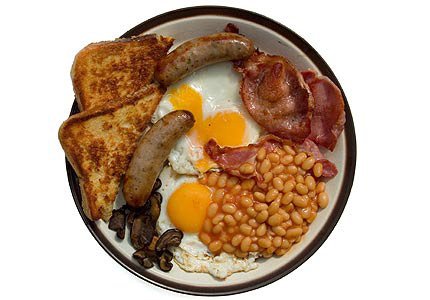

To eat well in England you should have breakfast three times a day.
- W. Somerset Maugham
I survived my half a year in England on a diet of boiled potatoes, canned peas, Heinz beans, and 99p egg and cress sandwiches I purchased from a convenient store. The dollar was nearly worthless next to the mighty pound at that time, and I hoarded what little cash I could for bus passes and the odd pint, relegating whatever was left to keeping me alive. Needless to say, I ate miserably.
Except during breakfast. While I could never afford a nice dinner, I could occasionally dig up a few pounds for a Full English breakfast. To get it right is to have a plate filled with bacon, sausage, eggs, beans, toast, mushrooms, and tomatoes. If I was lucky, I'd even get a nice cup of tea thrown in for free. After days of meagerly getting by on starches and canned vegetables, this meat-heavy plate was a godsend.
For better or worse, when I dream of food in England I dream of this. Great plates of simply prepared food, where the quantity seemed the most important component of all. I certainly didn't eat it every day, but when I needed it the most -especially after a night out on the town- that massive plate of fried goodness was there for me. And for that reason I'll always have some special place in my stomach for this embarrassment of fried wonder. That is why now, for some odd reason, I'm struck with a strange urge to make it all...from scratch.
See, while it may seem like I could just go out and purchase some sausages, bacon, and beans and be done with the craving, each one of those elements is different over there than it is here.
American bacon may be a wonderful thing, but it's also sweetened and smoked, unlike its English counterpart. Their sausages, lovingly referred to as bangers, are stuffed with breadcrumbs to give them a different texture. And the beans...well, I don't have any idea what those are. That means I'll need to stuff my own bangers, cure my own bacon, bake the right kind of bread for toast, and even find the English formula for baked beans. While I won't grow the tomatoes or forage for the mushrooms, I think this is still going to be a massive project.
It's only now that I realize the simple truth that a Full English breakfast makes no sense at all. There is no semblance of balance, no acid, no spice. About the only common component is that everything except the beans are fried, from the meat to the mushrooms, and even -if you listen to the purists- the toast. The lonely tomatoes are about the only acidic element on the plate.
My favorite foods are spicy and acidic. I'm much more comfortable dealing with Mexican, Indian, and Korean cuisine than I am dealing with a plate of food where the only color comes from fried tomatoes.
Yet, there is something itching in me that believes this could be the most delicious breakfast I've ever consumed. Can you imagine a meal where so many of the main components were lovingly prepared from scratch and then were combined together on the same plate?
Anyone else have fond memories of this meal or know some resources to help get me started?


{ 6 trackbacks }
{ 27 comments… read them below or add one }
The beans are usually Heinz vegetarian beans from a can.
This came up in a google search: http://www.balsonbutchers.com/
They appear to sell the proper kinds of meats, but I would never urge you to skip the home charcuterie. Perhaps if you needed a control group for your culinary experiment.
You’ll be looking for a loin (not tenderloin) cut to make proper back bacon. I think you could get away with doing a shoulder with the same cure and call it good. (yes, technically it’ll be cottage bacon but it’ll be cured like back bacon)
I think I saw a banger recipe in Ruhlman’s book.
Bread definitely needs to be fried. Lived in England for 11 months and whenever they tried to serve a fry up with toast instead of fried bread the difference was immediately noticable.
And there is nothing in the world better than a proper fry up after a good night out. I always told people that most british food was either way too expensive or crap, but the one thing they did right was anything that involved frying.
second to Laurie’s comment they are usually the Heinz 57 beans, but they are different from the ones available in the US. Usually served in a green can. To be authentic you will probably have to get ripped off at a store that sells imported versions of the Heinz product (similar to the difference in American versus British Cadbury chocolate).
How come you left out the Black pudding? This was always my favorite part.
For the sausages you could do a lot worse than the bangers & mash recipe in Heston Blumenthal’s “In search of perfection”. It’s kind of complicated, but I reckon you can tone it down to get a less involved sausage.
The bacon may or may not be smoked, but is usually back, it might take some butchery reading to find the right cut & cure as I’m sure some bits are lost in translation between English & American. A starting point is probably with Hugh Fearnley-Whittingstall and his amazing meat book. There is a streaky (belly bacon) recipe http://www.guardian.co.uk/lifeandstyle/2006/nov/11/recipes.pork that you might be able to adapt.
The bread really wants to be white and not great quality, fry it , that definately adds to the breakfast experience.
The usual baked bean is from Heinz, but if you do find a good make it yourself recipe let me know I’d love to try it.
One Last thing looking at your plate, that looks like a southern (probably London) breakfast due to the lack of black pudding.
http://en.wikipedia.org/wiki/Back_bacon
Mike’s right. Also not sure about England, but in Ireland the rashers are brined rather than dry cured.
And on the subject of bangers. After eating this a couple times a year (sent over by family) growing up I’d highly recommend trying to find a way to improve these. Even the hand made ones from a local butcher in Rathcoole were insanely bland and mushy. I do remember there being a similar sausage that was far better (might have been called brown sausage or just sausage as opposed to bangers). Very much the same seasonings; more pork meat and far less breadcrumbs and fat in the mix if I remember correctly. Most of my younger Irish friends and family seem to have switched these for the bangers in a full breakfast.
Hear, hear on Ryan’s “brown sausage” upgrade. And Iberg’s black pudding. That’s how the kitchen at Trinity College Oxford did it.
Two frying pans. One for eggs. One for everything else. You want it served hot. None of this keep warm in the oven business.
Heinz in the UK is an overpriced product. I buy bargain beans and stick ketchup in, you cannot tell the difference.
Peoples appreciation of the full English comes from greasy spoons, bed and breakfasts and quality hotels so the quality of the ingredients can vary wildly.
Paul
A while ago I made Pioneer Woman’s Boston Baked Beans (http://thepioneerwoman.com/cooking/2010/01/the-lost-reicpe-boston-baked-beans/), which she said approximated English beans. They’re very savory with just a touch of sweetness.
Sorry for the double post–what made the friend credible is that she just spent 3 months in England.
If you find a recipe for English baked beans, PLEASE post it. I’ve been looking for one forever. The Heinz ones are hard to find hear and I tend to find Boston Baked Beans too sweet. Every time I read about how to make an English breakfast, there’re always like “Open the can of beans…” Does nobody make beans in England? Or pasties! I have yet to find a good pasty recipe.
An English fry-up is one of my favorites. When Chelsea and I first started dating, we would go to Fado for their all-day Irish breakfast (It was much better back then). We’re so sentimental about it that we made this cheesy video http://vimeo.com/2796572. I never thought about the breaky not being balanced. I guess it’s one of those things whose job is to deliver an unctuous wave of comfort to the hungover hoardes. The lack of an acidic punch is made up for in variety–a little crisp toast that can be dipped in yolk, creamy beans, crispy bits of blood sausage, pate-like bangers. I will say though, when Chelsea and I prepare a fry-up at home we always accompany it with whatever jars of preserves we’ve got in the fridge–usually mango chutney or chili jam. Those sweet and spicy jams give the breakfast a nice jolt of sweet, spicy and hot and a little tang. Setting out to tackle this dish “a la carte” is definitely ambitious. It’s simple but each component should be skillfully crafted. The bangers are pretty unique and I know of only one place that supplies them on the south side. I’m sure you could recreate the texture by adding a fair amount of bread and milk to the sausage mix. The black pudding–you’ve already got that one covered! Of course, you’ll have to smoke the streaky bacon and the Irish bacon. God speed! Will volunteer for tasting duty.
I dunno about the English Fry-Up, But here’s a link to a Full Scottish Breakfast, made from scratch right here in Chicago.
http://saucissonmac.blogspot.com/2009/03/lorne-sausage-and-full-scottish.html
Cheers.
Years ago, my last day in London, I was looking for breakfast. Saw a McDonald’s, but – no- not on my last day! So I went to a little homestyle place and found myself eating questionable sausages, cold toast, and watered down eggs. Worst breakfast ever. Should have gone to Mac’s!
I make my own baked beans (more American style than British) and I’ve contemplated the changes it would take to make them more like the Heinz ones in Ireland/England.
Here’s my “normal” recipe:
http://www.recipezaar.com/guinness-and-jameson-baked-beans-392109
The British beans clearly have less sugar/molasses and a stronger tomato flavor, so adjusting those ratios would probably be a good start.
I need to buy a can or 2 of the Heinz beans to compare as it’s been a while since I had ‘em. Nearly all baked beans in the US are compared to Bush’s, which is REALLY heavy on the brown sugar (not that I don’t like that).
So, I’d probably increase the tomato paste, cut the sugar in half and see how they turn out.
See, I’d consider fried bread part of an Irish fry-up, as opposed to a British fry-up where you get toast. Although an Irish fry-up would also include a potato pancake. This is why I love this part of the world–they take their fried starches incredibly seriously.
Heinz Baked beans, which up until WW2 the cans contained pork as well as beans, and which were originally imported into England from Canada are just an industrialized version of American, or Boston baked beans.
You know you could make the challenge even more challenging by adding some other classic components of an English cooked breakfast, namely kippers AND bloaters (two kinds of cured then smoked herrings the differences between and the preparations of which people get pedantic about), devilled kidneys, bubble and squeak, and kedgeree? I’ll let you look the last two up if you don’t already know them.
Oh yes, you definitely need to have bubble and squeak.
My Watties baked beans (which are pretty much like English ones I think) have in them: navy beans, tomato purée, sugar, salt, modified maize starch (corn syrup?), maize starch, gums, spices, onion flavouring and liquid smoke. I’d be guessing not very much sugar at all by American standards, and very little smoke. You should be able to mix the sauce and taste it as you go – nothing in that, apart from the starch, requires cooking. Just mix until it tastes right, then thicken with a bit of starch and mix with cooked beans. I think you’d probably want to leave the mix together for a good while after that so the flavours all become homogeneous – preferably by canning and pressure cooking and leaving in the pantry for a month or two!
As far as bangers go, the bought ones are probably full of soy protein in addition to the breadcrumbs, and made with the scrappiest bit of pork trimmings. How authentic do you want to be?
I think the ideal sausage ratio is something like 80-85% meat with the remaining 15-20% being made of rusk and seasonings. Any less meat and it’s too bready and bland, but any more meat and it falls apart.
I’ll be interested to hear how the bacon goes, it can be smoked or unsmoked but it has to be back bacon and it has to be fried so that the fat becomes crispy.
Black pudding and potato scones are fairly common in Scotland, but not so much down south. Sometimes I’ve had rosti too in the north of England, but this might just be my mother in law’s personal foible.
This is a fantastic idea. I hope you document the locations from which each ingredient is purchased, prepared, etc. I’m particularly interested in how you buy and utilize casing.
Bravo! More “From Scratch” posts, please.
I don’t want to claim priority here but a) I am British b) I live in Britain and c) have eaten too many “Full English Breakfasts” for my own good.
Some thoughts in no particular order:
1) The whole English/Scottish/Irish breakfast thing is overstated and is more a bit of nationalistic tub-thumping and tourism marketing than an accurate definition of difference.
2) Although a matter of taste, I would definitely include black pudding as a key element. Some would substitute white pudding.
3) There is a huge variety in the quality of sausages in the UK. Yes, they will nearly all contain some rusk/breadcrumbs but if done properly there should not be “sogginess”. Hugh Fearnley-Whittingstall and his great “”River Cottage Meat” book – http://www.amazon.com/River-Cottage-Meat-Book/dp/1580088430/ref=sr_1_1?ie=UTF8&s=books&qid=1268853619&sr=1-1 – says the following:
“The very best sausages are made by conscientious butchers who use lean shoulder and fat belly, along with fresh pork trimmings from their own cutting room, a little (10-15%) rusk made fromdried bread and their secret blend of herbs and spices. They won’t keep for more than a week but with a loyal clientele to support them, they won’t need to”
In his “River Cottage Cookbook” (also great, as is his “Fish” book) he dedicates a few pages to making your own “bangers”. He goes for a 50-50 combination of belly and boned-out shoulder. As above, any general trimmings from butchering the animal can be added. He also advises not to set the mincer to its finest setting as this can result in a pate-like consistency and less like a classic “banger”. You can make it without any rusk but he advises to use some as it improves the texture and helps to retain a little more fat in the banger. Here he says 5% by weight. he says you can use various cereal based products for rusk, including rice flour, fine oatmeal or fine white breadcrumbs. He uses a multigrain organic baby cereal from the Baby Organix range. A kilo of sausage meat will give you about 15 -20 large sausages (depending on length and tightness of stuffing). He uses the larger size of natural sausage casings called “hog casings”. He references a UK supplier called the Natural Casing Company Ltd in Farnham, Surrey which has ceased trading but references http://www.weschenfelder.co.uk as an alternative supplier. They come packed in salt and need to be soaked, rinsed and flushed through with fresh water before use.
There are various regional recipes for British sausages. I would recommend Lincolnshire or Cumberland – there will be recipes online I’m sure. He gives various advice on how to make sausages and a couple of recipes. He says all sausage recipes will need about 5-10 grams (1-2 teaspoons) of salt per kilo of meat.
Hugh’s Herb Sausage is as follows:
20 sage leaves
20 chives
4-5 sprigs of thyme, stripped from the stalk
small bunch of marjoram
teaspoon of freshly ground black pepper
1 kilogram sausagemeat
On the bacon: back bacon is what you need not “streaky” bacon as we call bacon from the belly. This is from the “loin” and is dry-cured. The problem with a wet-cure is that a lot of water can come out during frying – especially commercial bacon which in the worst and most common cases is because producers have injected the bacon with brine to bulk up the weight. dry-cure is much better.
On the baked beans – you need to get Heinz Baked Beans (http://www.heinz.co.uk/products/heinz_baked_beanz.aspx) for the authentic experience.
Oh – and you can’t drink coffee with it. It has to be strong tea, with milk and probably sugar in a chipped mug (not a dainty cup and saucer) and you should read a British tabloid newspaper while eating it (either The Sun or Daily Mirror according to your political bent). Ketchup is permissiible but (more likely if you are from the North of England) you should use HP sauce (other brands include “Daddy’s favourite sauce”) and goes under the generic title of “brown sauce”.
This is really a working man’s breakfast – despite its widespread popularity. Don’t try to pretty it up. Its not meant to be pretty. Its meant to be delicious – and it is.
acidity + spice = brown sauce *
*no idea how to make this from scratch either!
Here in Canada, we have Heinz beans in a green can, and I’m guessing they’re the same as the British ones. (We have the same Cadbury as them.) Maybe you could make a quick trip across the border or get a friend to send you some?
Brown sauce is a sweetened version of a tamarind sauce. Use A1 or steak sauce and read the label for the recipe.
Brown sauce, white bread, bacon: I could build a restaurant chain on that. Experts dip the bread in the rendered bacon fat. As I am a health freak I just drink Jack Daniels with it for breakfast.
Paul
Um, if you need a taste tester please feel free to contact. This breakfast looks so good it doesn’t need to make sense. Yum!!
For those searching for a beans recipe check out Preserved by Nick Sandler and Johnny Acton. They give a recipe that claims to be close to the Heinz beans in the tin but with less sugar. May have to test this out sometime soon (I’ve never tried the recipe).
Brown sauce can be bought under the name HP sauce. It’s a relatively tall, squar-ish bottle.
Baked beans can come in two brands around here in the States, Branston or Heinz. My family always bought Branston, so branston it is.
By the way, you missed out on grilled tomatoes.