
How to Store Lettuce in the Fridge

by Blake Royer on June 17, 2010

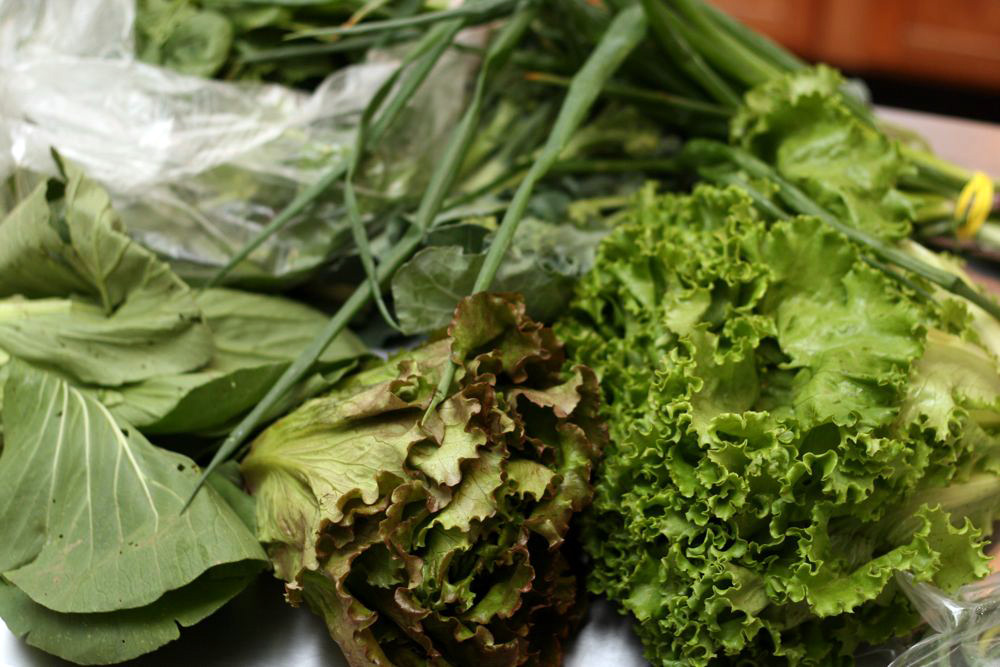
CSA haul 1

Even though it's been around for a few years now, I am still incredibly excited to have joined a CSA this year.  A few years ago, "CSA" was the big new food acronym, standing for Community Supported Agriculture, the rather wonderful setup where cooks and eaters pay in advance for the season and in return get a box  delivered to their neighborhood every week or two, effectively a farmer's market haul. The farmer gets all the money up front, which helps defray costs, and the CSA member gets the freshest, most local, most in-season produce possible. Every week is a surprise.

Elin and I decided to sign up for a CSA this year from Angelic Organics, outside Chicago. The first box came today: broccoli, bok choy, herbs, chard, garlic scapes, scallions, spinach...and more lettuce than I know what to do with.

I decided to employ a trick I've used a couple times in the past when faced with a huge amount of leafy produce and no plans for how, exactly, I'll be using it. I'm not always the most conscientious cook when it comes to using up what's in the fridge. I'm easily distracted, and more often than not, a bit lazy. Many a leafy vegetable has turned to sludge under my watch, as the whole washing, drying, tearing thing seems like too much effort.

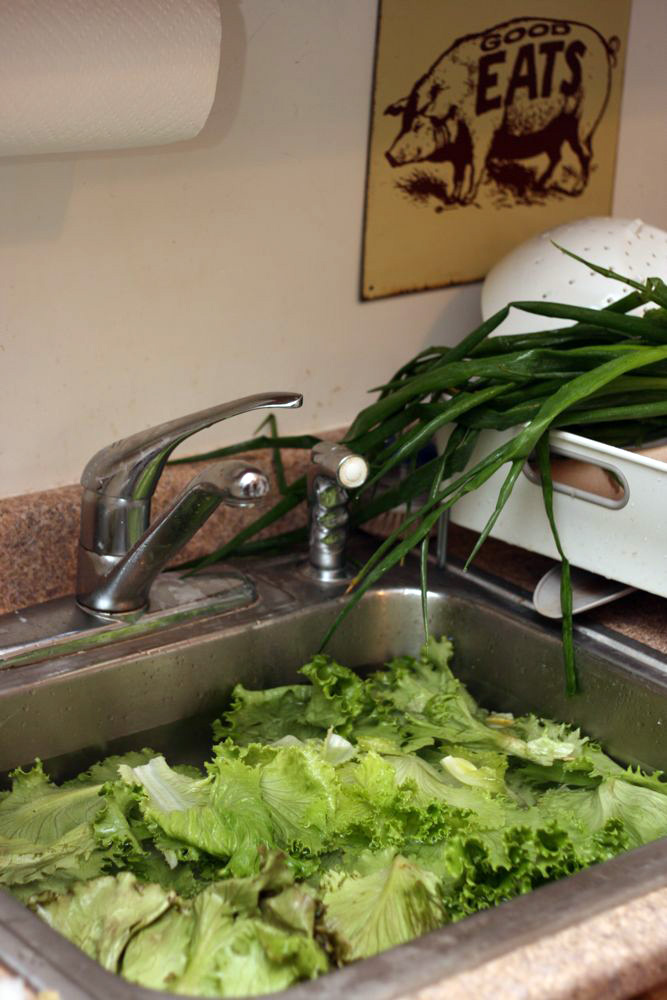
CSA haul 2

I found this trick in Jamie Oliver's Cook with Jamie, and I love the concept: washing and drying all the lettuce at once, then putting it nicely in the bottom fridge drawer lined with towels. For the lazy among us, this means that now there is nothing separating you from a salad, especially if you have the basic vinaigrette on hand in the fridge, which has seriously increased the amount of salad in my life. As Oliver puts it, washing them all at once means you've have "a good clean mixture of salad leaves on tap." On tap. Salad leaves. I love that.
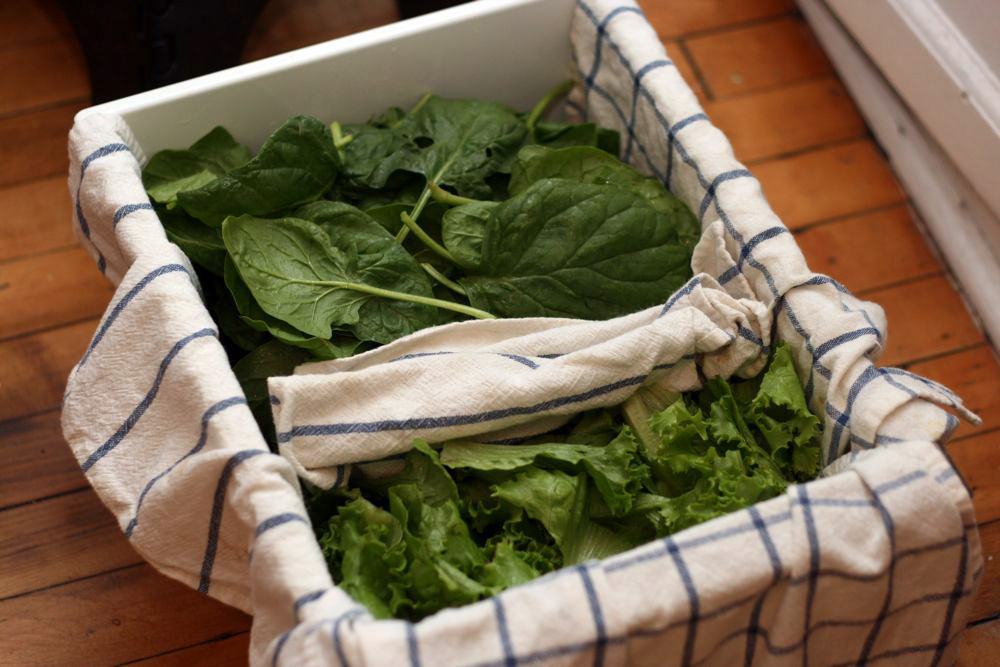
CSA haul 3

All you do is fill a sink with cold water, then submerge the leaves, spin them in a salad dryer (or in a dish towel), then stick them in the drawer.  Once they're nestled in, salad means reaching in for a handful, spooning some vinaigrette and maybe a shaving of Parmesan, and putting on the plate.

I figured this was a little trick more people should know about.

  • Share/Bookmark

{ 3 trackbacks }

Keeping Your Salad from Turning to Sludge
June 17, 2010 at 8:45 am
Romesco Sauce, Meet the Summertime Grill
July 15, 2010 at 10:59 am
Tomato Conserva: How to Make Homemade Tomato Paste
August 27, 2010 at 12:17 am

{ 16 comments… read them below or add one }

Laura T. June 17, 2010 at 8:53 am

I used this technique when I helped out in a restaurant one summer. I found that it also works really well with chopped fresh herbs.

SP June 17, 2010 at 11:09 am

I like it! I think I’m gonna have to do this. Trouble will be storing other veggies, but they can probably manage on the bottom shelf.

Punch June 17, 2010 at 11:34 am

Just in the knick of time. I just got back from the farmers’ market with a giant lettuce. I knew to fill the sink and soak then spin, but no bowls are large enough to hold it all. Lining the bottom shelf with towels is brilliant. Thanks

Ross June 17, 2010 at 12:02 pm

Very clever! I have about a 50/50 success rate with using my greens before they spoil. Having a drawer dedicated to them that I can just grab fistfulls out of will make it much easier!

artj June 17, 2010 at 12:13 pm

Great advice. I have a much different respect for farmer’s market and home-grown produce than I do for much of the conventional. A bag of grocery store lettuce goes from the shelf, to the grocery bag and to the fridge without much thought and seems to last forever. But the csa lettuce makes us think in a whole other way. It’s “alive” and we want to take care of it. By giving it a bath, drying it off and laying it down in a towel-draped drawer of its own you are treating it like it is alive, gently, like it needs to breathe. Enjoy your lettuce!

brant June 17, 2010 at 12:22 pm

help,
how do you deal with cilantro and parsley–short of having a window box of herbs. I have tried the wash and spin and store back in the plastic bag with cilantro but this herb in particular wants to go from fresh to sludge faster then you can say guacamole.

cookingschoolconfidential.com June 17, 2010 at 12:34 pm

And you figured right – this is a good tip. Especially this time of year.

Cheers!

Ross June 17, 2010 at 1:09 pm

For cilantro and parsley, I usually stick the cut ends in a small glass of water. It seems to keep them longer, though, to be honest, I haven’t really measured or anything.

artj June 17, 2010 at 2:11 pm

fresh herbs will also do well loosely wrapped in moist paper towels and stored in a ziplock bag.

Adam June 17, 2010 at 3:08 pm

For parsley, cilantro, and other herbs I have found this handy little device works for me:

http://www.amazon.com/Prepara-PP01-HS100-Herb-Savor/dp/B000YMOXKC

And it fits in the door of the fridge, too – which is nice cuz it is kinda tall and could get lost more easily on one of the shelves.

Ciaochowlinda June 17, 2010 at 11:04 pm

That is a very good tip. I use paper towels rather than the cloth towel and it really keeps lettuce so crisp.

Beth June 18, 2010 at 2:37 pm

Blake – brilliant. I have the same problem with my produce deliveries. In fact, I just tried to shove a huge bundle of chard and kale into my tiny fridge and thought – how should I do this?!

vielleanglaise June 18, 2010 at 5:43 pm

@adam

For parsley and basil, just stick them in a couple of cm’s of water in a vase, or a drinking glass, in a not too hot, not too cold place (not in the fridge) and if you keep the water fresh your herbs will keep for ages.

Also, of you have time, and the inclination, take your basil, mint, sage, rosemary or thyme and stick it in a pot of earth and it might “take”. For perennials, if you water it and look after them you’ll never have to buy those herbs again.

The light just flicks on when we open the fridge door. For most of the time it is a cold and dark plastic box. For something that was recently alive (our food) this is a hostile place.

As with humanss, the trick to preserving leaves in this frigid and obscure environment is keeping them dry. The above method is fine, but voluminous. If you have a smaller non-American fridge where space is a concern, you can keep your lettuce dry on its nicely compacted head, and then tear off and wash and dry leaves as you need them. It takes up less room in your crisper.

This fridge-space room is perhaps not a concern for North Americans, though the 2% of the planets oil produced to 20% consumed means it might become one…

Joanna June 19, 2010 at 10:27 am

Great idea!
I have a small farm and no matter how I try to stagger my greens plantings, I end up with a major pile all at once. I have a dedicated produce fridge in the shop, and will try this trick, only filling a big plastic tub since the fridge is all open shelving.

fressack June 19, 2010 at 6:32 pm

I can’t believe all the fuss you make about lettuce.
You should know by now that all this overestimated foliage has not got any vitamins or healthy ingredients at all.
So why don’t you just throw it away and store all the healthy and tasty stuff that comes along with it?

Naomi June 23, 2010 at 1:37 pm

Letting CSA veggies go to waste feels like a sin, doesn’t it. I ate beets for breakfast this morning so they won’t waste.

More CSA storing tips: Buy big tupperware to keep you veggies in and stack in the fridge. I have two 14×14x8 inch guys that I fill up after the drawer fills up. Also if it isn’t too hot you don’t even need to chill csa veggies. They came from the warm soil, and don’t entirely need to be kept cold until after 4-5 days.

Leave a Comment

Previous post:

Next post: