
This is why beef chuck roast cooked in a 131°F–140°F (55°C–60°C) water bath for 24–48 hours has the texture of filet mignon.
- Douglas Baldwin, A Practical Guide to Sous Vide Cooking
After my experiments with sous-vide chicken resulted in one of the finest birds I'd ever eaten, I immediately set off on a crusade to transform the cheapest cut of beef I could find into filet mignon. I know this sounds an awful lot like alchemy - that ancient (and ludicrous) practice of transforming humble metals into gold. But with the above quote ringing in my head, my mind started to race with the possibilities. Instead of starting with chuck, I decided to start with the least tender cut I could find. So chuck became round. This, my friends, is what is called "Nick getting ahead of himself."
I should have taken a step back and assessed my situation. The recipe clearly calls for chuck, which is relatively fatty. But I wanted to test the absolute limits of the machine. So that's how I found myself buying two and half pounds of top round from Whole Foods. It's about the leanest and least flavorful cuts of beef on the cow. It doesn't even make a good stew. The only way with round is to cook it until rare and then slice it as thinly as possible. That'll leave you with good roast beef, or a great Italian beef if you're smart, but what if you didn't have to slice it thinly, and could instead dig in with absolute abandon?
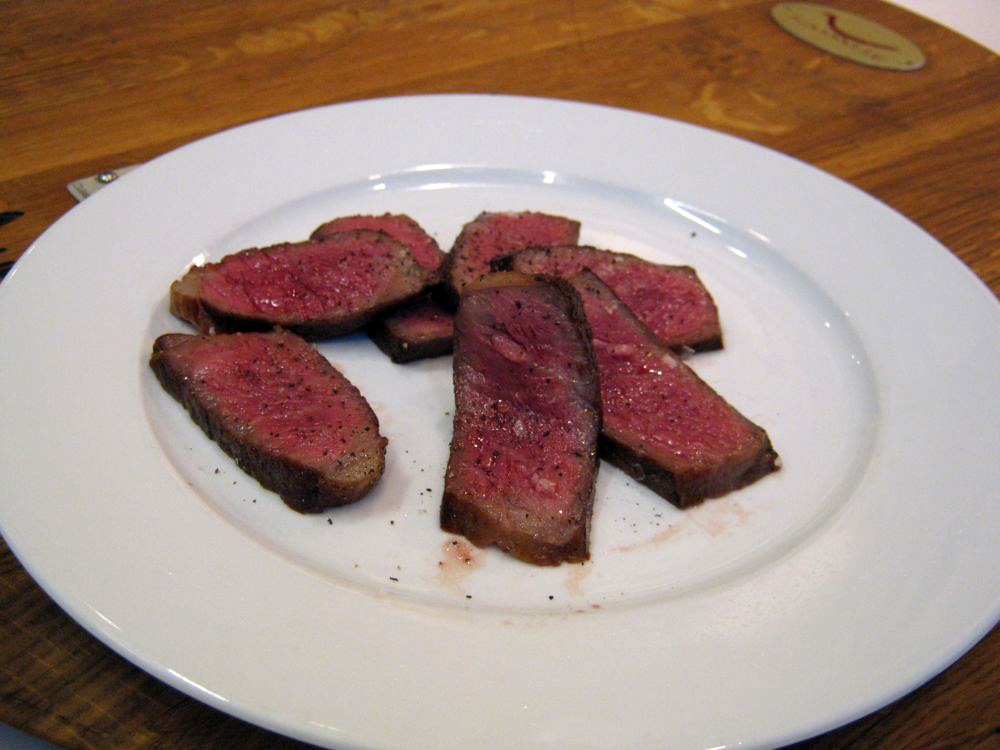
I have been lusting after steak since I attended the SousVide Supreme event a little over a month ago. There I ate a rib-eye which was cooked until rare in the machine, and then seared in a skillet to give it that beautiful crust. As you can see from the picture, it was perfectly rare from center to almost the edge. It was succulent and tender in a way I always wanted steak to be.
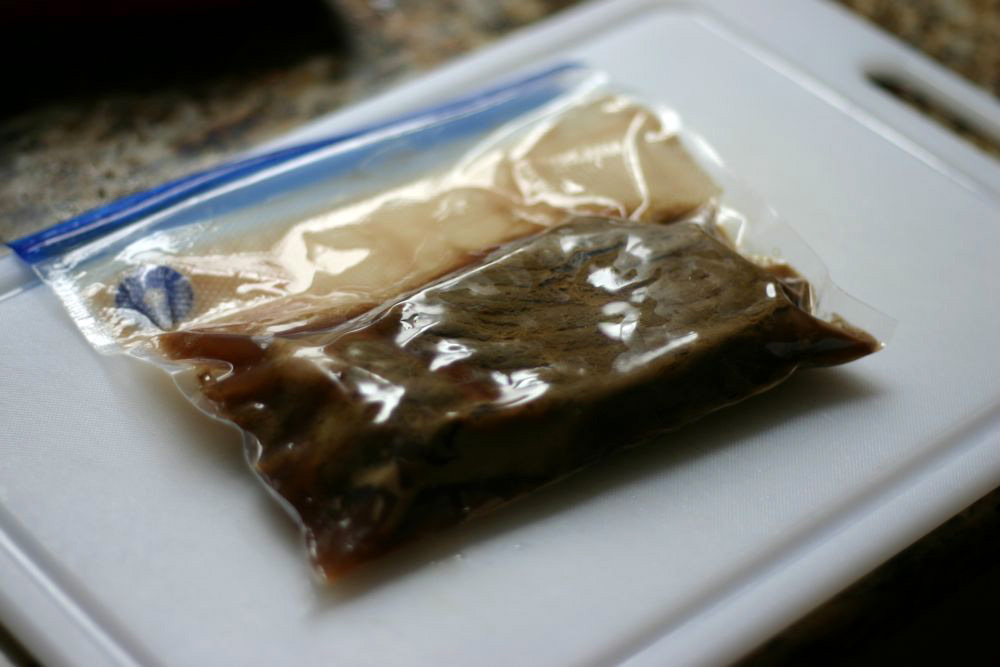
I knew that round would never get me there, but how close could I come? Any connective tissue should dissolve after so long in the machine. That should me leave with tender, if a tad dry, meat. Without much proof beyond the quoted line from Douglas Baldwin's A Practical Guide to Sous-Vide cooking, I decided to experiment for myself. I chopped the top round into four 1 1/2 inch thick steaks, sealed them up in plastic, and placed them in the SousVide Supreme at 133 degrees and walked away.
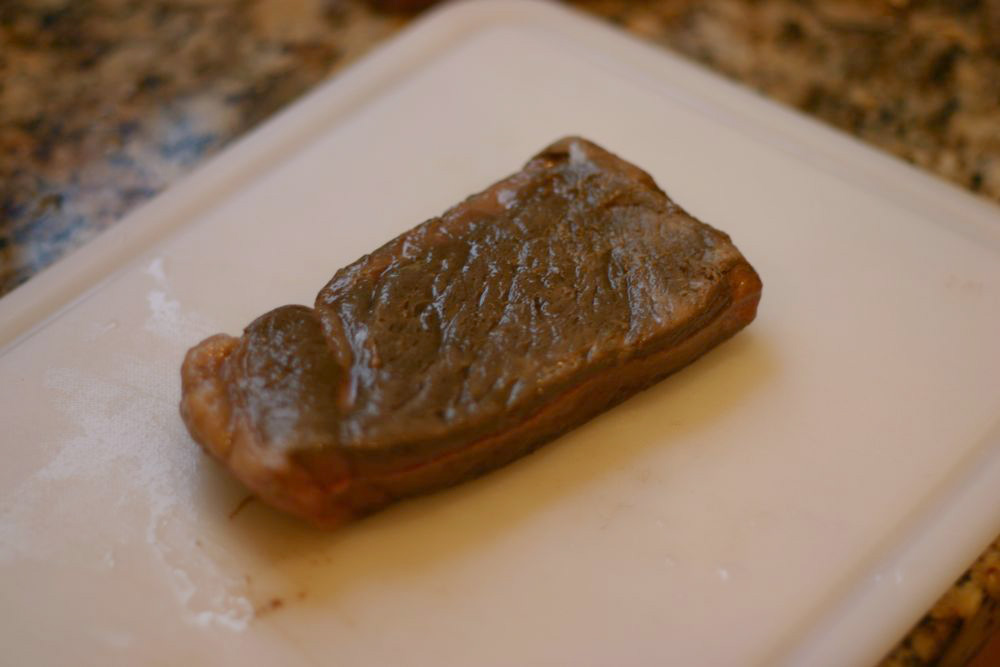
After 8 hours, I pulled out the first sample. The meat looks atrocious on the outside, all gray and spongy, which wasn't that far off to how the chicken looked after I pulled it out. I seared the steak on a skillet with a lot of butter to give it a good crust, and then seasoned it with salt and pepper.
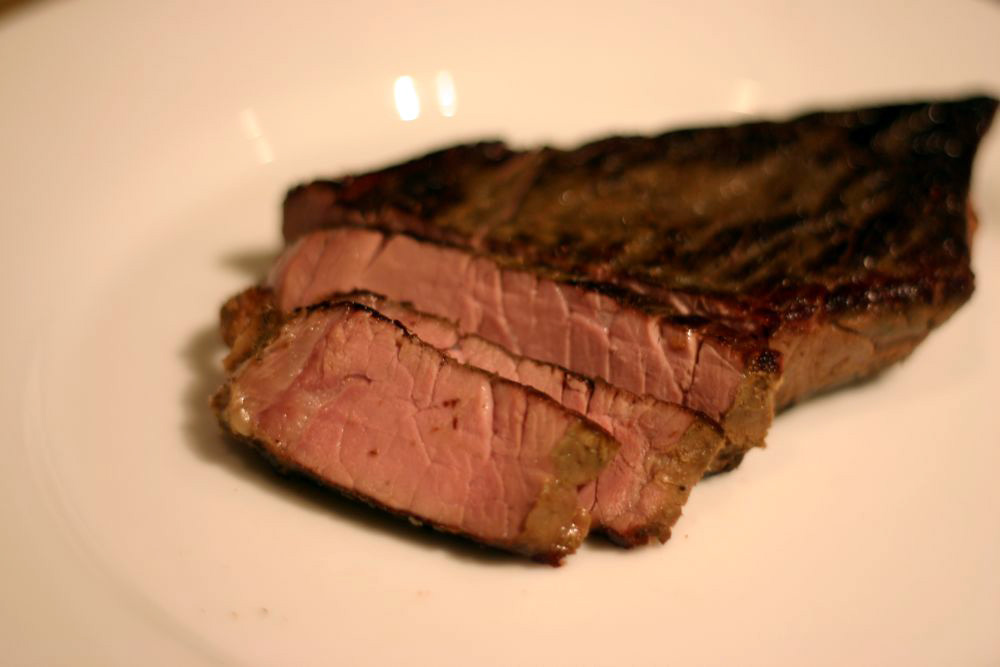
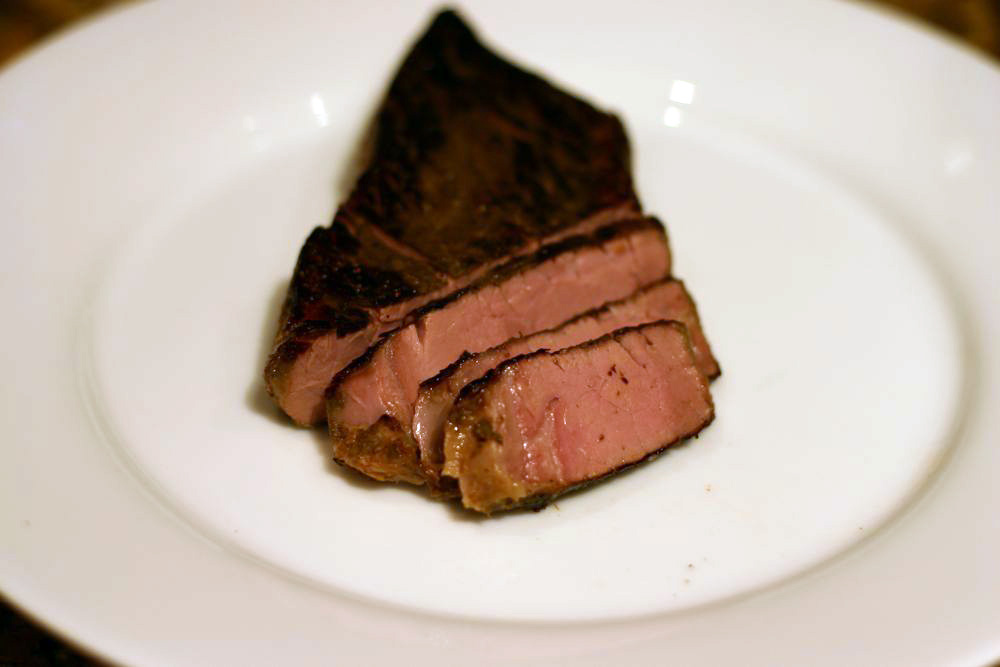
It came out looking rather nice, actually. I was astonished about how easy it was to cut, but the flavor and texture were not there. It was still chewy and still tasted more like a good roast beef than a fine filet. I realized it needed a lot more time.
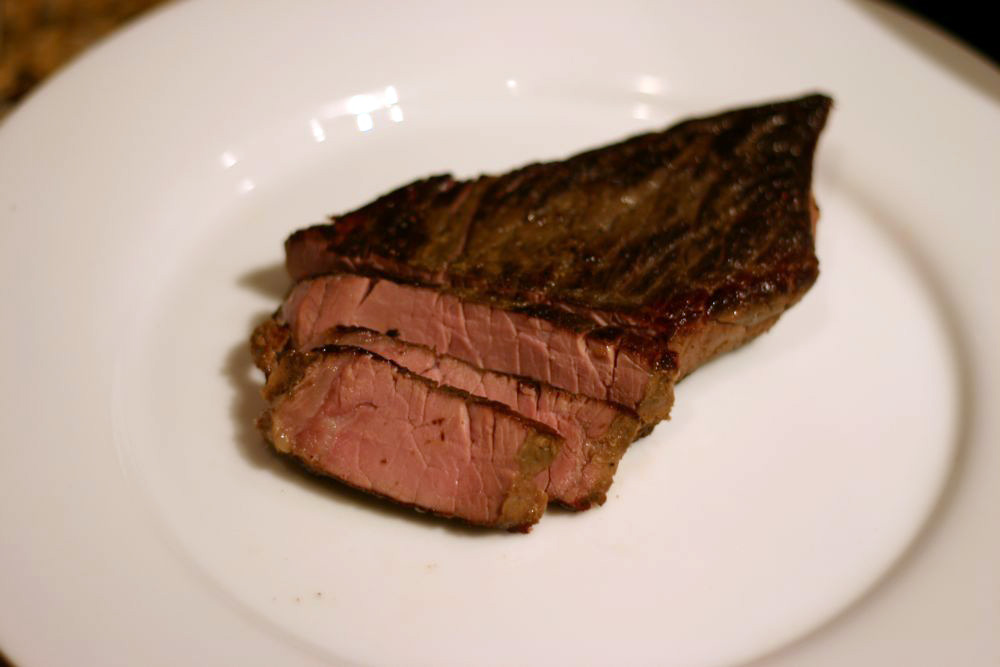
I waited 24 hours before checking again, and my wait was rewarded. It was as tender as any steak I'd had eaten before.
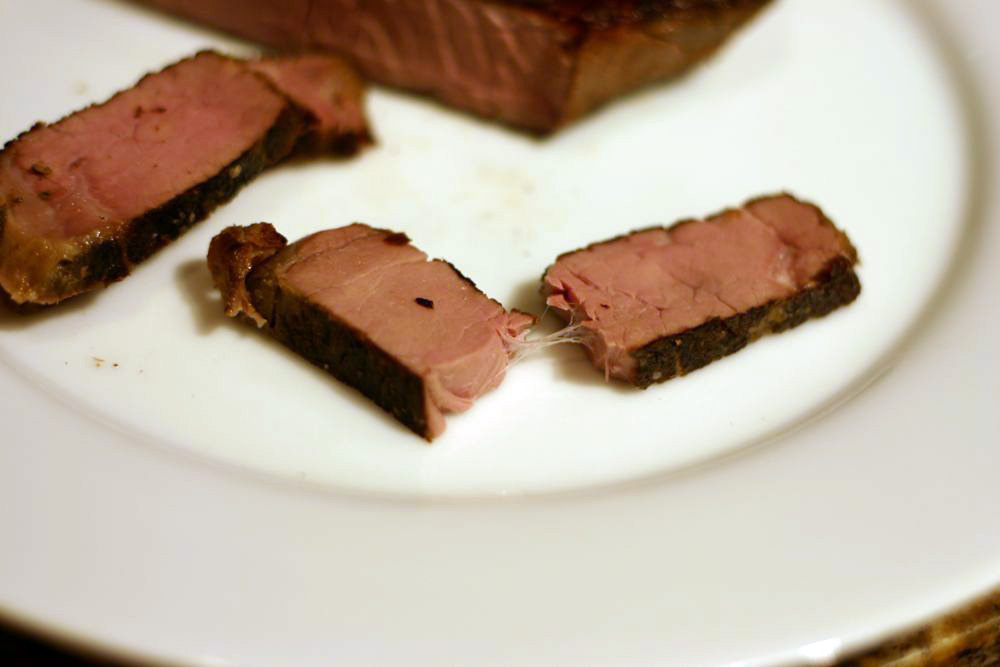
It was so tender I could actually pull the meat apart with my fingers. Obviously any connective tissue had been dispensed with. But it was still missing something. The meat wasn't succulent, or at least most of it wasn't. That's when I realized that the piece of meat probably would never get where I wanted because it didn't have enough fat. There was just bit of fat running along one end of the steak, and that actually tasted like a sirloin.
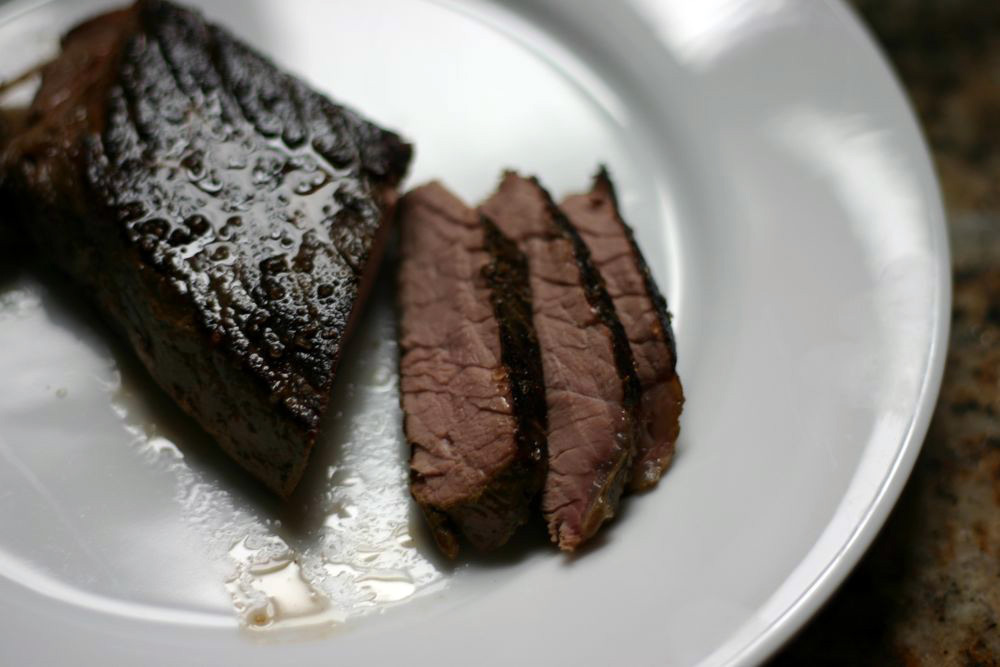
The steak I checked after 36 hours tasted much same as the one above.
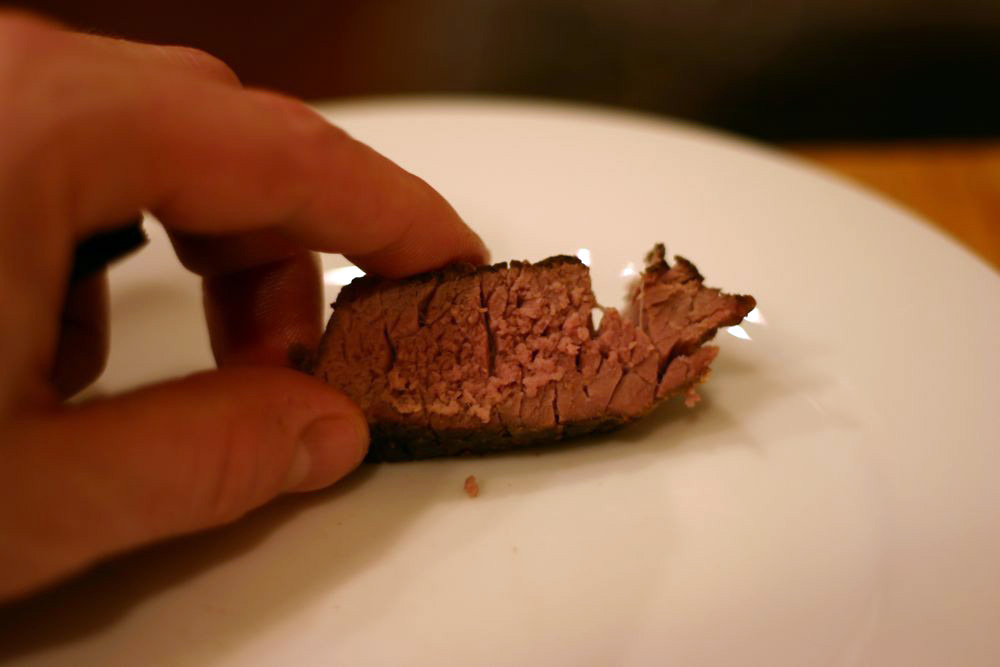
After 48 hours the steak started to pull like stewed meat, even though it was still completely medium rare. It was tender, but had lost all of its steak-like qualities. I admited defeat. End of the project.
What did I learn? Well, like I explained above, the author actually does call for chuck steak, which is much fattier than round. In my excitement, I tried to go beyond the limits of this new cooking device. I wish I had more time to play around, but my demo unit is already packed up. I'm thinking about just buying one. It's a little sad, but it was worth the effort. The round did taste about as good as round could possibly taste, and I used it well in salads and such. But it was never going to be a steak.
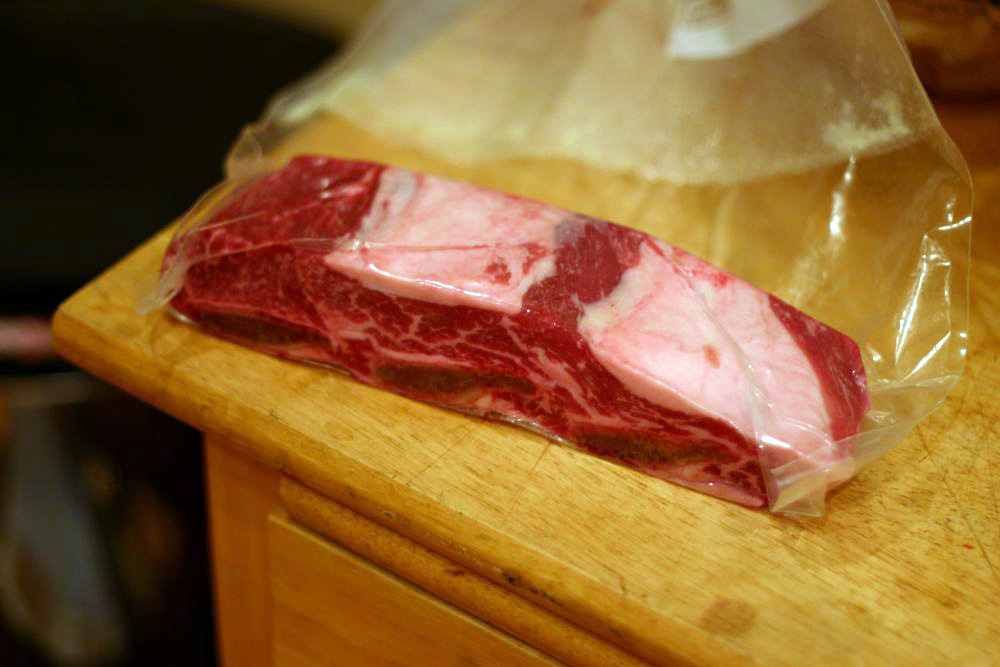
You know what does make a great cheap steak? Short ribs. Read this incredible quote by Michael Ruhlman:
With sous-vide though, you can cook short ribs at temperatures well below the point at which red meat becomes gray if you cook it long enough for the collagen to melt (133 degrees F/56 C for 72 hours for example). The result: rare short ribs that are meltingly tender.
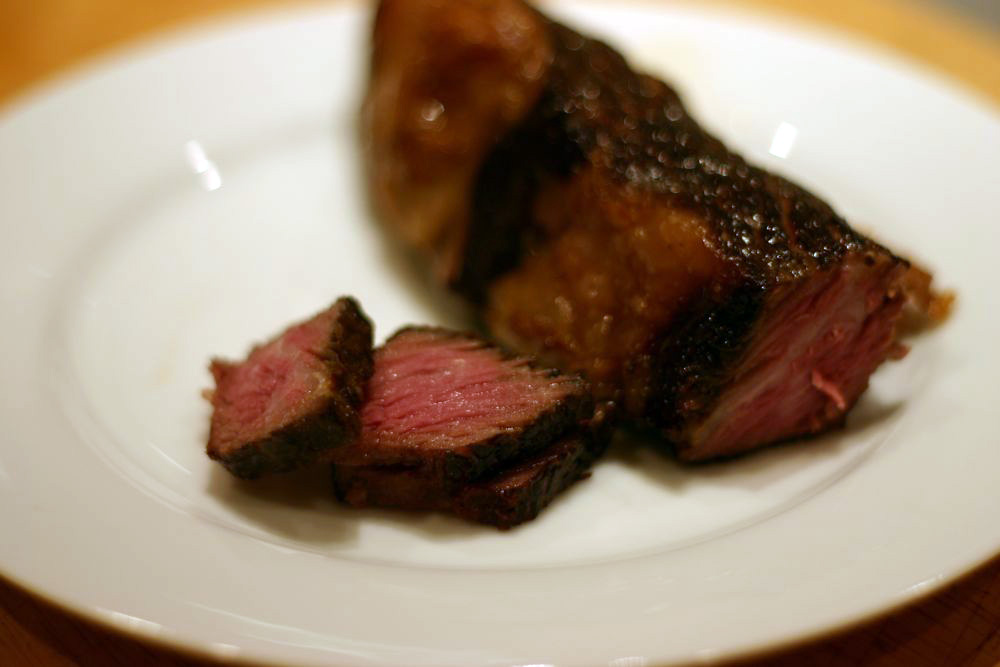
And that's, indeed, what I found. Incredibly tender short ribs that were rare and succulent. Other cuts only wish they had this much fat. They were easily some of the best short ribs I'd ever eaten, which is saying a lot. Short ribs always tend to be delicious, but never before have I had them like this. They were still rare inside, but could easily be cut with a knife. Not exactly water into wine (or, for that matter, round into filet mignon), but stunningly delicious nonetheless.


{ 1 trackback }
{ 24 comments… read them below or add one }
Oh, you geeky cooks- I love you so! Justice will not be served if you are not given one of these amazing machines! At the very least, your readers need more information which you cannot provide with the sample machine packed up and sent back!
http://www.houseneeds.com/shop/HeatingProducts/HydronicHeating/Honeywell/honeywellaquastat.asp
I think this is the sort of gear the do-it-yourselfers are recommending. An agitator would be desired if I understand the process correctly.
Given that you certainly seem to be right on about there not being enough fat in the round to give great flavor, what if you added some fat before sealing it and cooking it? Seal the bag with a little bit of butter in it, or even something more extravagant if you have it, like bacon or beef fat. That way you could add the fat for that extra flavor boost while still working with a cheap cut of meat.
I’d be curious to see how the chuck shoulder tender turns out sous vide. It comes from the shoulder but it is kind of an anomoly–lean and tender and from the shoulder. It’s got a pretty beefy flavor. I’ve only seared and grilled to medium rare but would be interested to see how it comes out cooked in the bag.
Excellent write up, stumbles and all. I can imagine how hard it was to send the unit back.
Nick,
I think you are right, fat fixes the flavor and maybe you should do the same experiment with adding some. The other point is also not to eat the content of the pouch just after the cooking process. Even under vacuum (especially if the vacuum was not especially strong because of a low quality vacuum packing machine) some juice will get out of the meat. If you chill the pouch immediatly after cooking then the juice will go back into the meat which be more flavorfull.
Jean-François
How much electricity is used to sous vide 36 hours?
I love food experiments. Yes…. I’m a dork.
You were looking for the cheapest steak possible… and you went to Whole Foods?
Really?
I cooked a chuck roast sous vide last week to 132 degrees. 30 hours. It was awesome. Tender and flavorful. Pictures and writeup will be on my blog later this week.
Christine: Thanks. It’s addicting stuff. Can’t wait to have my own machine.
Jumper: I suppose I should seriously look into the DIY sous vide, but there is always the chance something goes wrong. I love that I could leave something in SousVide supreme for days and not worry. But i’ll check out the link.
Remy: That’s fascinating. I’m not sure what the end result would be. Certainly the meat would have more flavor, but I suppose what makes a steak a steak is the fat that runs through the meat. But cooking round in a bag with beef fat sounds like something that has to work.
Art: I’m really upset I didn’t start with chuck. That has so much more fat than round. It’d have to work. At the very least it would be tastier.
Chris: You bet. Especially carrying the box all the way to the loop to the fedex. That was fun.
Jean-Françoisk: Huh. I’d heard that about braising, so you’d have to be right that the meat should rest for a while to allow the meat to reabsorb some of the juices. I’m so excited about this technique.
Justin: I don’t have the exact figures, but one of the selling points of the machine is that it uses very little energy. I believe it. The machine never gets really hot. All it needs to do is gently maintain temperatures.
EB: That’s what this website is all about. Dork out at will.
Stuart: I tend to buy all my meat at Whole Foods so I can be confident that the meat was properly raised and killed. It is more expensive, and for that reason I almost never buy expensive steaks. part of this experiment was to see if I could achieve that same quality with a relatively affordable cut.
There are plenty of good farms in Illinois, have you considered looking into buying direct from them? I know I used to get some great, inexpensive, properly-raised beef that way when I lived in Champaign.
In my opinion, there is no added value to be noted from cuisson sous vide for the home cook in our hemisphere. There are many methods for achieving proper browning and inner tenderness for meat cuts that require only basic equipment and elementary skills. The classic processes are quicker and much tastier. As to prepared dishes, such as vegetables and sauce etc. they are widely available in frozen form which allows for personal adjustments in reaching the desired taste and texture. Overall, cuisson sous vide is pretty useless and deprives one with the pleasure of actually cooking.
Constantin: you are wrong.
I’m a home cook. I’ve used sous vide techniques. Just to stick to the topic of sous vide steak: I can take a cheap cut of beef and, using sous vide, turn it into something extraordinary that I couldn’t achieve via other methods. Take a chuck steak, cook it to medium rare for over 24 hours. You end up with something that seems like it should have cost, say, five times more than chuck. That’s value.
Also, as I argue here, sous vide is a basic technique that home cooks benefit greatly from understanding.
Stuart: I wouldn’t say that you are wrong as I am not an adept of the black or white approach.
I checked, however, your “stabilization cooking” argument, and I still cannot see any benefit for the home cook. The result you and I seek (in the steak case for instance) can be easily achieved by searing the piece of meat and then treating it at low temperature (75°C or so) for a couple of hours (use a thermometer to monitor the heat at the heart of the piece). Meanwhile, the meat can be turned, basted, etc.
Moreover, it does feel and smells like you are (in control and) cooking something.
Stuart: I regret that I still cannot see any benefit in simmering plastic pouches for so many hours just to retrieve the contents which would afterwards require high heat treatment anyway.
In my view, cooking sous vide conditioned meat in their original pouches can be of benefit to large catering operations only.
Constantin: The result I seek cannot be achieved by your method. I seek a tender, medium-rare steak. A steak cooked at 75°C might be tender, but it will be burnt.
Thanks Stuart,
Perhaps I haven’t quite understood your cooking method.
As I understand, you buy vacuum packed meat. Is this correct? Then, how do you proceed?
Constantin,
I haven’t bought vacuum packed meat, but that would work. In general, I take chuck, season it, and vacuum seal it. I place that in a 55°C water bath for about 30 hours. The collagen breaks down, so the chuck becomes as tender as a very fine cut of beef… while retaining the flavor of medium rare chuck. Once it comes out of the water bath, I pat it dry and quickly sear it on both sides (sometimes brushing it with butter first, but this isn’t needed). Since it is already quite warm, it achieves a nice brown very quickly. The result is an excellent, tender steak that costs very little. It should not be compared to a pot roast, since that – while tender – is technically overcooked. The result is very different.
Hi again Stuart!
In practical terms, where the heck do you keep your meat at a constant 55°C for this long?
Constantin:
That’s the trick. I was using a SousVide Supreme countertop unit that I no longer have. Other alternatives include a crockpot or rice cooker with a temperature control unit (such as an Auber or a Sous Vide Magic) or any basin or pot with an immersion circulator (the most expensive option).
Stuart:
This sounds like a very costly and time-consuming option!!
I trust you obtain exceptional results by your method, but there are so many other variables that determine tenderness. For instance, collagen fibers density differ from one type of meat to another and focusing on dissolving collagen may not be the best or tastier choice. High collagen fiber content meat can become fibrous and dry when the collagen is dissolved.
In short, however you cook it, you’ll never make a chuck cut as tender as a tenderloin.
I hate to be so skeptical, but I must admit that it probably will take me, and the basic “gourmet” consumer, much more of a solid argument to opt for sous vide cooking.
Frankly, while understanding your argument, I don’t believe that your method could be endorsed by home cooks.
I would love to be convinced though.
Constantin & Stuart Boz:
I’ve enjoyed this conversation. I do have to say that after using a sous vide machine, I’m on Stuart’s side. But hopefully I can better explain why.
The greatest trick about sous vide is that it allows the home cook have to have as much control over his meal as the fine dining chef. In this way, it democratizes food in a way never imagined. You’ll be able to cook a steak as perfectly and precisely as a chef.
Braising and cooking things over low heat are still valuable cooking methods, and should not be discarded. But sous vide has pluses that can’t be denied and we should exploit this new cooking method as much as every other cooking method. The most practical one being that you can cook meat precisely until it is done. The texture of chicken can completley change in 1 to 2 degrees. This machine is precise down to a tenth of a degree. The result is meat that retains far more of its juices. It requires no skill to get this done besides sealing it in a bag and placing it in the water bath. It’s remarkable.
The whole plastic thing is the hardest thing to sell. At first, I was against this concept, because it puts a layer between you and the food. But as Heston Blumenthal explained at the SousVide Surpreme event, any aroma you smell in the air while cooking is actually a bad thing. Essentially it has escaped from the food. While it smells wonderful in the air, it’ll ultimately taste better if it is contained in the meat for you to open up on the plate. I know this sounds insane.
Constantin, you CAN make chuck taste like tenderloin! That’s the great news. I find the home cooking possibilities far more interesting the fine dining prospects. We’ll be able to turn cheaper cuts of meat into more delicious meals. Beef stew doesn’t have to contain stringy pieces of meat anymore. Short ribs can be tender and succulent, and be medium-rare. My round didn’t turn out exactly how I wanted it, but it still tasted better than any round I’d had before. Isn’t this all something a home cook should get excited about?
Hello Nick!
Thank you for your explanation. I am not sure, though, that I would agree that any aroma coming out of cooking equates to a loss in the flavour of the outcome, but I understand what you want to stress. And indeed, keeping the aroma in is key to a savoury dish. This was the idea behind pressure cooking or the one that led cooks to wrapping food in aluminium foil and more recently in heat resistant plastic sheeting.
In this connection, in our part of the gourmet world, the “plastic thing” is not really a problem. For instance, it is quite common practice in France to cook terrines or galantines in a tight wrap of plastic film. And a nice way to make veal Orloff roast is to wrap it in film as it keeps the structure and the flavour tight. We do the same with a whole foie gras which we would season with dry and wet ingredients (walnuts, figues, berries, herbs, Madère, Cognac etc.) before wrapping it tightly in foil and cooking it in a very low heat bain marie.
Similarly, it is not uncommon our side to wrap a piece of wild boar meat, or other large game meat, which is generally very tough, in foil and leave it brooding for many hours in a bath of stock in the oven.
No, in my opinion the real questions here are:
1. What does vacuum packing (sous vide) bring over plastic film wrapping?
2. What is the SousVide Supreme? And, if I understand correctly that it is a precision water heater, what is its comparative advantage in relation to traditional gear? For example how does it compare with a water filled Dutch oven placed in a regular electrical oven with the water temperature monitored by a thermo sensor?
This being said, I have never heard of the SousVide Supreme until I read your story and I don’t believe it is available in Europe. But somehow this machine intrigues me.
I understand that you got to test it and frankly I wouldn’t mind to try it as well. Could you perhaps let me know their coordinates?
Go to this web address for the SousVide Supreme article in the New York Times:
http://www.nytimes.com/2009/12/09/dining/09sous.html?_r=2
Or you can go direct to:
https://www.sousvidesupreme.com/index